
With just over three months to go until the parliamentary elections, nearly one in four voters are yet to make a decision on who to vote for, the latest Noverna Analytics poll released on Monday by Politis showed.
The survey, conducted between January 25 and February 9, set corruption, the economy and social policy emerging as the issues most concerning voters.
It showed a six-party parliament if current trends hold.
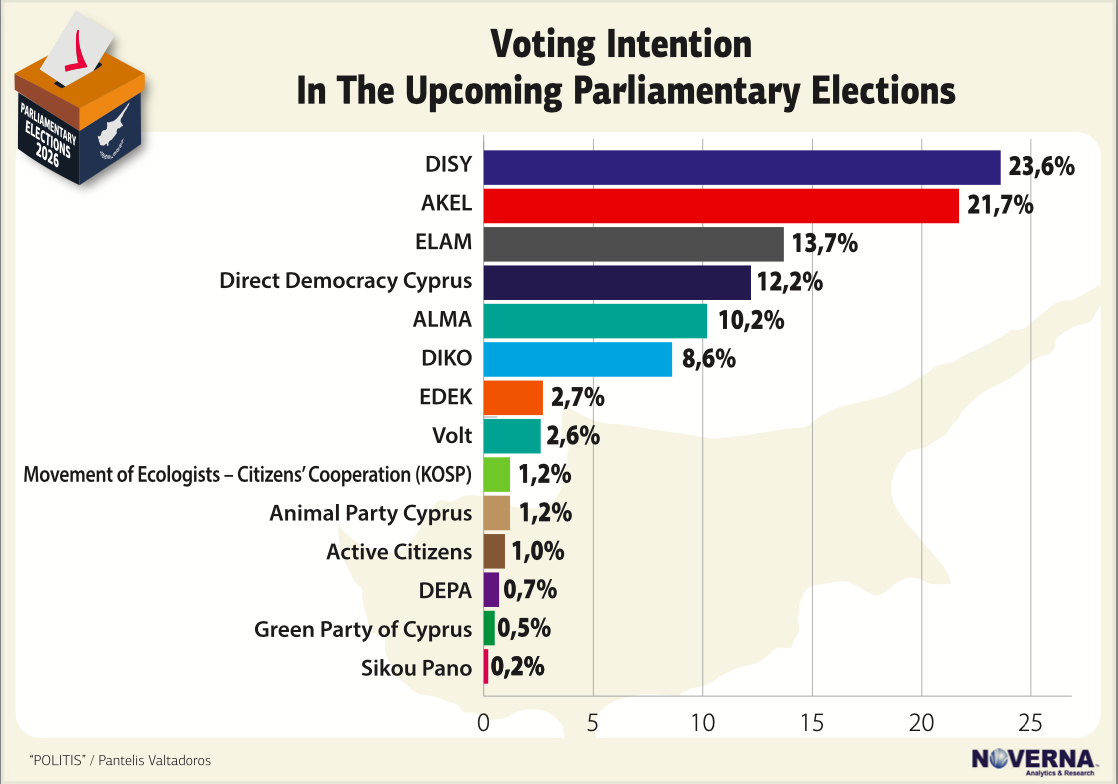
Disy leads with 23.6 per cent, followed closely by Akel at 21.7 per cent when undecided voters are proportionally allocated.
“We are talking about the two major parties which seem to be shrinking. However, both are expected to exceed 20 per cent,” Politis director Dionysis Dionysiou commented.
The gap between the two parties falls within the margin of statistical error, leaving the contest open.
Elam comes in third party with 13.7 per cent, followed by Fidias Panayiotou’s Direct Democracy of Cyprus at 12.2 per cent and Alma at 10.2 per cent.
Diko stands at 8.6 per cent, while smaller parties including Edek, Volt and the Ecologists remain below three per cent.
“These parties are still very low,” Dionysiou said, stressing the dominance of the six main contenders in shaping parliamentary dynamics.
Direct Democracy of Cyprus appears to draw significant support from those seeking a protest vote, while former auditor-general Odysseas Michaelides’ Alma party gains traction on a platform critical of corruption.
Dionysiou explained, “Phidias’ party is voted for to send a message of ridicule of politics, while Michaelides’ party is chosen partly to punish other parties. Neither is supported solely on policy.”
According to the analysis, these two parties together could capture 30-35 per cent of the electorate otherwise inclined to vote for Elam.
“Traditional issues such as the Cyprus issue are giving way to corruption, transparency, the economy,” Dionysiou said.
The survey records that 84 per cent of respondents view corruption as a major factor in their vote, 82 per cent cite the economy, and 70 per cent regard social policy and migration as decisive.
The survey presents a stark portrait of discontent with national institutions.
President Nikos Christodoulides maintains a public perception as a strong diplomat, with 55 per cent overall approval and 46 per cent backing on his handling of the Cyprus issue.
Domestically, approval falls to 30 per cent for governance and 21 per cent for anti-corruption efforts.
A total of 57 per cent believe corruption has remained the same and 31 per cent saying it has worsened during his tenure.
Parliament suffers from low public confidence, with only 40 per cent of respondents believing it votes in the interest of the average citizen, and 62 per cent saying laws fail to meet social needs.
Younger voters are particularly critical, with a near negligible percentage expressing that legislation fully responds to society’s requirements, while older citizens offer slightly more positive assessments.
While 71 per cent claim they will “definitely” vote, 29 per cent are undecided, abstaining, or planning blank ballots.
The survey suggests a fragmented centre, with Diko, Alma, Direct Democracy of Cyprus, and Volt collectively occupying around 29 per cent of the political space but lacking cohesion.
This fragmentation makes a Parliament without clear majorities highly probable, requiring alliances that may be unstable.
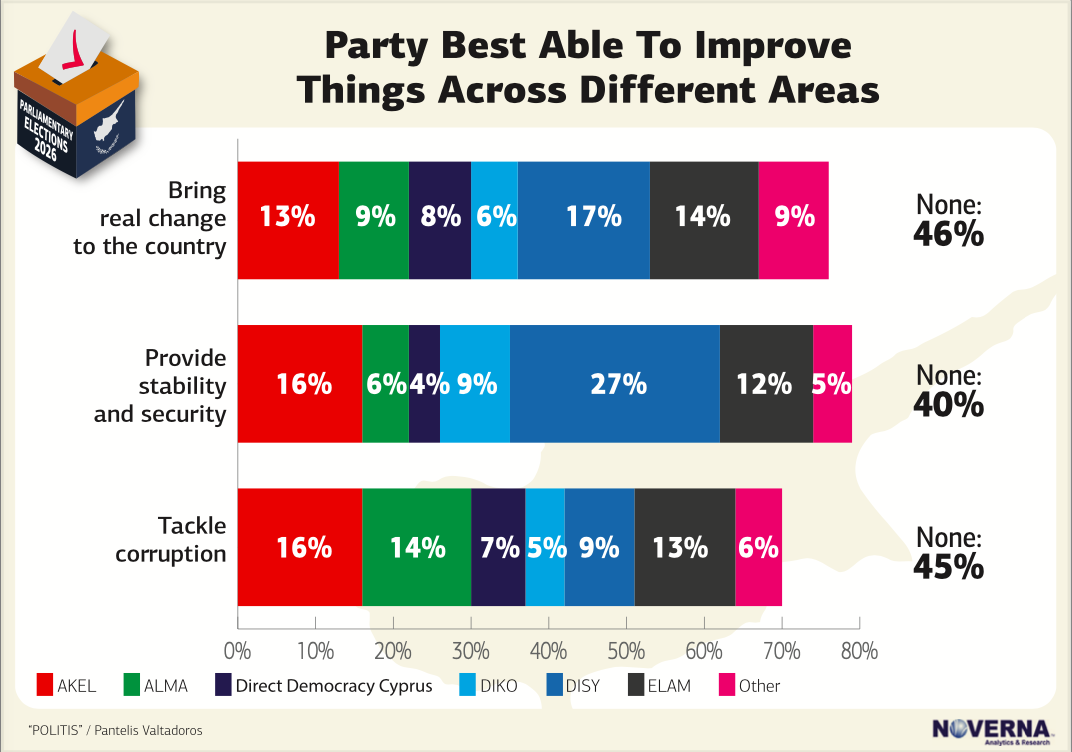
Forty-six per cent of respondents believe no party can achieve reform, while among those expressing confidence, Disy leads at 17 per cent, followed by Elam at 14 per cent and Akel at 13 per cent.
A CyBC poll conducted earlier in February shows similar trends, with Disy at 17 per cent and Akel at 16 per cent, Elam at 11 per cent, Alma at 9 per cent, and Direct Democracy of Cyprus at 6.5 per cent.
Voters can register to vote on the government website below until April 2: https://www.elections.gov.cy/moi/elections/elections.nsf/home/home?openform




Click here to change your cookie preferences