
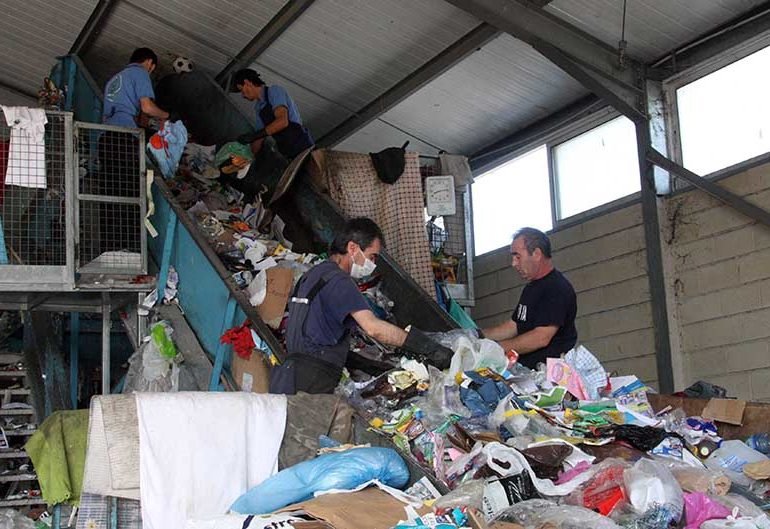
The government’s plans to introduce a new landfill tax have cast a spotlight on Cyprus’ troubled waste management system, with Ecologists Movement MP Charalambos Theopemptou describing the situation as “frustrating” on Thursday.
“If they increase the price per tonne at Koshi, they will need to increase the cost of the pay-as-you-throw system,” Theopemptou told the Cyprus Mail.
Koshi is one of the island’s main waste disposal sites, where rubbish collected by municipalities is weighed and charged per tonne.
Due to a lack of adequate infrastructure, household waste contains more materials than it should, including organic waste, which Theopemptou said accounts for 40 per cent of the waste disposed of at Koshi.
“The landfill tax comes at a time when we are supposed to be implementing a pay-as-you-throw system, where residents are given incentives through lower fees if they recycle packaging, paper, hazardous household waste and organic waste,” he said.
He placed the new tax within the broader context of government waste policy, suggesting that previous “green taxes” on water, energy and waste may have been introduced to fund potential fines linked to infringement cases filed against Cyprus by the European Commission.
“These taxes are the result of EU obligations and coincide with the areas where the EU was preparing to start infringement proceedings against us,” he said.
The taxes in question were introduced by the Anastasiades government, but eventually came into effect in 2024.
“In my opinion, they were included simply to collect money to pay future fines,” he added.
Theopemptou said the landfill tax announced on Wednesday came “on top of all these”, noting that Cyprus is currently facing three infringement procedures related to waste management.

The union of Cyprus municipalities on Wednesday expressed condemned the new landfill tax.
“Despite our well-documented positions and repeated interventions, the government has made a decision that essentially transfers the cost of a long-standing state failure to municipalities and citizens,” it said.
The union accused the government of delayed planning and mismanagement, arguing that Cyprus lacks the necessary waste management infrastructure, which led to the infringement cases.
“This is a new tax imposed because the state has failed over time to effectively manage the waste issue,” the union said.
It emphasised that relevant European targets aimed at limiting landfill waste were known for years, stressing that it was the government’s failures were now passed on to the households.
“The green transition must be fair and based on timely planning and state responsibility, not on new burdens for citizens,” the union said, urging the government to reexamine the proposal.
“We call on the Government to review the implementation framework and ensure in practice that there will be no additional cost transfer to local communities,” the statement concluded.
The Federation of Environmental Organisations (Opok) voiced similar criticism.
“Solid waste management in Cyprus remains one of the most critical environmental issues, with serious impacts on the environment and society,” Opok said.
It argued that waste management remains inadequate, particularly due to the absence of sufficient recycling facilities, known as green points.
This, it said, has contributed to the spread of illegal dumping sites, which are often linked to fires and environmental damage.
Referring to recent data from the statistical service Cystat, Opok said per capita waste reached 650 kilos in 2023, totalling 625,000 tonnes of municipal solid waste.
While Cyprus is among the highest waste-producing countries in Europe, recycling rates remain well below European targets and much of the waste continues to be landfilled, it added.
“The lack of adequate control and implementation leads to illegal dumping and the creation of a landscape of waste sites,” Opok said.
The pay-as-you-throw system requires residents to purchase designated municipal bin bags. In return, municipalities do not impose a flat annual garbage fee – which can exceed €200 per household in parts of Nicosia – and provide recycling facilities while collecting general waste only in the approved bags.
In theory, residents benefit by paying only for the waste they produce, creating an incentive to recycle and reduce general waste.
Municipalities, in turn, reduce costs at waste management plants, where charges are calculated per tonne.
The introduction of the ‘pay-as-you-throw’ system is currently limited to the Aglandja district of Nicosia. Criticism of the system has come from residents who say that they are forced to pay €100 for bags they do not fully use.
Agriculture Minister Maria Panayiotou said on Wednesday that the landfill tax will initially be reduced from €35 to €10 per tonne and will increase by €5 annually starting in 2028, up to a maximum of €70.
“The €5 increase will continue until 2039, but it will depend on the implementation of the pay-as-you-throw scheme. The €5 increase does not necessarily mean a greater burden, because the volume of waste will be reduced and separate collection will be applied,” she said.
The decision follows consultations with the European Commission, which initially set out a price of €35 per tonne.
The tax is intended to give the government and local authorities more time to expand waste management measures and infrastructure under the municipal waste management plan for 2022–2028.
The estimated extra burden on the annual garbage fee per household without the pay as you throw scheme could increase significantly, amounting to €26.50 in 2030.
If effective recycling and a decrease in landfill usage is achieved, the 2035 cost would remain at €6.76, or decrease to €3.50 on the condition that Cyprus achieves the 10 per cent landfill objective.
Panayiotou made it clear that the government did not want to pass on the fees to residents, announcing that local authorities would receive a total of €48 million to implement the schemes.
“Of course, unfinished business remains, such as the submission of the action plans and the completion of the upgrading of the infrastructure of the Oeda [green points],” she added.



Click here to change your cookie preferences