
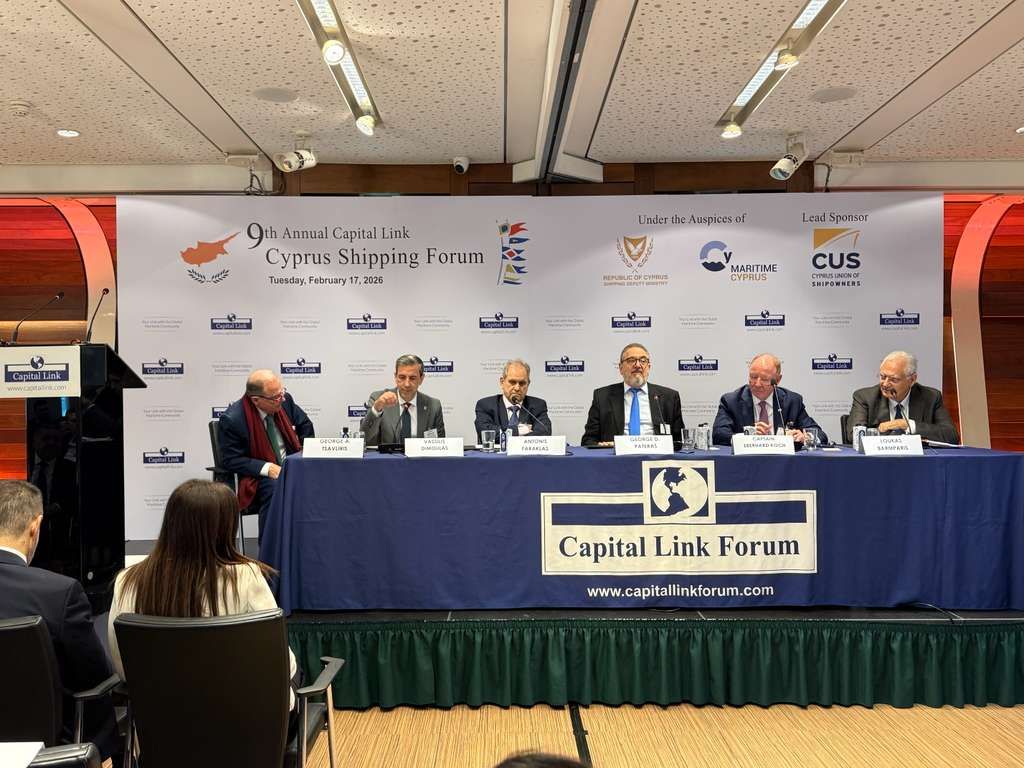
Shipping must focus on energy efficiency rather than an “obsession” with alternative fuels that lack the necessary infrastructure, George Pateras said, arguing that decarbonisation efforts risk drifting away from technical and economic reality.
Speaking at the 9th Capital Link Cyprus Shipping Forum, the Contships executive and former president of the Hellenic Chamber of Shipping said the industry has already reduced emissions significantly over the past two decades, even before the International Maritime Organisation (IMO) drive towards “Net Zero” by 2050.
As mentioned in Newmoney, shipping, he noted, is facing one of its biggest challenges in recent decades. However, he suggested that the debate has become distorted.
“Shipping has already significantly reduced emissions over the last 20 years without ‘Net Zero’,” he said, adding that “Net Zero does not mean zero emissions, but a benchmark for taxation of those who exceed the limits.”
He argued that environmental taxation is becoming a convenient policy tool.
“The IMO and the EU need money, and what better way to collect it than through environmental taxes on transport, without losing votes?” he said.
Putting the figures into context, he stated that “the level of CO2 in the atmosphere is 440 ppm, of which anthropogenic emissions are only 16 per cent (~70 ppm). Shipping produces only 3.8 per cent of that, less than 3 ppm.”
“We spend billions to save 3 ppm, parts per million, while the rest of the world continues to burn, smoke and produce cement,” he added.
Pateras also voiced concern over regional emissions regimes, including those emerging in Europe and Africa, saying they create fragmentation and uncertainty.
“Of course they worry me,” he said. “It’s hard to get three people to agree on something outside their comfort zone, imagine the IMO or the EU!”
He added that many so-called green laws are “political tools, without any real cost or effectiveness analysis”, noting that he is “amazed at how confident non-experts are, while scientists and engineers have serious doubts.”
On alternative fuels, he acknowledged that major liner companies have ordered vessels capable of using methanol or LNG.
However, he pointed out that most are simply marked “ready”, with very few actually operating on those fuels.
In his view, efficiency remains the only practical route for now.
“Personally, I believe that improving efficiency is the only realistic way forward, until we get to perhaps nuclear power,” he said.
He warned that the infrastructure required for alternative fuels carries its own environmental burden.
“The infrastructure for alternative fuels requires huge carbon emissions to build bunkering stations, which often outweigh any savings it promises,” he said.
Turning to the feeder segment, where Contships operates in the 1,000–2,000 TEU capacity range, Pateras said this part of the market has been under-invested.
“We are the largest private feeder operator in the 1,000–2,000 TEU capacity segment,” he said, adding that orders represent “just 7 per cent of the existing fleet, while other sizes are up to 50 per cent.”
“Most feeders are old and fuel-intensive. So yes, they need to be replaced,” he said.
As to whether those investments will pay off, he was cautious.
“Whether they will pay off depends on the purchase price and the charter market , without a crystal ball, I cannot predict,” he said.
However, he maintained that the fundamentals remain supportive.
“Since small feeders serve the first and last mile in the supply chain, demand for them will remain strong, especially as more large mother vessels enter the market,” he said, adding that they also serve ports “that are growing and have less developed infrastructure.”
Pateras concluded by saying that “Their market is not going to weaken.”




Click here to change your cookie preferences