

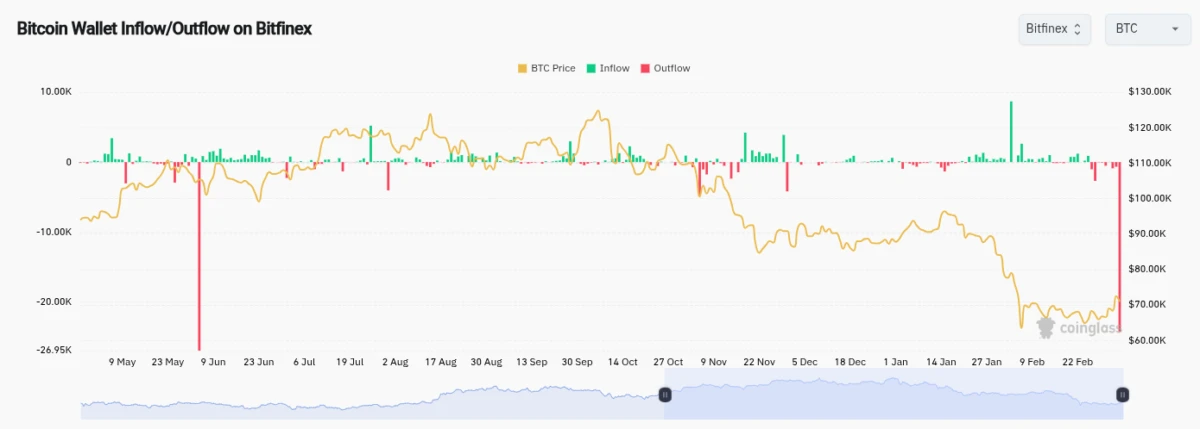
Crypto exchange outflows have recently spiked dramatically, with nearly 32,000 BTC, valued at approximately $2.26 billion, leaving trading platforms in just one day. On March 3, Bitfinex alone experienced its largest single-day withdrawal since June 2025, recording an outflow of around 25,000 BTC alone.
This “anomalous” event could signal large holders moving assets into cold storage, a move typically associated with long-term accumulation. The sustained negative netflow, continuing throughout the week, points to reduced selling pressure and a growing preference among investors for security and self-custody over exchange exposure. While Bitcoin whales secure their holdings, Mutuum Finance is rolling out its dual-market architecture that gives users more control over how they lend and borrow.
Mutuum Finance
Mutuum Finance (MUTM), a new DeFi project built on Ethereum, operates a dual-market system that includes a Peer-to-Peer (P2P) lending marketplace and a Peer-to-Contract (P2C) mechanism for pooled lending. The project has attracted more than $20.78 million in funding. Its native token, MUTM, is valued at $0.04, with a holder count exceeding 19,080.
Peer-to-peer lending marketplace for direct loans
Peer-to-Peer (P2P) lending allows lenders and borrowers to connect directly without relying on an intermediary. Users can negotiate customized terms, including specific interest rates and collateral requirements. For example, a user who holds 10,000 USDT may choose to lend those funds directly to another user. The borrower provides collateral, such as SHIB, to secure the loan and agrees to pay interest over a specified period. When they repay the principal plus interest, the collateral is released back to them, and the lender receives their funds along with the agreed return. Peer-to-Peer lending is reserved for more niche or less liquid assets, such as meme coins.
P2C lending for interest rates that adjust with demand
The protocol’s Peer-to-Contract (P2C) model introduces interest rates that adjust automatically. In this model, lenders deposit assets into shared pools, and borrowers access liquidity instantly by providing over-collateralized assets. Interest rates are not fixed; they shift dynamically based on each pool’s utilization ratio. When borrowing demand increases, rates rise, benefiting lenders with higher yields.
Conversely, when demand softens, rates decrease, incentivizing borrowing. This mechanism ensures that interest rates remain responsive to real-time market conditions.
mtToken staking unlocks protocol dividends
Yield-bearing receipt tokens called mtTokens are minted at a 1:1 ratio when a user deposits funds into Mutuum Finance’s (MUTM) lending pools. These tokens track the supplied assets along with any interest earned over time. mtTokens can also be staked in the project’s Safety Module to earn dividends. Here is how it works: a portion of the protocol’s revenue is used to purchase MUTM tokens directly from the open market. Those purchased tokens are then distributed to participants who have staked mtTokens.
This buyback-and-redistribute mechanism does not increase token scarcity by removing coins from circulation; instead, it channels value back to those supporting the platform’s stability. For someone holding mtTokens, staking them means receiving additional MUTM rewards whenever the protocol completes a buyback cycle.
The recent 32,000 BTC outflow reflects a trend where investors are prioritizing security and long-term positioning. However, despite this huge move, the cryptocurrency is yet to show any major price gains. BTC hovers under $70,000, down 23% in the last 90 days. The asset is trading 46% below its all-time high. On the other hand, Mutuum Finance, with its dual-lending model and mechanisms for passive rewards through mtToken staking, presents an avenue for managing liquidity. The protocol’s non-custodial structure allows participants to lend, borrow, or stake while maintaining control of their funds.
DISCLAIMER – “Views Expressed Disclaimer – The information provided in this content is intended for general informational purposes only and should not be considered financial, investment, legal, tax, or health advice, nor relied upon as a substitute for professional guidance tailored to your personal circumstances. The opinions expressed are solely those of the author and do not necessarily represent the views of any other individual, organization, agency, employer, or company, including NEO CYMED PUBLISHING LIMITED (operating under the name Cyprus-Mail).





Click here to change your cookie preferences