
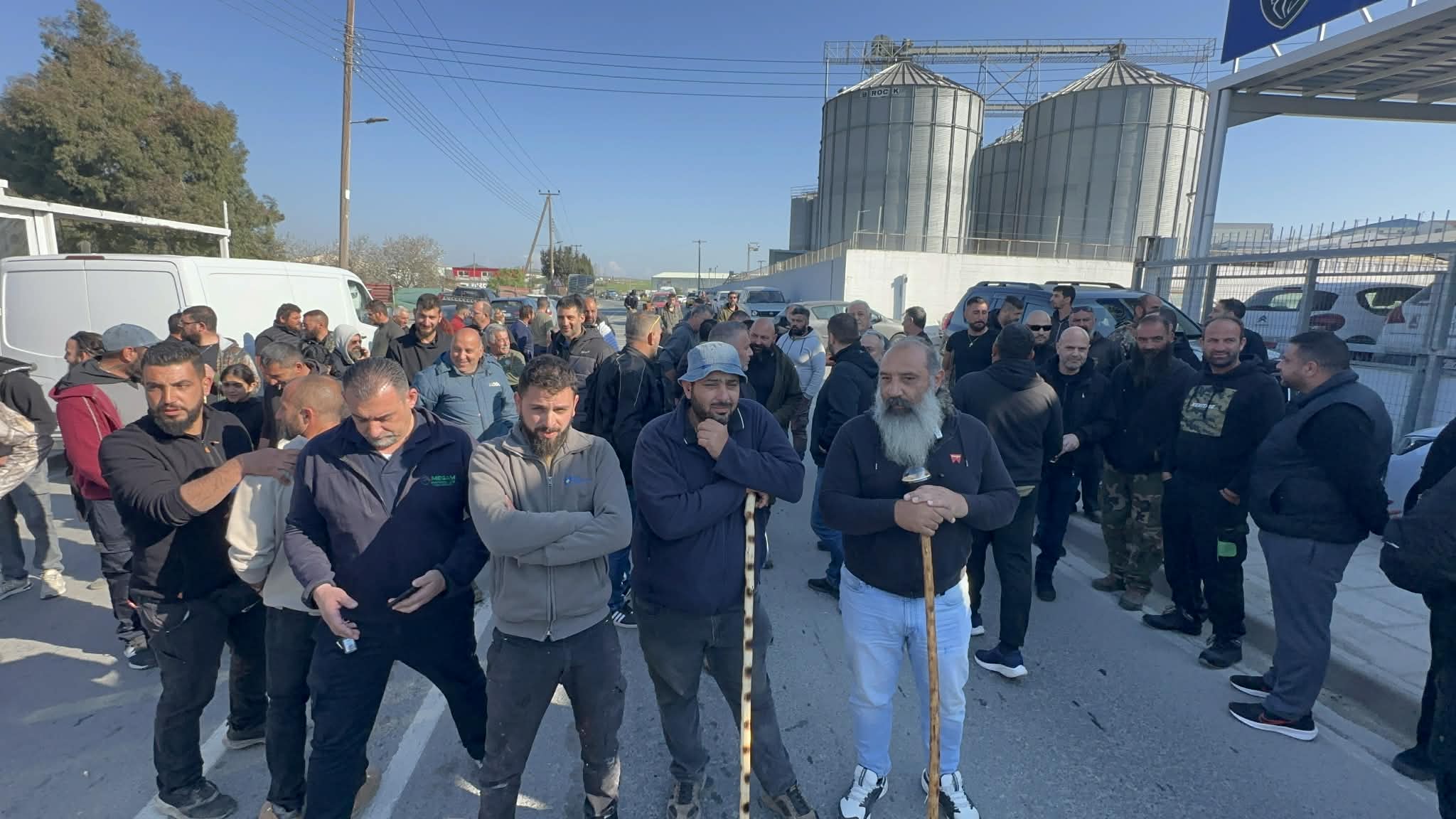
Livestock farmers in the Larnaca district on Wednesday staged a protest against the ongoing culling of animals in the aftermath of an outbreak of foot and mouth disease in the area in recent weeks.
The demonstrators gathered near the cooperative animal feed production organisation (Sopaz) building near the village of Aradippou, and even closed the road connecting Aradippou with nearby Athienou for a short period of time.
Farmers at the protest expressed hope that President Nikos Christodoulides will attempt to secure an exemption from European Union law regarding the disease, which stipulates that when even one animal in a livestock unit tests positive for foot and mouth disease, every animal in that unit must be slaughtered.
He is due to discuss the matter with European Commission President Ursula von der Leyen, while on Wednesday afternoon, government spokesman Konstantinos Letymbiotis announced that European Animal Welfare Commissioner Oliver Varhelyi will visit the island and meet stakeholders. However, EU law on the matter is unequivocal.
Livestock farmer Andreas Zachariou, for example, told the Cyprus News Agency that “everyone must respect what [Christodoulides] said, and he will convey to us the official response from the European Union”.
However, fellow farmer Costas Nicolaou was terser with his words, warning that if farmers’ demands for the culling to be halted are not met, “we will continue with the closure of roads, airports, and ports, until the president understands that in Cyprus, we want a proper leader”.
“What is happening is disgraceful,” he said, adding that Agriculture Minister Maria Panayiotou “should have taken other measures”.
“They cannot just do what Europe says. It should be our country first, and then Europe. We do not accept any culling from anyone, and this is an ultimatum,” he said.
However, the government has made clear that it has no intention of halting the culling, with Panayiotou having said on Tuesday that the culling of animals in the case of an outbreak of foot and mouth disease is mandated by European Union law and is as such not negotiable.
Not following the regulations, Panayiotou said, could see Cyprus ejected from the European single market, and see tight restrictions placed on the movement of people, goods, and services between the island and Europe.
Thus far, around 13,500 animals have been culled since the outbreak, though some MPs remained less than placated by Panayiotou’s statements.
Akel’s Yiannakis Gavriel asked whether “we will slaughter 500,000 animals” if the disease is detected in the Paphos district, before adding, “how will we replace them?”.
“By culling, will the disease be eradicated from Cyprus, or will it continue to exist in the north and then make its way into the south again?” he asked.
Earlier, veterinary association chairman Demetris Epaminondas had told the Cyprus News Agency that vaccinations of animals cannot replace culling as a method of preventing the disease’s spread, as the vaccine’s aim is “to limit the transmissibility of the disease”.
He added that allowing infected animals to live also entails the “risk that the virus will be transmitted further either by air, or by machinery, or in any other way which would affect other units”.
“That is why these extreme measures are being taken,” he said.
Later, he said that Cyprus finds itself “in a peculiar situation due to the concentration of large animal populations in small geographical areas”, while also pointing out that the Green Line, which separates the island’s two sides, “cannot be 100 per cent controlled”.
He also urged the public to be “understanding and calm” regarding veterinarians tasked with undertaking the culling.
“None of our colleagues want to participate in this thing called euthanasia. We did not study to kill animals, we studied to treat animals,” he said, before stressing that veterinarians “are not the enemies of livestock farmers”.
“On the contrary, we have been mobilised from the very beginning, with vaccinations and implementation of legislation, trying to limit the disease,” he said.
As such, he said, “it would be good not to target us”.


Click here to change your cookie preferences