
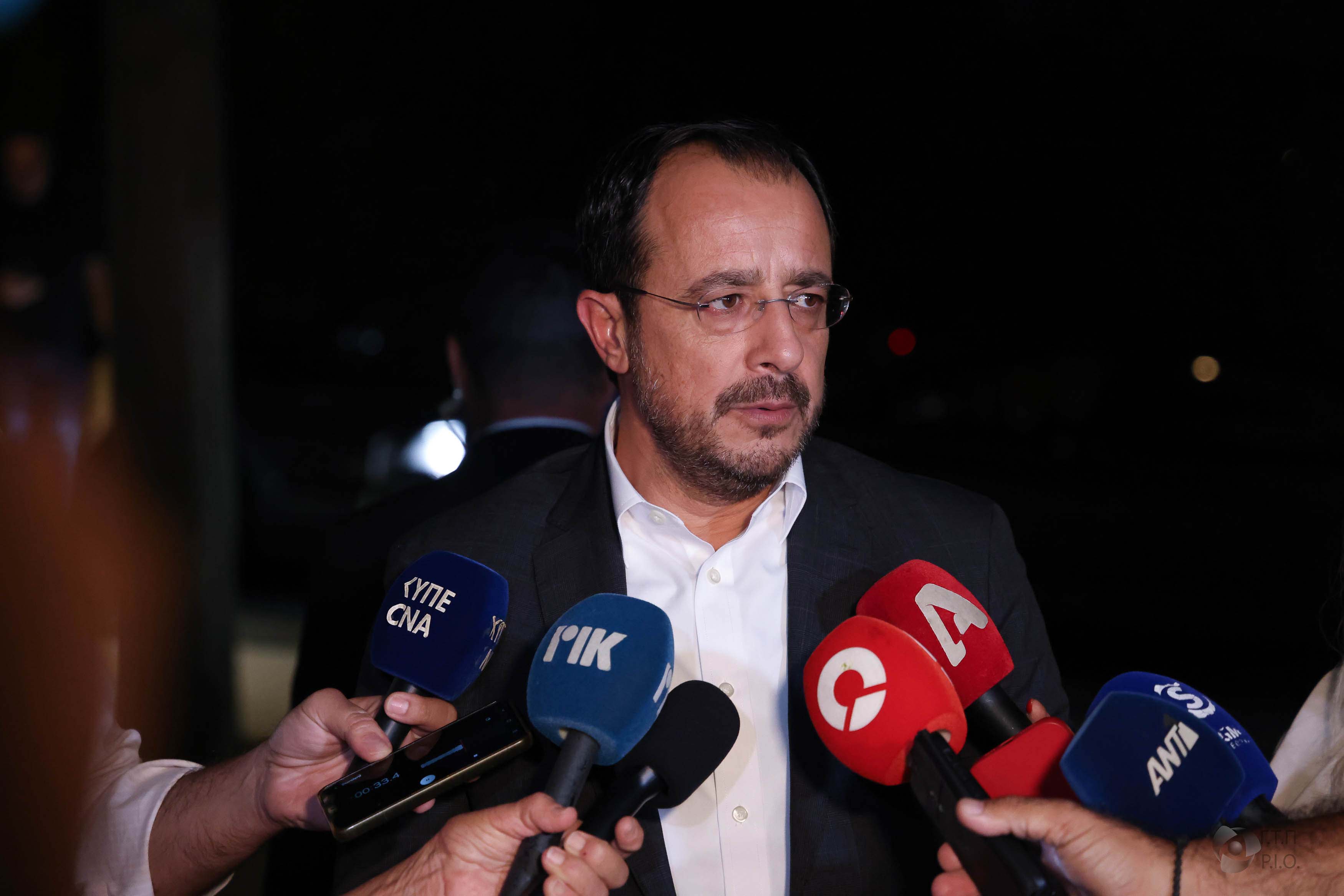
President Nikos Christodoulides said on Friday that Cyprus will seek a reassessment of the future of the British bases once the current regional crisis subsides, declaring that “everything is on the table” in forthcoming discussions with the United Kingdom.
In an interview with Bloomberg TV, the president made clear that while Cyprus is not directly involved in the conflict, it remains deeply affected due to its geographic position and regional role.
“We are part of the region, but we are in no way involved in this crisis,” he said, stressing that the island continues to function as “a stable, safe and fully functional hub for business, investment and tourism.”
Christodoulides indicated that recent developments had already prompted direct communication with London.
“I already had a discussion with the Prime Minister about some developments that we saw and did not like in terms of the management of this crisis,” he said.
He added that a broader reassessment would follow once conditions allow.
“When it is over, we need to put everything on the table, discuss and decide together on the future of the bases.”
The president had previously commented on the bases as “a remnant of colonialism”.
He reiterated that Cyprus has responsibilities towards the more than 10,000 Cypriots living within the base areas.
Christodoulides was explicit in addressing the risk posed to the republic, affirming that “we do not want our country to be a target”.
At the same time, he emphasised the importance of Cyprus’ role within the European Union during the crisis, portraying the island as an interlocutor between Brussels and the Middle East.
“We do not know the region from books. We know it because of geography and relationships, and we are transferring this experience to the European Union,” he said.
He pointed to what he described as an unprecedented level of European solidarity in response to recent developments, highlighting the activation of the EU’s mutual defence clause.
“We saw for the first time the solidarity of the European Union in practice, we tested Article 42.7 and we tested it successfully,” he said.
Christodoulides argued that this moment should be used to strengthen the EU’s geopolitical role, particularly in its immediate neighbourhood.
“The countries of the region expect an initiative from the European Union… it is the EU’s neighbourhood.”
On defence, he reiterated Cyprus’ interest in closer alignment with Nato, while acknowledging political constraints.
“If it were possible to join Nato tomorrow, we are ready to apply. It is not feasible at present and we do not want to do it just to get a veto from Turkey,” he said.
Beyond security, the president warned that prolonged instability would have significant economic repercussions for Cyprus and the wider region.
“All countries will be negatively affected if the situation continues, the effects will be serious on the economy, tourism, trade and energy,” he said.
He called for targeted and temporary measures at an EU level to mitigate the impact, including discussion of mechanisms such as a cap on natural gas prices, though he cautioned that such policies would need to be tailored to national circumstances.
Christodoulides also stressed the importance of maintaining a unified European position in relation to Russia, warning that inconsistency would undermine the bloc’s credibility.
“We must have a common approach and a common message, otherwise the credibility of the European Union will be damaged,” he cautioned.
In reference to the US-Israeli conflict with Iran, the president insisted that “we must turn this crisis into an opportunity”.
Christodoulides concluded by outlining a vision of coordinated international action aimed at de-escalation and stability and “to create a coalition of the willing to present a plan and achieve de-escalation.”

Click here to change your cookie preferences