
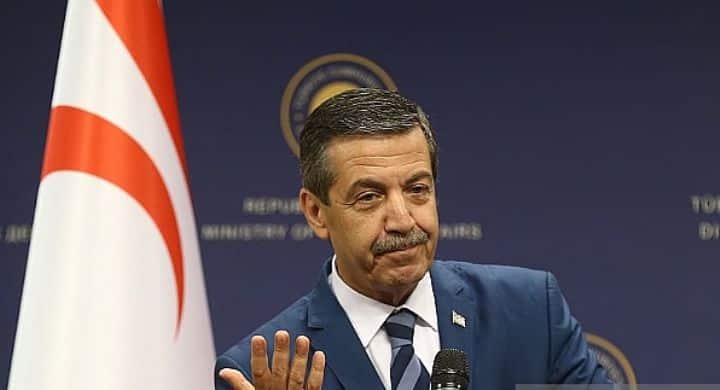
The Turkish Cypriot ‘foreign ministry’ on Tuesday evening expressed its displeasure at the latest agreement concerning the development of natural gas which was signed by the governments of Cyprus and Egypt on Monday, saying that it was signed “disregarding the inherent rights of the Turkish Cypriot people”.
“It is a clear manifestation of the Greek Cypriot leadership’s persistent policy, pursued since 2003, of systematically usurping the equal rights and interests of the Turkish Cypriot people on the island and in the eastern Mediterranean,” it said.
It added that the agreement is “entirely null and void from the perspective of the Turkish Cypriot people” as it was “concluded without the consent of the Turkish Cypriot people and disregarding their sovereign and equal status on the island”.
“It is clear that the Greek Cypriot administration’s continued abuse of the usurped title of ‘Republic of Cyprus’, claiming to represent the entire island and signing agreements with third countries … not only violates the legitimate rights and interests of the Turkish Cypriot people, but also seriously undermines stability and cooperation in the eastern Mediterranean,” it said.
It added that “the Greek Cypriot administration has neither the authority to make decisions on the Turkish Cypriot people’s behalf, nor the unilateral right to decide on the use of the island’s natural resources”.
“Any step taken while ignoring this fact is invalid both politically and legally, and constitutes a clear violation of rights,” it said.
To this end, it said that “despite the unilateral and persistent initiatives taken by the Greek Cypriot side, we would like to reiterate that, as in the past, a just order in the region based on mutual respect and cooperation can only be achieved with the inclusion and consent of the Turkish Cypriot people”.
“Our state … has the will to take the necessary steps in all matters concerning the rights of the Turkish Cypriot people, and will not hesitate to take the necessary political, diplomatic, and technical measures to ward against any attempt to usurp their equal and legitimate rights to natural resources,” it said.
It added, “we would like to emphasise once again that lasting cooperation and stability on the island and in the eastern Mediterranean can only be achieved if all parties act on the basis of the sensitivities of the Cyprus issue and the equal rights and status of the two peoples on the island”.
As such, it said, third countries should “refrain from supporting, and explicitly oppose the unilateral initiatives undertaken by the Greek Cypriot administration, which increase tension in the region, and prioritise a dialogue which includes all sides”.
The statement was endorsed by the Turkish foreign ministry, which reshared it to its own social media accounts.
Monday’s agreement was a reiteration of previous agreements signed by the governments of Cyprus and Egypt regarding natural gas under the seabed off Cyprus’ coasts.
Energy Minister Michael Damianos had said that it does not differ at all from a similar agreement signed in the past”, but noted that now, “essentially, Kronos and Aphrodite are included together in relations to the intention to take the deposit to Egypt”, with Kronos and Aphrodite the name of two gas fields.
Damianos added that the agreement is “mainly a political confirmation of the direction which the two countries have already chosen”, and that “the implementation of projects depends to a large extent on the companies operating in the blocks”.
It had initially been hoped that Italian energy giant Eni would have confirmed its final investment decision for the Kronos field, which is located in Block 6 of Cyprus’ exclusive economic zone (EEZ) in advance of the Egypt Energy Show, though this has not yet come to pass.
Given the proximity of the Kronos field and Block 6 to Egypt’s Zohr gas field, which Eni also operates, Eni will be able to use its own infrastructure to take the Cypriot natural gas to the Segas liquefied natural gas (LNG) terminal in the Egyptian port city of Damietta, and export the gas to Europe and, if required, elsewhere from there.
The previous agreements to which Damianos was referring were signed by Cyprus and Egypt last year, saw the Egyptian government designated as the “host government” for Block 6.


Click here to change your cookie preferences