
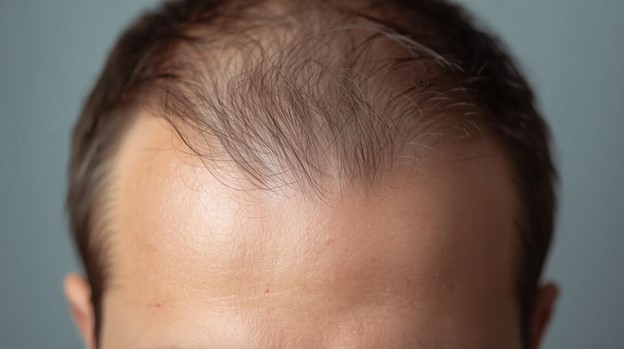
Most people notice it slowly. A little more hair on the pillow. A wider part. A hairline that seems to be quietly moving back. For many, this isn’t stress or a bad diet — it’s something that was written into their biology long before the first strand fell. Genetic hair loss is one of the most common yet least understood conditions affecting both men and women, and knowing how it actually works can change the way you approach it.
What Genetic Hair Loss Actually Means
Genetic hair loss, medically called androgenetic alopecia, is a hereditary condition where hair follicles are sensitive to a hormone called DHT (dihydrotestosterone). DHT is a byproduct of testosterone, and it’s present in everyone — men and women alike.
When someone has a genetic predisposition, their hair follicles carry receptors that react strongly to DHT. Over time, this sensitivity causes the follicles to shrink. Each hair growth cycle produces a thinner, shorter strand than the one before it. Eventually, the follicle becomes so small that it stops producing visible hair altogether.
This is not hair falling out suddenly. It’s a slow, quiet miniaturization of the follicle itself.
Where Does the Genetic Part Come From?
There’s a common myth that genetic hair loss is inherited only from the mother’s side. That’s not accurate. The genes responsible for androgenetic alopecia can come from either parent, and in many cases, both sides of the family contribute.
Research has identified multiple genes involved in this condition. The androgen receptor gene (AR gene), located on the X chromosome, does play a significant role — which is partly why the maternal line gets blamed — but studies have shown that men with a bald father are also at significantly higher risk. It’s a polygenic trait, meaning many genes influence the outcome together.
So if you have hair loss on both sides of your family, your risk is higher. But having it on just one side doesn’t mean you’re safe either.
How Early Can It Start?
Earlier than most people expect. Androgenetic alopecia can begin as early as the late teens or early twenties, though it often goes unnoticed for years. The early signs are subtle:
- Gradual thinning around the temples or crown
- The hairline taking on a slightly receding shape
- Hair that feels finer or less dense than before
- Increased shedding that doesn’t seem to slow down
In men, the pattern often follows a predictable path — starting at the temples and crown, eventually merging. In women, the pattern is different. Hair thins more diffusely across the top of the scalp, and the frontal hairline is usually preserved. This is why female pattern hair loss can go undiagnosed for longer — it doesn’t look like “baldness” in the way most people picture it.
Why Early Awareness Matters More Than Early Panic
Genetic hair loss is progressive by nature, but the rate of progression varies enormously from person to person. Some people lose hair rapidly in their twenties. Others experience slow, gradual changes over decades. Genetics sets the stage, but other factors influence how the condition unfolds — things like scalp health, nutritional status, stress levels, and hormonal fluctuations.
This is why treating genetic hair loss isn’t simply about blocking DHT. The scalp environment, blood circulation to the follicles, and the overall health of the hair growth cycle all matter. Approaches like Traya are built on the idea that genetic hair loss needs to be addressed from multiple angles — not just the hormonal pathway, but also the nutritional and scalp-health factors that can either accelerate or slow the process.
Understanding this changes how you think about intervention. It’s not about reversing genetics. It’s about giving your follicles the best possible conditions to keep functioning as long as they can.
Final Thoughts
Genetic hair loss doesn’t have to feel like a sentence. Knowing that it’s rooted in follicle sensitivity to DHT, that it comes from complex hereditary patterns, and that it progresses gradually — that’s actually useful information. It means there’s a window of time where thoughtful, consistent action makes a real difference. The earlier you understand what you’re dealing with, the better your options become. Not because any treatment will rewrite your DNA, but because the right approach can meaningfully slow the process and keep more of your hair for longer.
DISCLAIMER – “Views Expressed Disclaimer – The information provided in this content is intended for general informational purposes only and should not be considered financial, investment, legal, tax, or health advice, nor relied upon as a substitute for professional guidance tailored to your personal circumstances. The opinions expressed are solely those of the author and do not necessarily represent the views of any other individual, organization, agency, employer, or company, including NEO CYMED PUBLISHING LIMITED (operating under the name Cyprus-Mail).





Click here to change your cookie preferences