
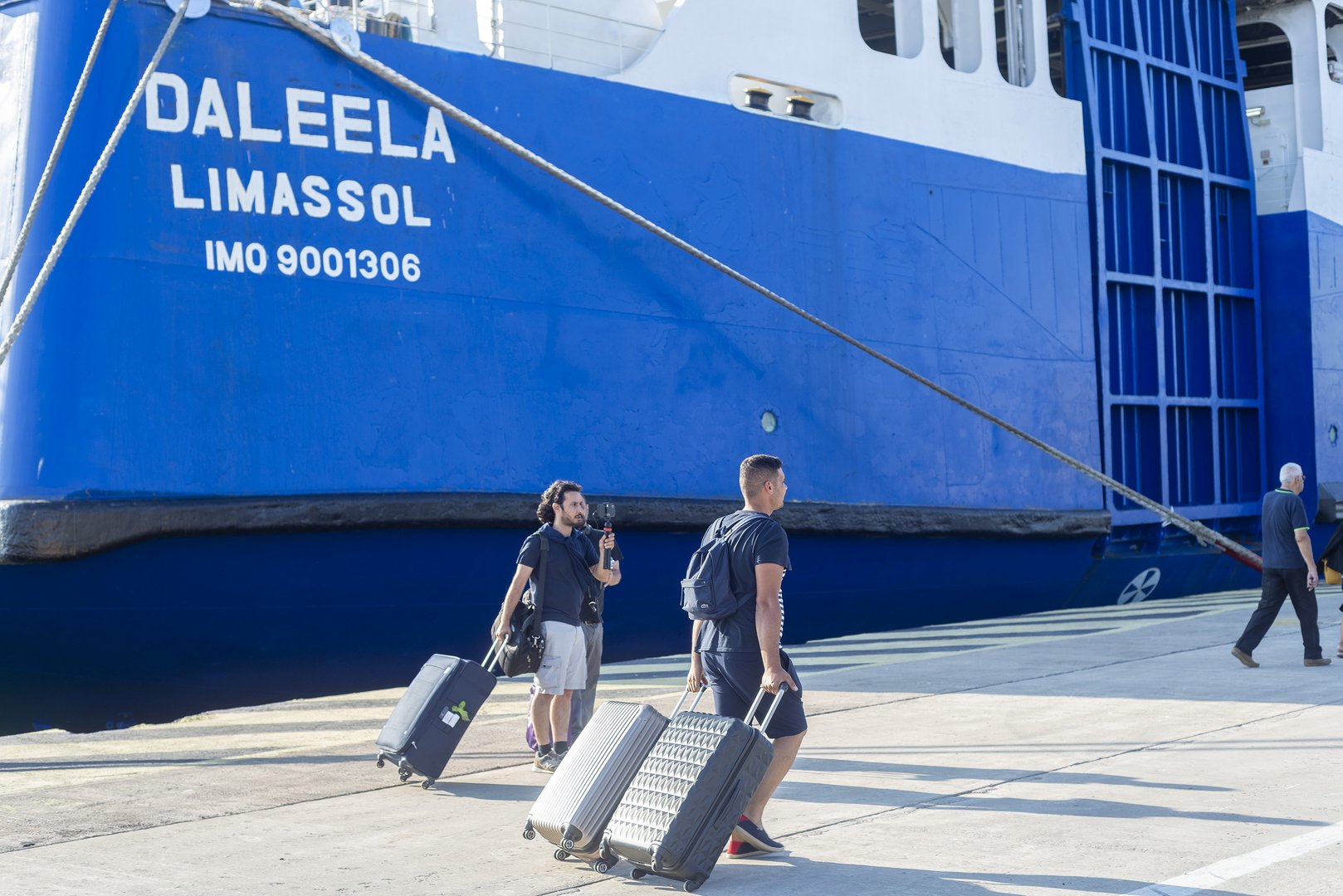
Following a series of complaints over the unavailability of ferry tickets, the audit office found that from 2022 until 2025 ferries on average were running at 49 per cent of full capacity, yet the company running the routes was still getting paid in full via a state subsidy.
In report made public on Thursday, the audit office said it investigated the complaints and verified the numbers through the shipping deputy ministry.
Auditor-general Andreas Papaconstantinou said the ferry connection between Cyprus and Greece was relaunched in 2022 based on a political decision with the aim of providing an alternative means of travel.
Every year, Scandro Holding Ltd carries out 22 return routes during the summer period with a guaranteed compensation of €5.47 million per year, plus 6 per cent of revenue from the sales of tickets. The amount not covered by tickets is supplemented by a state grant.
The audit office analysed data concerning the routes, ticket bookings and payments from July 1 until August 31, 2025, during which 32 routes were carried out, namely 16 Limassol-Piraeus and 16 Piraeus-Limassol. Of these, 21 were selected as random samples.
The investigation indicated that while the demand was high, the tickets were sold out as soon as the platform opened, however the ferries were on average only half full from 2022 till 2025.
Specifically, the average number of passengers who travelled from 2022 till 2025 was 173 per route in a ferry with a capacity of 350.
“While 61,600 passengers could have been served over the four years, only 30,459 were,” the audit office pointed out.
For some routes, tickets had been sold out, however there were 107 places that were not utilised. The same applied for transporting vehicles, with the ferry running on 18 per cent of its capacity.
According to the audit office, this happens because the system allows “complete distortion” practices, where one person can travel alone in a four-bed cabin at a price cheaper than a single cabin.
Also, due to other weaknesses, the system may not always present the true status of availability, it added.
The audit office furthermore found that reservations could be cancelled at any time before departure with a full refund, which led to many places being reserved and then cancelled.
According to the company’s policy posted on its website, if the cancellation takes place within 30 months from the day of departure, then only the port taxes are refunded.
However, the shipping deputy ministry said the policy is flexible and the company refunds the whole value of the ticket plus port taxes.
“This does not secure reasonable management of reservations, as it encourages the reservation of multiple places as soon as the platform opens and the cancellation of those that will not be used just a few days before the scheduled department, denying the opportunity to make the seats available to other interested passengers,” the audit office said.
It added that the shipping deputy ministry was not make aware of, did not monitor and did not check no-shows or cancellations, so there was no clear picture of whether the company refunded the tickets or issued new ones at no additional cost.
The audit office added that the ticket prices were considered to be quite low, meaning that the grant received from the state covered approximately 93 per cent of the of the projected revenue.
Furthermore, it said, ticket prices remained the same despite the season and the guaranteed compensation of €5.47 million and the 6 per cent compensation on ticket sales did not create any incentive to fill the ferry, on the contrary it only guaranteed a lower running cost for the company.
The audit office also found that the performance indices set did not give the true picture regarding passengers, leading to the automatic renewal of the contract for a further three years.
It added that it was necessary to strengthen the monitoring mechanisms at the shipping deputy ministry, in order to verify the data.
“The deputy ministry must reassess the service and take measures for the current contract as well in order to effectively serve the public and public interest,” it said.
The audit office pointed out that maritime connectivity should not operate as a subsidised service, but a reliable and quality service of general interest, which would bring about an added value mainly for the people and also for the state.
“Such an approach would substantively contribute to enhancing tourism, a sector of strategic importance for the economy, social cohesion and the international image of the Republic of Cyprus,” it said.
In conclusion, the auditor-general said the political decision to continue the implementation of the plan did not in any case annul the obligation of the shipping deputy ministry to reasonably use public funds.
“It is imperative to immediately reassess, so that with less burdening of the public finances, more people are served.”
The shipping deputy ministry’s deputy permanent secretary Kyriakos Aliouris issued a rebuttal later in the day, saying that the audit office’s decision to use the average occupancy rate of the ferry “does not give the real picture”, given that the boat is typically fuller at the height of summer.
He added that the boat provided by the company was larger than expected, and that additionally, a four-bed cabin which is booked by a single occupant cannot then be booked by three other unrelated people, meaning that the cabin, technically, would be a quarter full while being fully booked.
Additionally, he said the deputy ministry had sent an eight-page letter explaining the situation to the audit office, but that this letter had not been taken into account, and that instead, the audit office had simply attached the letter to the end of its own report.



Click here to change your cookie preferences