
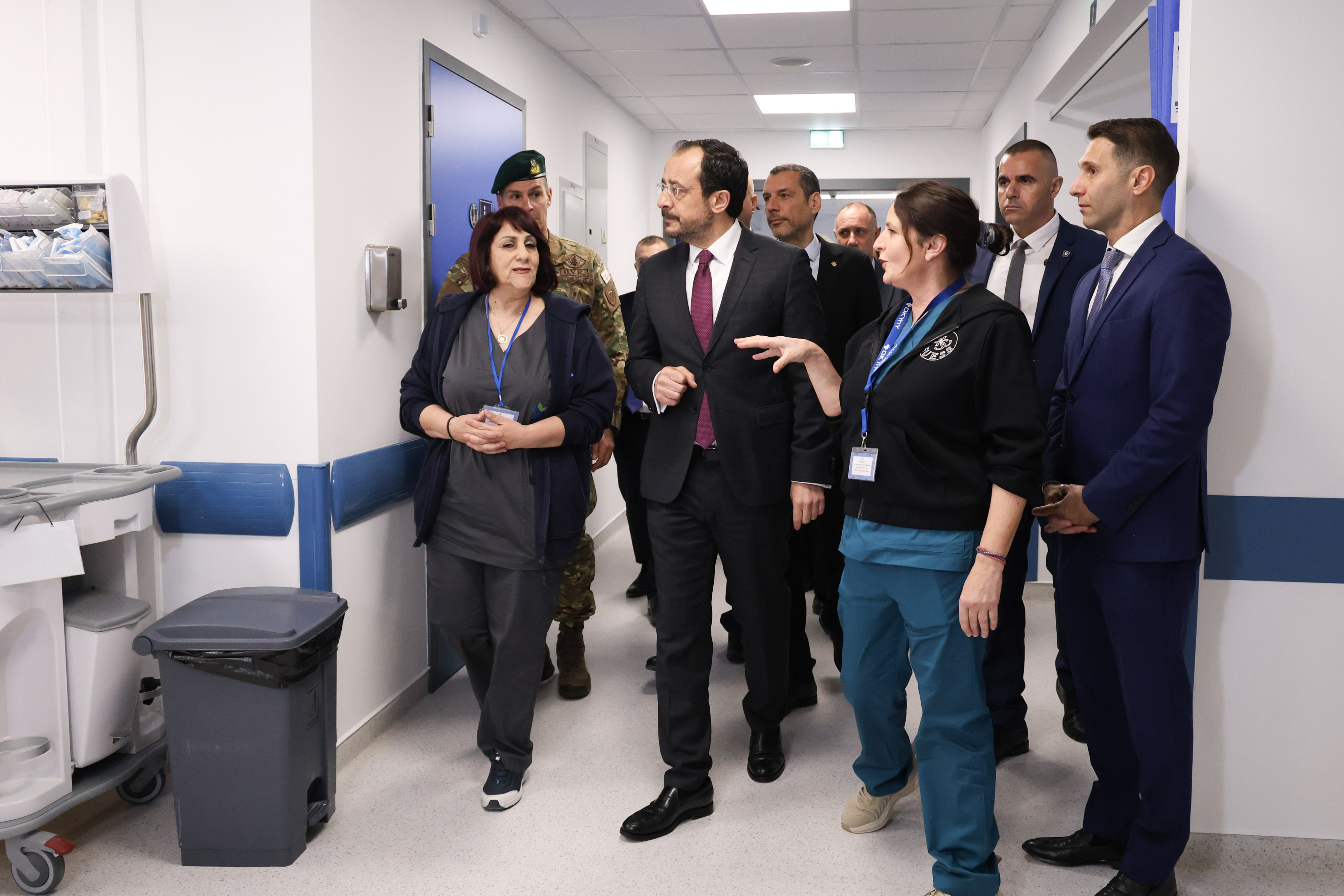
The government’s broader strategy for healthcare and equality for all was outlined by President Nikos Christodoulides on Monday as he inaugurated new and upgraded facilities at Paphos general hospital.
Speaking at the official opening of the accident and emergency department (A&E), short-stay ward and infectious diseases unit, Christodoulides said the projects mark “another important and substantive step” in improving healthcare services and supporting Cypriot families.
He added that his presence alongside the health minister and government spokesman aimed at sending “a clear message of state support” for such projects.
Christodoulides said the new facilities build on recent developments at the hospital, including the Mother and Child wing and upgraded infrastructure in gynaecology, maternity and paediatric care, addressing long-standing needs in the Paphos district.
“These are not simply technical interventions. They are substantive improvements that enhance the sense of security of citizens and upgrade the quality of care, while ensuring conditions of dignity for every patient and their family,” he said.
Christodoulides stressed that healthcare is a central pillar of government policy, in which the government is able to invest because of a positive economy.
“With some of the best performances in Europe, even amid two wars, we are able to invest meaningfully in these sectors and return to society what a government with our philosophy of social liberalism must provide,” he said.
He underlined that access to quality services must be equal across the island.
“We have a minimum obligation to offer our citizens the same services wherever they live. Investment in health is, above all, an investment in people and in the future of our society,” he added.
“Our goal is for citizens to trust the healthcare system and to know that in every corner of Cyprus they will receive high-level care, with professionalism, respect and humanity,” he said.
He highlighted the importance of continuous training, infrastructure upgrades and cooperation among healthcare professionals in building a modern and effective system.
Christodoulides said the government has invested more than €150 million in upgrading public hospitals in recent years.
Referring to longstanding complaints about delays in accident and emergency departments, he said addressing waiting times had been a priority since March 2023.
“With planning, determination and clear political will, we proceeded with the expansion and strengthening of A&E departments in all public hospitals,” he said.
He cited the introduction of fast-track clinics as a reform that has already delivered results, helping to decongest hospitals and reduce waiting times, particularly for non-emergency cases.
“These interventions are not theoretical. They have produced tangible results, improving daily life for both patients and healthcare professionals,” he said.
Christodoulides said that after Paphos, the next focus would be Larnaca, acknowledging that problems remain and must be addressed through both infrastructure investment and service improvements.
The new projects in Paphos, he said, enhance the functionality and self-sufficiency of the general hospital, reducing the need for patient transfers and ensuring a faster, higher-quality service for residents.
“And most importantly: we do not stop here,” he said.
He confirmed that plans are progressing for the construction of a new hospital in Polis Chrysochous, aimed at meeting the needs of the wider region and easing pressure on Paphos hospital.
“Whether you live in Pyrgos Tillyrias, in central Nicosia or in Paphos, the state has an obligation to provide the same level of services,” he said.
“With projects like those inaugurated today, we demonstrate in practice that upgrading the health sector is not just announcements or fine words, but a continuous and steady course with people at its centre,” he concluded.


Click here to change your cookie preferences