
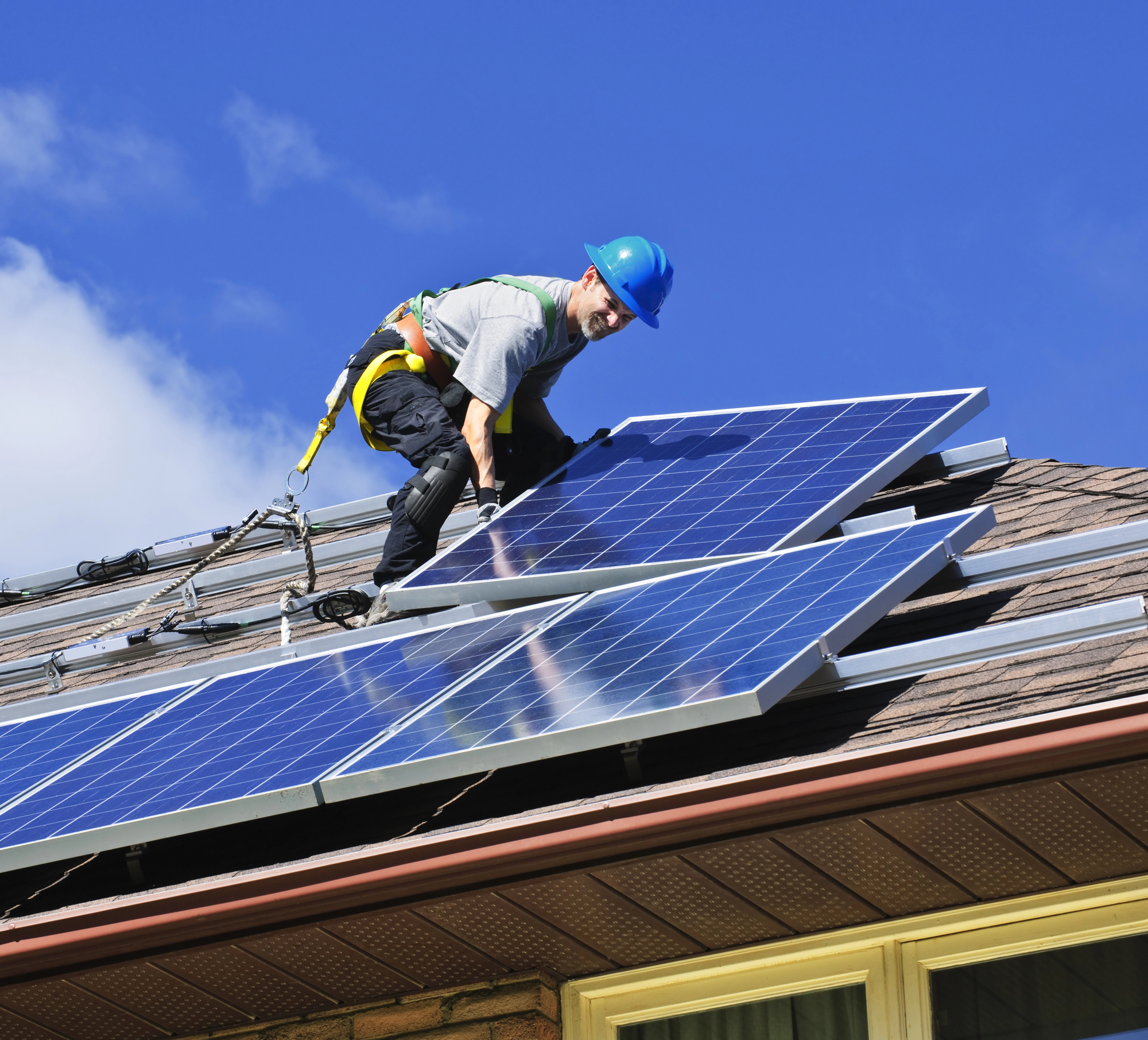
ReVision Energy, one of the largest solar companies in New England, had roughly 40 open positions in Maine and another 20 across New Hampshire and Massachusetts, the last time it publicly counted. The company trains new hires internally, covers their electrical licensing costs, and offers employee ownership. It still can’t fill the seats fast enough. Vaughan Woodruff, who runs ReVision’s training center, has pointed to a national analysis showing that only 6% of workers needed for energy-sector jobs are currently in the training pipeline, leaving a 94% gap.
Yehuda Gittelson works for a smaller company, Solaris Energy Solutions, in Portland, and the math looks similar. “We’ve had job postings up for months,” he said. “People apply, but the ones with the right mix of physical ability and willingness to learn are harder to find than you’d think. We can train the solar part. We can’t train the showing-up-in-January-when-it ‘s-12-degrees part.”
The national numbers frame the problem. The specific pressures in southern Maine make it worse.
The Boom and the Brake
Maine’s solar sector grew fast. The state’s installed solar capacity increased from 62 megawatts in 2019 to 977 megawatts by 2024, according to data cited by the Governor’s Energy Office. Community solar drove much of that growth after Governor Janet Mills signed legislation in 2019 that created the program and set a 2050 target for 100% renewable energy. Federal incentives through the 2022 Inflation Reduction Act added fuel. Electrician wages in the solar trade rose 20% in some union classifications, reaching $60 an hour, and the steady work attracted new entrants to the field.
Then the policy environment shifted. The One Big Beautiful Bill Act, signed in July 2025, accelerated the phaseout of key tax credits and set a July 4, 2026, construction-start deadline for projects seeking the full value of Section 45Y and 48E credits. The residential solar tax credit under Section 25D expired entirely at the end of 2025. Maine’s community solar market contracted by 87% year-over-year by the end of 2025, according to SEIA’s year-in-review report, the steepest decline among states.
The workforce felt it immediately. Two large solar projects that would have kept 40 to 50 electricians employed through the summer were canceled before the building season started, according to a July 2025 NEWS CENTER Maine report. Total job losses in the union trades reached about 100. Applications for electrical apprenticeships fell 40% in the same period.
“The guys who came into the trade during the boom are now wondering if the work will hold,” Gittelson said. “Some of them left for other construction jobs. You can’t blame them.”
The federal workforce squeeze
The national picture compounds Maine’s local problems. PV Magazine reported in April 2026, drawing on the IREC National Solar Jobs Census and the 2025 U.S. Energy and Employment Report, that the industry’s current workforce of about 280,000 falls roughly 53,000 positions short of what’s needed to meet installation targets of 60 to 70 gigawatts. Hiring has been difficult across the board: 86% of solar employers told USEER researchers they struggle to fill open roles.
The OBBBA’s apprenticeship mandate adds another layer. To claim the full tax credit, projects must ensure that 15% of total labor hours are performed by qualified apprentices. The IREC census found that only 43% of the current workforce has access to the training needed for those roles. The mismatch is pushing larger developers to build their own internal training pipelines rather than rely on third-party labor.
For a company of Solaris’s size, building an internal training program isn’t realistic. Gittelson and the other experienced installers train new hires on the job, which works but limits how quickly the crew can grow.
What Maine has tried
The state has made real investments. The Clean Energy Partnership Program has directed more than $7 million toward workforce development since 2022, funding a range of training efforts. ReVision Energy built an apprenticeship model for PV design. Portland Adult Education stood up a pre-apprenticeship track in renewable energy. Further north, Oxford Hills created a combined heat pump and solar technician program, and four community colleges expanded their HVAC curricula to include clean energy applications.
Maine’s $62 million Solar for All grant, awarded by the EPA in 2024, included earmarks for workforce training that would have prepared more than 700 residents for building trades positions. That program was terminated after EPA Administrator Lee Zeldin announced the agency no longer had authority to distribute funds under the OBBBA. Dan Burgess, acting commissioner of the Maine Department of Energy Resources, said the cancellation would deprive the state of the skilled electricians and installers needed to meet its energy targets.
Gittelson has watched these programs with the awareness of someone who entered the field through an unusual door. “I had an engineering degree, which most people on a solar crew don’t have,” he said. “The pre-apprenticeship programs are trying to build a version of that foundation for people coming from other trades. The question is whether the programs can move fast enough to matter.”
The Contradiction
Southern Maine’s solar market faces a paradox. Demand for residential installations remains strong. Maine electricity rates range from 23 to 32 cents per kilowatt-hour, among the highest in the country. Net Energy Billing still offers 1:1 retail-rate credits for rooftop solar. Homeowner interest in battery backup has grown since the federal tax credit expired. The economics still pencil out for most households.
But the labor to meet that demand keeps thinning. Experienced installers age out or move on to higher-paying electrical work in commercial construction. New entrants need months of on-the-job training before they’re productive on a roof. The training infrastructure, while growing, hasn’t reached the scale needed to replace attrition, let alone expand capacity.
Gittelson pulled into a driveway in Scarborough on a recent morning with a two-person crew. A year ago, he’d have had three people. The job took longer. The next one will too.
“The demand is there,” he said. “The roofs are there. What we don’t have is enough people who can safely and correctly put panels on them.”
DISCLAIMER – “Views Expressed Disclaimer – The information provided in this content is intended for general informational purposes only and should not be considered financial, investment, legal, tax, or health advice, nor relied upon as a substitute for professional guidance tailored to your personal circumstances. The opinions expressed are solely those of the author and do not necessarily represent the views of any other individual, organization, agency, employer, or company, including NEO CYMED PUBLISHING LIMITED (operating under the name Cyprus-Mail).





Click here to change your cookie preferences