
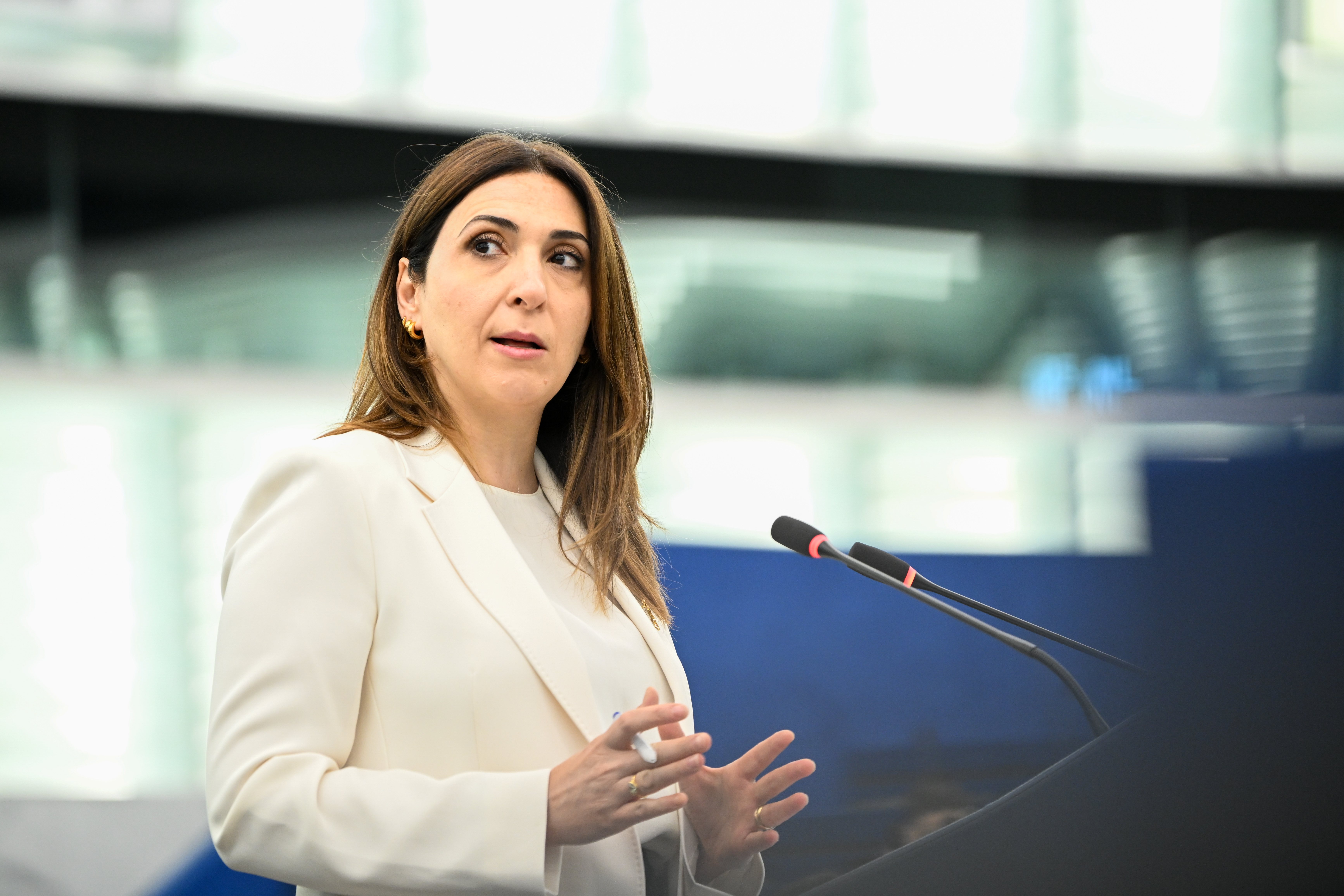
Enlargement is an “indispensable commitment” for the European Union, European Affairs Deputy Minister Marilena Raouna said on Tuesday as she opened a European Parliament debate on the governance of the bloc.
“Our union is a project that has constantly evolved, not despite crises, but because of them, in many cases, because it is those moments that have driven the deeper integration of the European Union,” she said.
She added that “enlargement is an indispensable commitment of this evolution”, and said to this end that the matter was “at the heart of the informal ministerial meeting of European ministers that was held a couple of weeks ago in Nicosia with the participation of our enlargement partners.
“In that discussion, we focused on the fundamentals, the backbone of enlargement, the rule of law, democratic institutions, economic criteria,” she said, adding that the discussions “highlighted that geopolitical urgency does not lower the bar for accession”.
This comment comes after the EU knocked back advances made by Ukraine in the hope of being given a “fast track” to membership in light of Russia’s invasion of the country, though news website Politico has since reported that Kyiv will instead be offered a “package of short-term benefits” to bring it closer to the EU in the meantime.
With this in mind, Raouna on Tuesday said that “enlargement partners are expected to deliver sustained and measurable results”, and that at the same time, “the union must ensure clarity, predictability and fairness” in its treatment of candidate countries.
To this end, she said that Cyprus, during its term as the holder of the Council of the EU’s rotating presidency, “has diligently worked and has delivered concrete progress on enlargement, despite the challenges, while upholding the credibility of the established methodology and its merit-based character”.
She then added that the EU “also needs to be ready at the time of accession”.
“In parallel to the enlargement process, the union needs to lay the necessary internal groundwork for reform and address key questions related to its priorities and its policies, as well as its capacity to act,” she said.
On this matter, she pointed to the signing of the One Europe, One Market roadmap for reforms aimed at strengthening the European single market which was signed by the presidents of the European Parliament and European Commission, Roberta Metsola and Ursula von der Leyen, and Cypriot President Nikos Christodoulides last month.
This roadmap, she said, “represents a concrete and ambitious step to enhance our strategic autonomy by strengthening our competitiveness, completing our single market, and making it simpler for people and businesses,” she said.
It has now been almost 13 years since Croatia, the last country to join the EU, did so in 2013, and in the intervening years, one member state, the United Kingdom, has left the bloc.





Click here to change your cookie preferences