
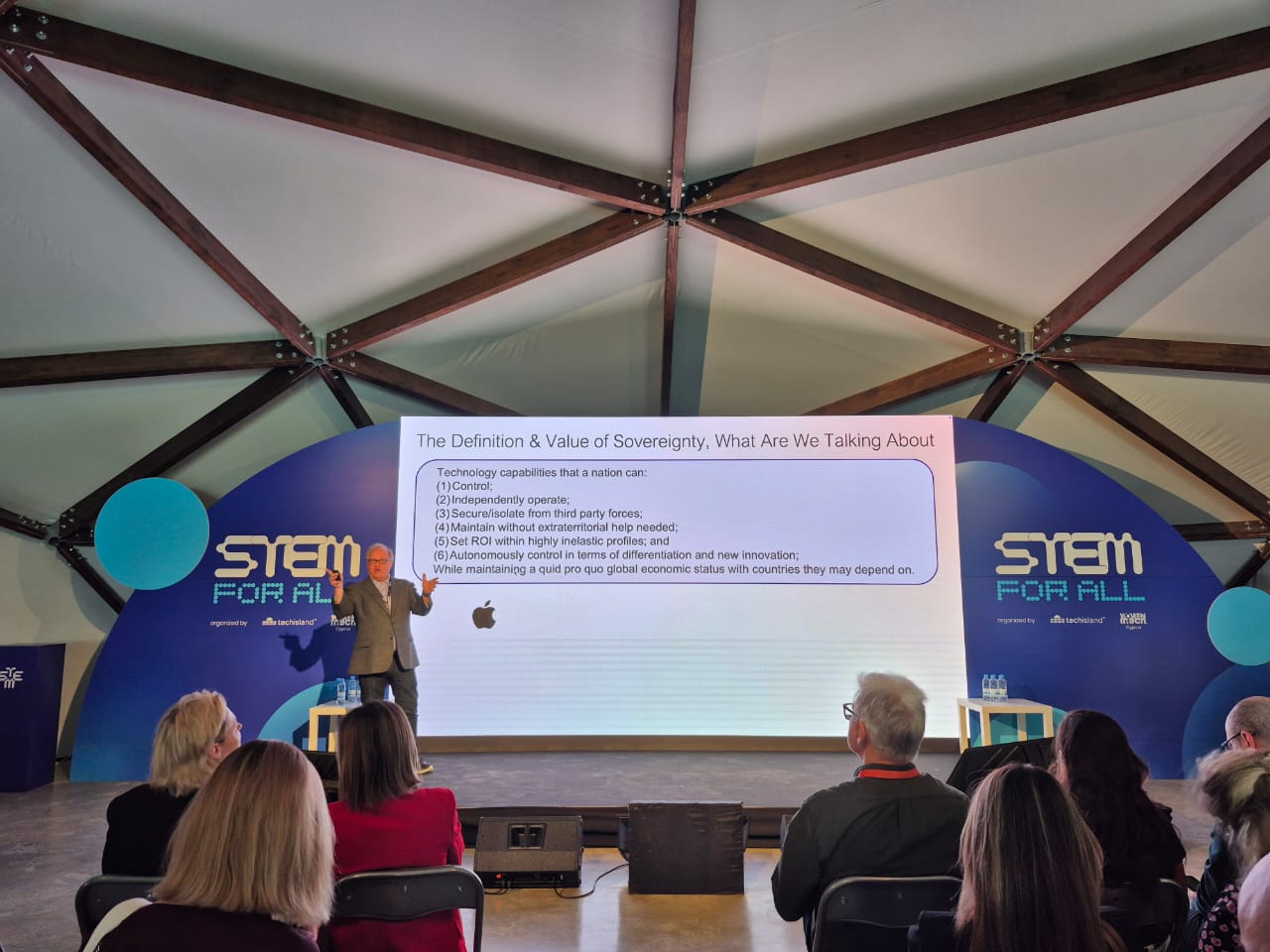
Keith Witek, Chief Operating Officer of Tenstorrent, said sovereignty in the age of artificial intelligence is no longer only a political or regulatory question, but a practical question of which technology capabilities a country can control, operate, secure and use to create differentiated value.
Speaking during a keynote speech titled ‘Sovereignty in the Age of AI’ at the Doers Summit in Limassol, Witek said AI is forcing countries to rethink what sovereignty means in a world increasingly shaped by infrastructure, chips, platforms, computing power and global technology supply chains.
Every major computing revolution, from the mainframe to the cloud, expanded access to more people, he said.
AI, however, may be different.
Witek warned that it could become the first computing revolution to reverse that trend by concentrating power in the hands of those who own the infrastructure.
Defining sovereignty, Witek said it refers to technology capabilities that a nation can “control, independently operate, secure or isolate from third-party forces”, as well as maintain without extraterritorial help.
He said sovereignty also means being able to “autonomously control differentiation and new innovation”, while capturing value in areas where demand remains highly inelastic.
At the same time, Witek made clear that sovereignty does not mean cutting off global economic relationships.
Rather, he said, it involves maintaining a “quid pro quo global economic” position with countries on which a nation may still depend, while avoiding full exposure to external control.
He linked this directly to economic and technological power, showing how the world’s leading technology nations also hold strong positions in GDP, market capitalisation and global capability.
According to his presentation, the US ranks first in technology power and first in GDP, with public technology market capitalisation of $40 trillion.
China ranks second in both technology power and GDP, with public technology market capitalisation of $7 trillion.
Japan ranks third in technology power and fourth in GDP, with $3 trillion, while South Korea ranks fourth in technology power and thirteenth in GDP, with $2 trillion.
Taiwan ranks fifth in technology power and twenty-second in GDP, with public technology market capitalisation of $2.5 trillion.
Germany ranks sixth in technology power and third in GDP, with $1.5 trillion, while the Netherlands ranks seventh in technology power and eighteenth in GDP, with $1.2 trillion.
The United Kingdom ranks eighth in technology power and sixth in GDP, with public technology market capitalisation of $1 trillion.
For Witek, these figures show that technology power and economic power are now deeply connected. He also used earlier computing eras to show how much long-term value can be captured by those who control critical layers of technology.
Referring to the Microsoft and Intel PC era, Witek said the monopoly was “largely unchanged” over decades.
According to his presentation, Microsoft recorded an average operating margin of 37 per cent between 1995 and 2014, compared with 29 per cent for Intel and 5 per cent for others.
Only one company climbed the rankings during the last two decades, he said, showing how difficult it is to displace technology leaders once they control essential layers of the market.
The lesson for countries, Witek said, is that sovereignty must be linked to where the “highest differentiated value” is created. “A country cannot control everything”, he mentioned.
Instead, he said, it must first identify the product technology that drives the highest differentiated value for global customers.
It must then match its own strengths and capabilities to the technology and sovereign control needed for that product, so it can provide “unique global value” and differentiation against competitors.
The final step, he said, is to use business models, global partnerships and monetisation strategies to capture larger markets, higher margins and higher market capitalisation.
In practical terms, this means choosing carefully where to compete.
Witek said countries must understand where they can secure their “sovereign seat at the table”, rather than trying to control every layer of the global technology system.
His presentation mapped the global technology ecosystem across several layers, including IP, chip design, masks and tape-out, foundry, packaging, circuit boards, product designs, complex systems, ecosystems, services, modules, content and interfaces.
Within that stack, he identified several monopoly or limited-source choke points, including CAD, CPU, graphics, fabric, foundry, DRAM, EUV, AI, modem, cloud, operating systems and software.
These choke points, he suggested, are where dependency can become strategically important, particularly in an AI era shaped by infrastructure ownership and limited sources of critical technology.
For Cyprus, Witek said the question is not whether the country can own the entire AI stack. The real question is where Cyprus can build enough capability, partnership strength and differentiated value to matter.
In this context, he said a credible sovereign AI strategy depends on choosing the right layers of the stack, rather than trying to compete everywhere at once.
Witek also outlined the key ingredients needed to secure a sovereign position in technology.
His presentation listed retained talent, geopolitical advantage, attitude, scale, education, capital, open platforms and velocity as the factors driving sovereignty.
Retained talent, he said, is essential because countries cannot build sovereign capability if the people who understand the technology leave.
Geopolitical advantage also matters, he suggested, because a country’s location, partnerships and strategic position can help define where it can compete.
Education and capital were presented as necessary foundations, while “open platforms” and “velocity” were linked to the ability to move quickly, build ecosystems and avoid dependence on closed technology systems.
Witek’s message placed sovereignty in practical terms, linking it to control over infrastructure, access to talent, strategic partnerships and the ability to innovate without being fully dependent on external forces.
He said the AI era is making these questions more urgent because infrastructure ownership increasingly determines who captures value, who sets the rules and who remains dependent on others.
The keynote came as Cyprus is trying to strengthen its position as a technology and innovation hub, with wider discussions at the Doers Summit focusing on the country’s collaboration with NVIDIA on a national supercomputer, the launch of Plug and Play in Cyprus, startup growth, AI infrastructure and talent development.
Finally, Witek said Cyprus must think carefully about where it wants to sit in the next global technology cycle.
For him, the central question is whether the country will remain mainly a user of AI infrastructure, or whether it can secure a meaningful role in the infrastructure, platform and innovation layers that will shape the next era of computing.





Click here to change your cookie preferences