
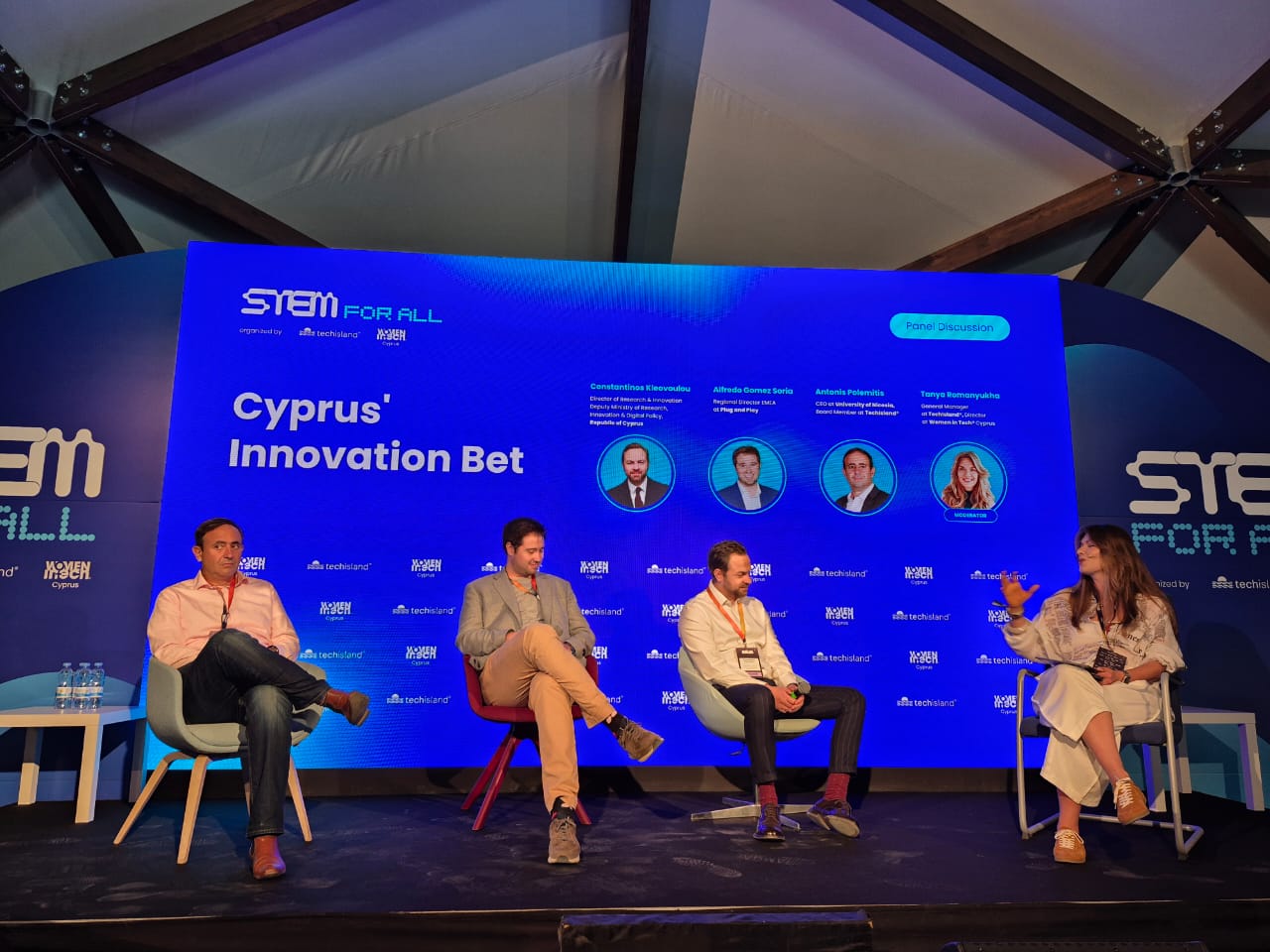
Cyprus has moved beyond talking about becoming a technology hub, but its next challenge is harder: turning new AI infrastructure, global partnerships and university-led research into companies that can compete internationally.
That was the central message of a panel discussion titled ‘Cyprus’ Innovation Bet’, held as part of STEM for All by TechIsland and Women in Tech Cyprus at the Pentagon Stage of the Doers Summit.
The panel, moderated by Tanya Romanyukha, General Manager of TechIsland, brought together Konstantinos Kleovoulou, Director of Research and Innovation at the Deputy Ministry of Research, Innovation and Digital Policy, Antonis Polemitis, CEO of the University of Nicosia, and Alfredo Gomez Soria, Regional Director EMEA at Plug and Play.
Opening the discussion, Romanyukha said Cyprus is no longer discussing the possibility of becoming a tech hub, but the reality now being built on the island.
“Five years ago, we were talking about Cyprus becoming a tech hub,” she said.
“Today, we’re not talking about potential anymore, we’re talking about reality,” she added.
Citing KPMG data presented earlier at the event, she said the tech sector now contributes 17 per cent to Cyprus’ GVA, with a total economic impact of €8.5 billion.
“That doesn’t happen by accident,” Romanyukha said, adding that “it happens through deliberate, coordinated action – and frankly, through people like the ones on this stage.”
That momentum, she said, “really started with one trip”, referring to President Nikos Christodoulides’ visit to Silicon Valley, where he met NVIDIA, Amazon, OpenAI and leading investment funds.
Out of that visit, Romanyukha said, three major developments are now taking shape in Cyprus: a national supercomputer in partnership with NVIDIA, a global accelerator through Plug and Play, and a joint degree between the University of Nicosia and Columbia University.
“We’ve gone from talking about a tech hub to building one,” she said.
But the discussion quickly moved from announcements to delivery, with speakers repeatedly pointing to the same question: whether Cyprus can make this new infrastructure accessible, useful and commercially relevant for startups, researchers and companies.
Kleovoulou said Cyprus identified a “critical gap” in its capacity to support AI and data-intensive research and innovation, which had forced academia, industry and government to rely increasingly on foreign providers.
That reliance, he said, created concerns around data sensitivity, sovereignty and long-term budgets.
As a result, Cyprus decided to invest in national high-performance computing and AI infrastructure, not on the scale of the huge data centres being built abroad, but at a level suitable for the country’s size and needs.
The aim, he said, is to give users across industry, academia and government the ability “to test, to pilot, and to develop their AI workloads and applications”.
At the same time, Cyprus created Pharos, which Kleovoulou described as an “AI factory antenna”, connecting the local ecosystem to Europe’s wider network of high-performance computing facilities and AI factories.
“So, essentially, what we have been doing, we are creating an edge machine to test, to pilot, to develop,” he said, adding that the ecosystem would then be able to access larger European machines in order to scale up.
The upgraded machine, hosted at the Cyprus Institute, is expected to open to the public around July, once calibration and validation work is completed with NVIDIA’s support.
Kleovoulou said the system had previously been available to some companies and researchers, but the addition of state-of-the-art GPUs and AI capability is expected to widen the pool of users.
Details on access, duration and cost are expected to be announced later, although he said the previous model included smaller pilot calls and larger competitive calls for more advanced projects.
The discussion then moved to Plug and Play, one of the partnerships expected to help Cyprus move from infrastructure to execution.
Romanyukha noted that Plug and Play operates in more than 60 locations globally, telling Gomez Soria “You could have gone anywhere, but you chose Cyprus.”
Gomez Soria said the move was strategic, because Cyprus already has many of the ingredients needed for an innovation ecosystem, including universities, government support, startups, investors, international companies and specialised talent.
For Plug and Play, he said, the role is to help founders expand, grow and gain the technical support they may have been missing, while also connecting them with international mentors and opening corridors to Europe, the MENA region and Central Asia.
He said Cyprus has “great talent” and “great human capital” coming out of universities, as well as diaspora returning to the island and people who have relocated to the country.
However, he also made clear that Cyprus cannot simply celebrate the progress already made.
“The big challenge, and this is not a Cyprus problem, this is a global problem,” he said, is the disconnect between research and development and its contribution to GDP.
He said industry also has to play a stronger role, particularly in sectors such as maritime, where Cyprus already has scale, expertise and international reach.
Plug and Play’s three-year programme in Cyprus will focus on energy, maritime, AI, gaming, fintech and industry-agnostic startups, with the goal of creating new opportunities, exports and jobs.
Asked what should happen after the three-year programme, Gomez Soria said the aim is for industry to become much more active and for corporates to take a bigger role in sustaining the ecosystem.
“We want the corporates to play the biggest role in the island as well,” he said.
He also said Cyprus needs more corporate venture capital, stronger partnerships between established businesses and startups, and local players that can take part in acquisitions and exits.
It should not be a case, he said, of international companies acquiring startups and leaving Cyprus as a back-office location.
“We need to make sure that also there is some consolidation, that the local players play a role in it,” he said.
For academia, the question was equally practical. What universities must now provide in a world where AI, global accelerators and specialised infrastructure are changing what students, researchers and founders need.
Polemitis said the University of Nicosia is preparing for the 2030s and for a world in which “any cognitive activity can be done in a data center”.
That means Cyprus must think carefully about where it can still build differentiated infrastructure.
“Our bet here is that the answer is biology,” he said, explaining that biological, health and environmental research depends on local data, local samples and physical infrastructure.
He referred to UNIC Evolve, the university’s research and ecosystem platform, saying the institution has so far invested €100 million and is aiming towards €1 billion.
The project, he said, is a Greece-Cyprus initiative combining AI teams in Cyprus with life sciences and deep omics infrastructure in Athens.
Cyprus alone, he said, is too small to support some of the necessary studies, but Greece and Cyprus together can provide the patient and participant populations needed.
Polemitis said this type of hard infrastructure matters because it can support a new class of startups that Cyprus currently does not have.
These are companies that need expensive, technical equipment, from gene sequencers to proteomics machines and specialist laboratories.
“Some of these machines are millions of euros each,” he said, adding that they also require technical staff.
The second part of the discussion turned to the startup world itself, which speakers said is changing quickly because of AI.
Romanyukha said founders can now ship in weeks what once took a year, often with much smaller teams.
Gomez Soria said this has changed what investors expect from founders.
The old pre-seed model, where a founder raised money simply to build an idea, is no longer enough, he said.
Today, many founders already arrive with a minimum viable product and early signs of traction.
For Plug and Play, which he said invests in more than 250 startups a year, even a first cheque now comes with higher expectations.
“We’re already looking for that traction, even for the first check,” he said.
He added that many founders are also reconsidering whether they need to raise money at all, especially if they can generate early revenue.
The obsession with unicorns, he said, has also shifted.
“The concept of unicorn has been burned down,” he said, while stressing that unicorns still matter.
For Cyprus, Gomez Soria said the mindset should be clear: companies may be built on the island, but they must be designed for international markets from the beginning.
“It’s built in Cyprus, but sell everywhere,” he said. The issue of talent then became one of the strongest parts of the panel.
Romanyukha said that with AI and remote work, geography matters less than before. “Our brightest minds can work for anyone, from anywhere,” she said.
Asked how Cyprus can move from a brain-drain narrative to one where ambitious Cypriots see the country as a launchpad, Polemitis said the same things that keep young talent on the island are also what can bring experienced diaspora professionals back.
He said many of the university’s best hires over the past decade have been Cypriot or Greek diaspora, including people with strong backgrounds in tech, research and life sciences.
Cyprus, he said, must provide “a home for specialised skills”.
A decade ago, he said, Cyprus was a strong place for accountants, but much harder for physicists, bioinformaticians and other specialised professionals.
Things have improved with the growth of the IT sector, but he said the ecosystem still needs a major cultural adjustment.
Polemitis was particularly direct on the pace required to compete with global technology centres.
“I don’t think the ecosystem still fully understands the pace and aggression of Silicon Valley,” he said.
He said Cyprus must tell young people that the technology sector is not easy, comfortable or forgiving.
“There is no free lunch,” he said, adding that “Tech is the most competitive market in the world. We have to work.”
He also warned against treating Cyprus as an end market.
Cyprus, he said, is part of the European Union and should think from day one about access to France, Germany, the US and other major markets.
“Cyprus should never be that end market,” he said.
Instead, Polemitis said, founders should use Cyprus as a base, while travelling more, building international networks and thinking much more aggressively about scale.





Click here to change your cookie preferences