
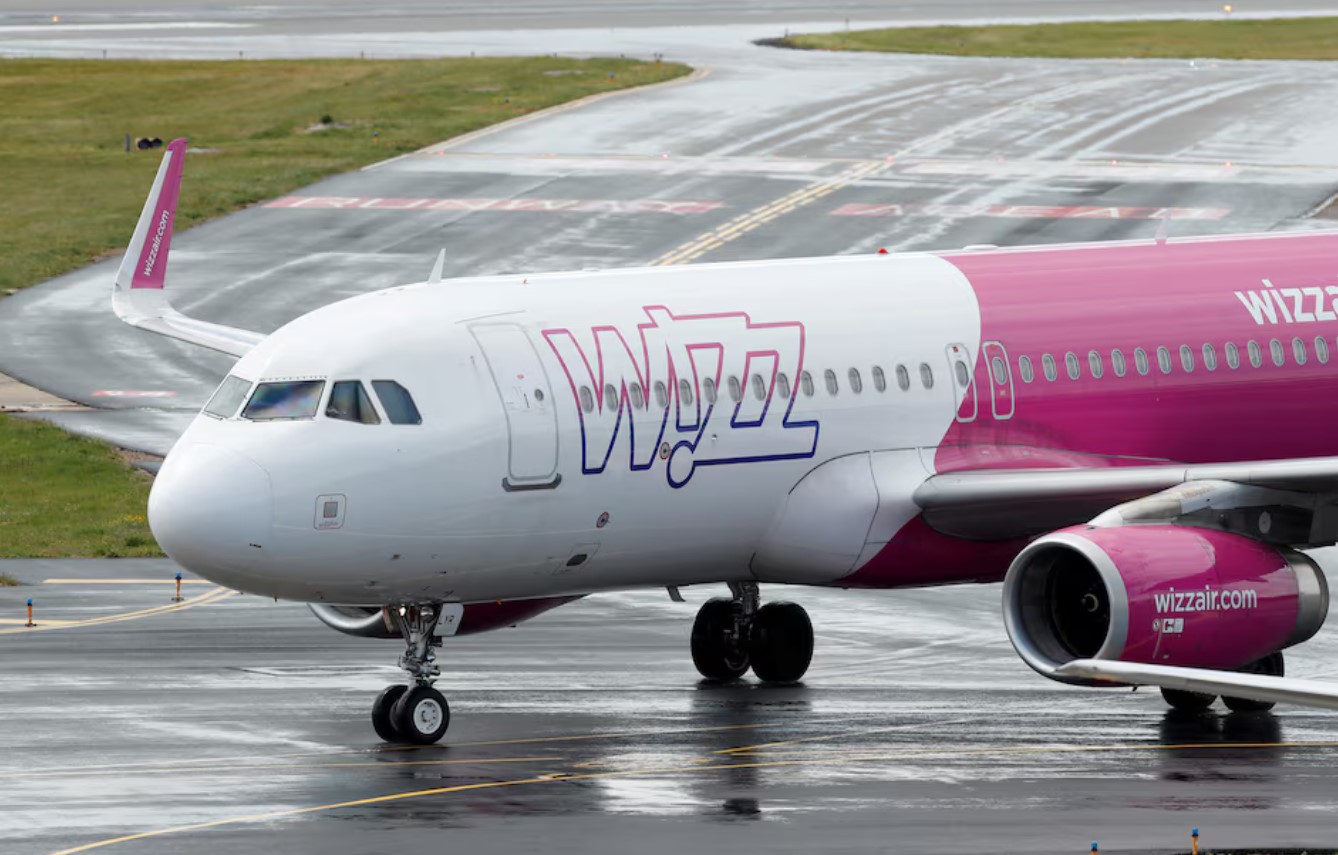
Budget airline Wizz Air announced on Monday that it plans to introduce Starlink connectivity across its fleet from 2027, becoming the first European ultra-low-cost carrier to deploy the satellite-based internet service.
The airline said installations will begin in 2027 and that all new-generation Wizz Air aircraft are expected to be equipped with the technology.
According to the company, passengers will be able to access high-speed, low-latency internet while travelling at cruising altitude, with the aim of providing a consistent onboard experience regardless of route.
The announcement marks a significant technological investment for the airline, which has traditionally operated in the ultra-low-cost segment.
“Ultra-low-cost travel has always been about making opportunities accessible to more people,” said Wizz Air chief commercial officer Ian Malin.
“In 2027, we’re taking that philosophy into the space era,” he said.
“Our customers shouldn’t have to choose between affordable fares and reliable internet onboard to stay connected to the people, work and moments that matter most,” he added.
“We’re proud to lead that change by collaborating with Starlink to bring maximum benefit to Wizz Air,” Malin said.
Starlink, operated by SpaceX, provides satellite-based broadband connectivity and has increasingly been adopted by airlines seeking to improve internet access for passengers.
“We’re thrilled to bring Starlink onboard Wizz Air and transform the travel experience for millions of its customers,” said Jason Fritch, vice president of Starlink Enterprise Sales at SpaceX.
“Keeping passengers and crew seamlessly connected at 30,000 feet is exactly what this technology was built to do,” he added.
“We look forward to delivering reliable, high-speed internet from departure to arrival,” Fritch said.
The rollout is expected to take place progressively from 2027 as aircraft are fitted with the required equipment.
The move comes as Wizz Air continues to expand its operations and invest in its network and onboard offering.
Last week, the airline announced that it would bring forward an increase in capacity from its Larnaca base, adding 57,500 extra seats during August and September 2026 in response to stronger-than-expected demand.
The additional capacity includes 24,500 seats in August and 33,000 seats in September.
The expansion affects routes linking Larnaca with Athens, Barcelona, Bucharest, Tel Aviv, Kutaisi and Iasi.
Among the changes, flights between Larnaca and Athens will resume on August 13, 2026, with 10 weekly services, before increasing to 14 weekly flights from September 23, 2026.
The airline is also increasing frequencies on several other routes from Cyprus as it responds to stronger demand during the late summer and early autumn period.





Click here to change your cookie preferences