
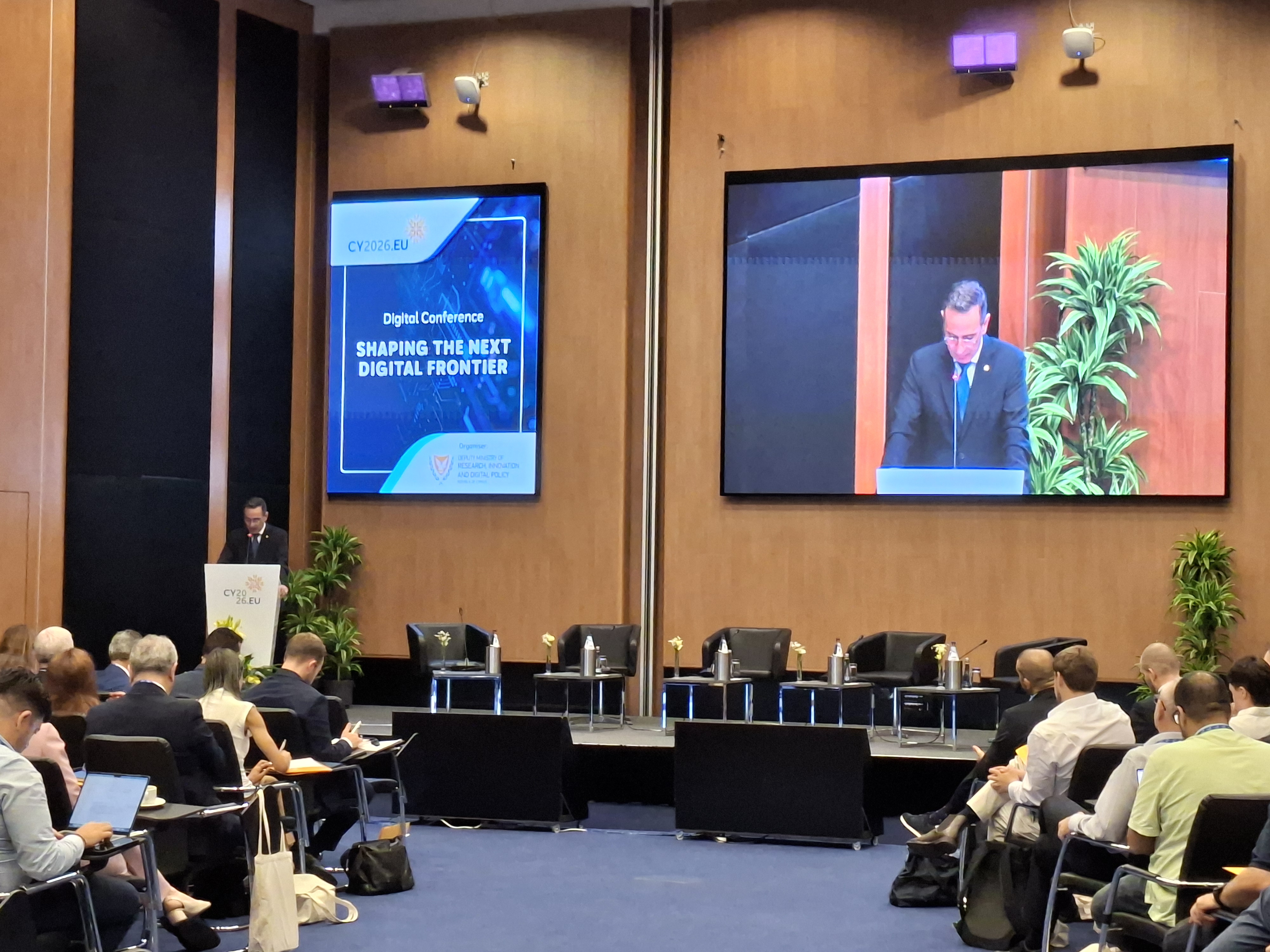
Deputy Minister highlights digital priorities at EU conference
Europe must move beyond regulation and become a builder, deployer and scaler of critical technologies, according to Deputy Minister of Research, Innovation and Digital Policy Nicodemos Damianou.
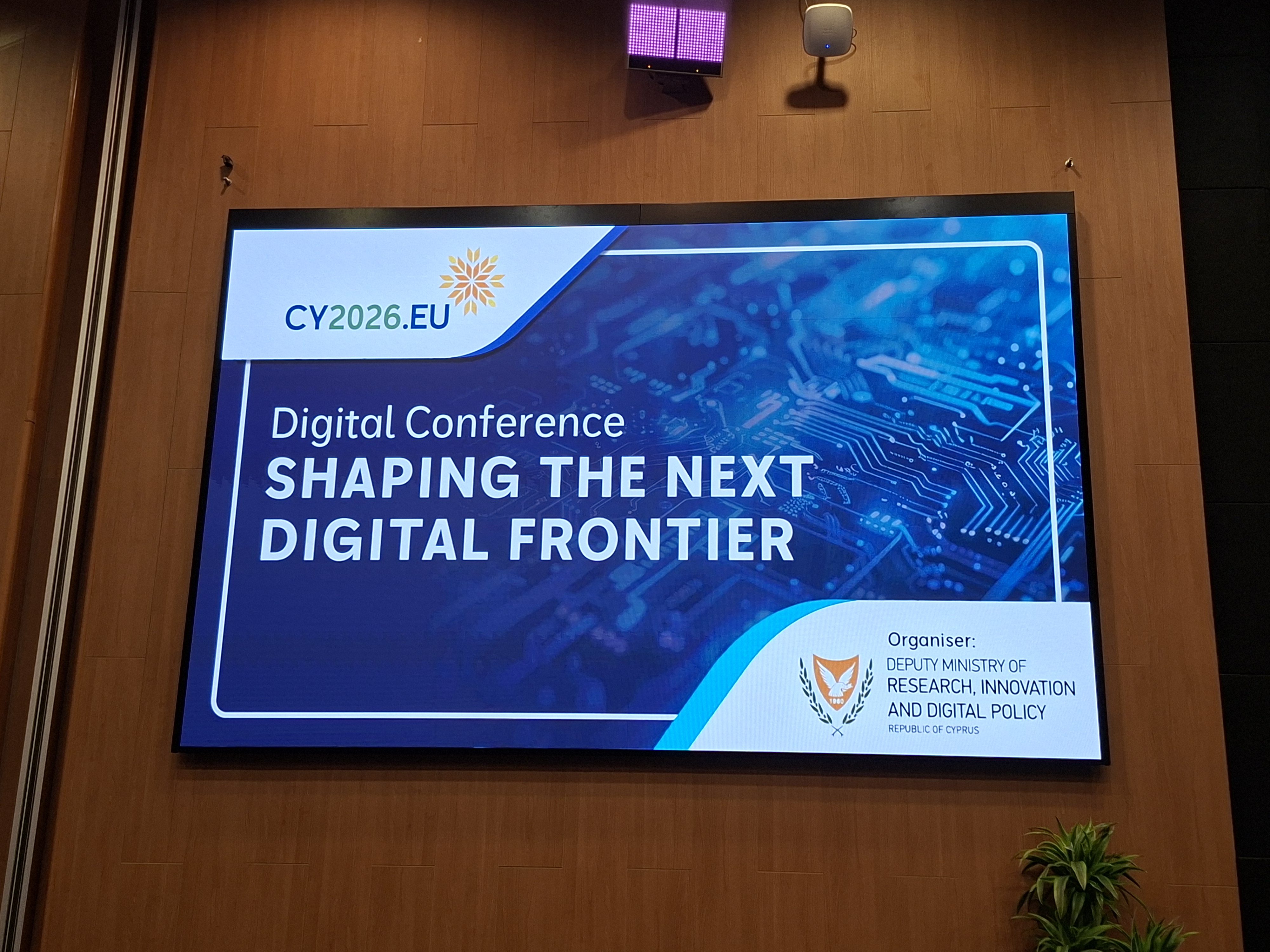
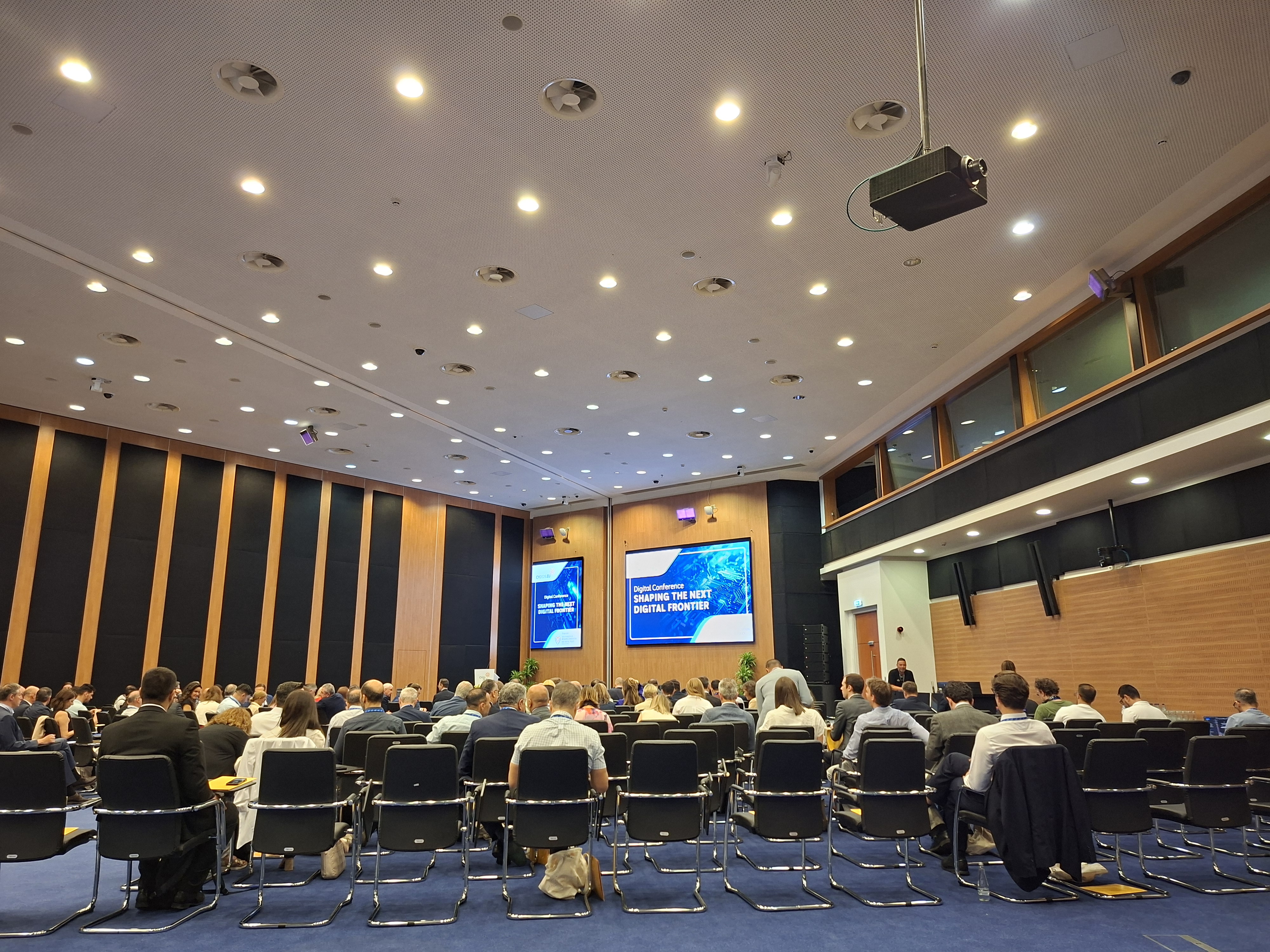
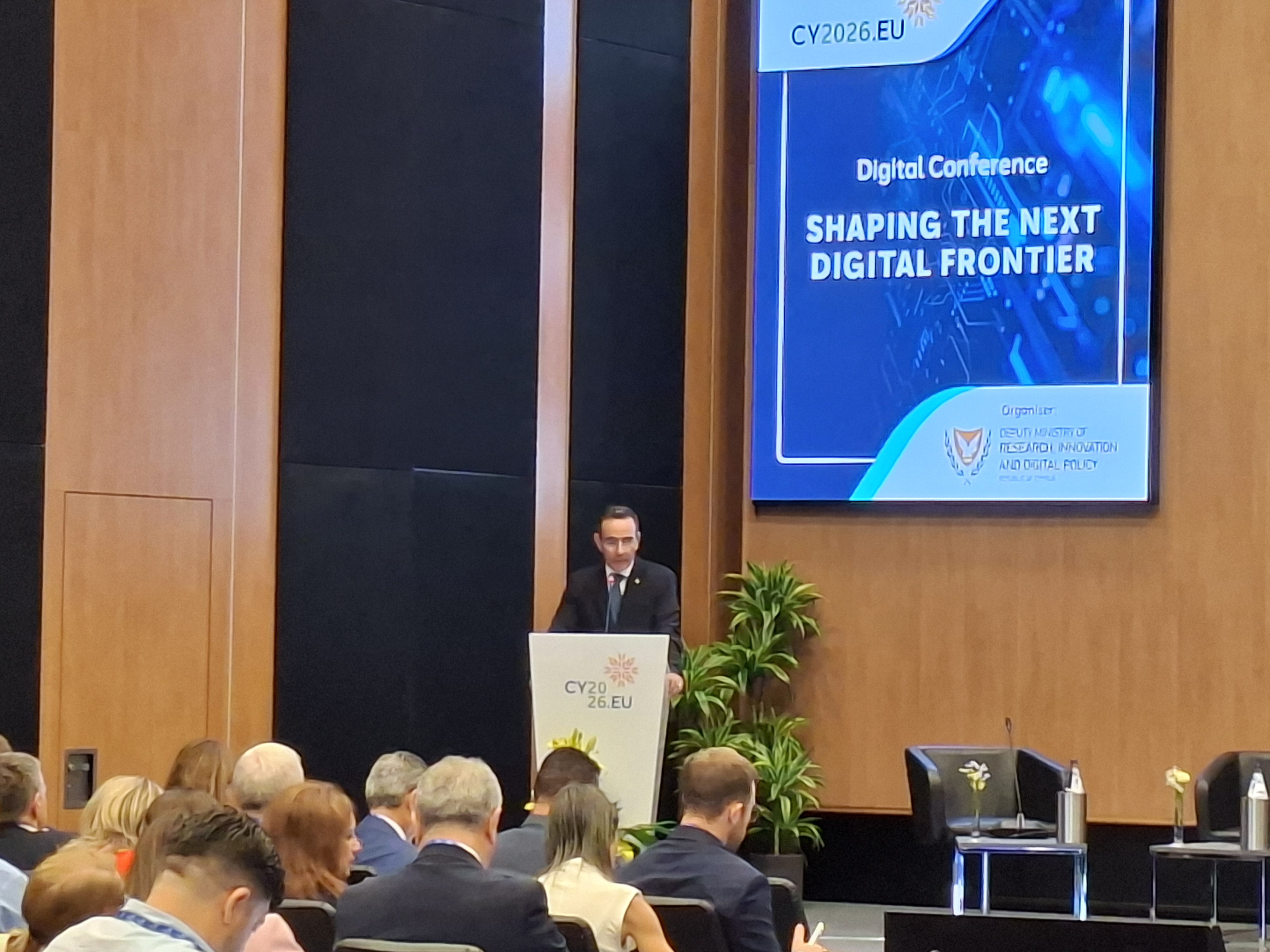
Speaking at the opening of the ‘Shaping the Next Digital Frontier’ digital conference in Nicosia on Tuesday, organised in the context of the Cyprus Presidency of the Council of the European Union, Damianou stressed that Europe could no longer afford to rely on technologies developed elsewhere and needed to compete on innovation, investment, speed and scale.
“Europe cannot afford to be merely a regulator of technologies developed elsewhere,” said the deputy minister.
“We must be a builder, a deployer, and a scaler of critical technologies,” he added.
Damianou said that technology had become a decisive factor in geopolitical influence, economic resilience and strategic relevance, while artificial intelligence was rapidly shifting from experimentation to widespread deployment.
He explained that cloud and data infrastructure had become strategic assets, connectivity was now essential for growth and social inclusion, and space technologies had evolved into critical infrastructure supporting digital services, climate monitoring, navigation and defence.
He also underlined that cybersecurity represented the foundation of trust supporting all of these capabilities.
According to Damianou, global competition in artificial intelligence, semiconductors, quantum technologies, cloud computing and space was intensifying, with governments and major international players investing heavily in infrastructure, computing capacity, talent and industrial ecosystems.
“Leading on trust, while competing on innovation, investment, speed, and scale,” was the approach Europe should follow, he said.
He argued that Europe already possessed world-class scientific excellence and pointed to European Commission data showing that the continent had a 30 per cent higher per capita concentration of AI researchers than the United States.
“But research alone is not enough,” Damianou said.
He described a paradox in which Europe generated outstanding ideas but accounted for only 8 per cent of global scale-ups, adding that the largest gap remained between research, innovation and digital deployment.
To address this, he said coordinated action was required and welcomed the presence in Nicosia of the Governing Board of the European Institute of Innovation and Technology, which had met in Cyprus the previous day.
Damianou argued that many promising entrepreneurs were forced to seek financing abroad and said startups required access not only to capital but also to data, computing resources, talent and supportive regulation.
He stressed that societies needed practical applications of AI rather than simply frameworks and pilot projects.
“We need AI in practice, in our hospitals, our public administrations, our SMEs, our energy systems, and our transport networks,” he said.
He also highlighted the importance of Earth observation technologies for climate monitoring and disaster response, as well as satellite connectivity to reach areas beyond the capabilities of terrestrial infrastructure.
The deputy minister used Cyprus as an example of how innovation ecosystems can evolve.
Building on a strong scientific base and success in Horizon Europe, he said the country’s startup ecosystem had become one of the fastest-growing in the world.
According to the StartupBlink index, Cyprus has recorded the highest startup growth rate in the European Union for three consecutive years, with the number of startups increasing fivefold since 2020.
Damianou also said that the technology sector contributes more than 15 per cent of Cyprus’ GDP, making it the fastest-growing sector of the economy.
Moreover, the sector accounts for one-third of foreign direct investment inflows, placing Cyprus second in the EU and tenth globally on a per capita basis.
He added that first-quarter figures showed that the country’s knowledge-driven economy was currently the fastest-growing in the European Union.
Cyprus, he said, was increasingly using its geographical position to act as a bridge between Europe and neighbouring regions and as a platform where technologies could be developed, tested and refined before being scaled across the single market.
“It is precisely this integrated model, where innovation capacity, technological capability, economic transformation, and outward-looking engagement intersect, that has guided the work of the Cyprus Presidency over the past six months,” he said.
Damianou also outlined several achievements pursued during the Cyprus presidency.
Regarding research and innovation, he said discussions on the next framework programme had focused on strengthening links between scientific excellence and market deployment, with member states aiming to reach a common position in the coming week.
On the Digital Single Market, he highlighted the agreement reached at Council level last week concerning the European Business Wallets, which will provide a harmonised digital identity system for businesses across the bloc.
He also referred to regulatory simplification and an agreement reached between the Council and the European Parliament on the AI Act.
According to Damianou, the agreement provided sufficient time for harmonised implementation while introducing a new provision prohibiting unlawful and harmful AI-generated content targeting children.
Protecting young people online, he added, had remained a consistent priority throughout the Cypriot presidency.
Discussions had progressed on both the digital age of majority and the creation of a common age-verification mechanism.
Damianou further highlighted progress on the Digital Networks Act and the cybersecurity package, describing them as essential to strengthening Europe’s investment capacity, resilience and digital single market.
He also said Cyprus had streamlined work on the EU Space Act, producing a full compromise text that clarified governance structures, responsibilities and the scope of the legislation.
Throughout these efforts, he said, Cyprus had remained guided by the presidency motto, “An Autonomous Union. Open to the World.”
“Technological sovereignty must never be misunderstood as isolation or protectionism,” said the deputy minister.
“On the contrary, it means possessing sufficient capabilities to make strategic choices with confidence,” he added.
Damianou said that a Europe investing in its own capabilities would become both more competitive and a stronger global partner.
He opened and concluded his address with the story of Panayiotis and Demetra, two pupils attending a primary school in the village of Kambos near Nicosia, which has only two students.
The children won third place in the local sCYence Fair in 2024, secured first place at the Youth Tech Festival in Limassol in 2025 with their robot “W.I.S.E Roby”, and later represented Cyprus at an international youth technology competition in Greece.
Through their teacher Christiana, they connected with Austrian Space Forum director Gernot Gromer, who travelled to Cyprus and spent a day discussing space exploration with them.
This year, Gromer returned to extend the experience to 100 pupils from neighbouring schools.
“What those two children demonstrated in a small classroom in Kambos is a lesson for Europe itself, that curiosity, collaboration, and a refusal to accept limitations can create opportunities far beyond what geography might suggest,” Damianou said.
“The next digital frontier will not be defined by infrastructure alone, nor by regulation, algorithms, or satellites alone,” he added.
“It will be defined by people,” the deputy minister stated. “By their talent, their ambition, and their willingness to transform bold ideas into lasting impact.”



Click here to change your cookie preferences