
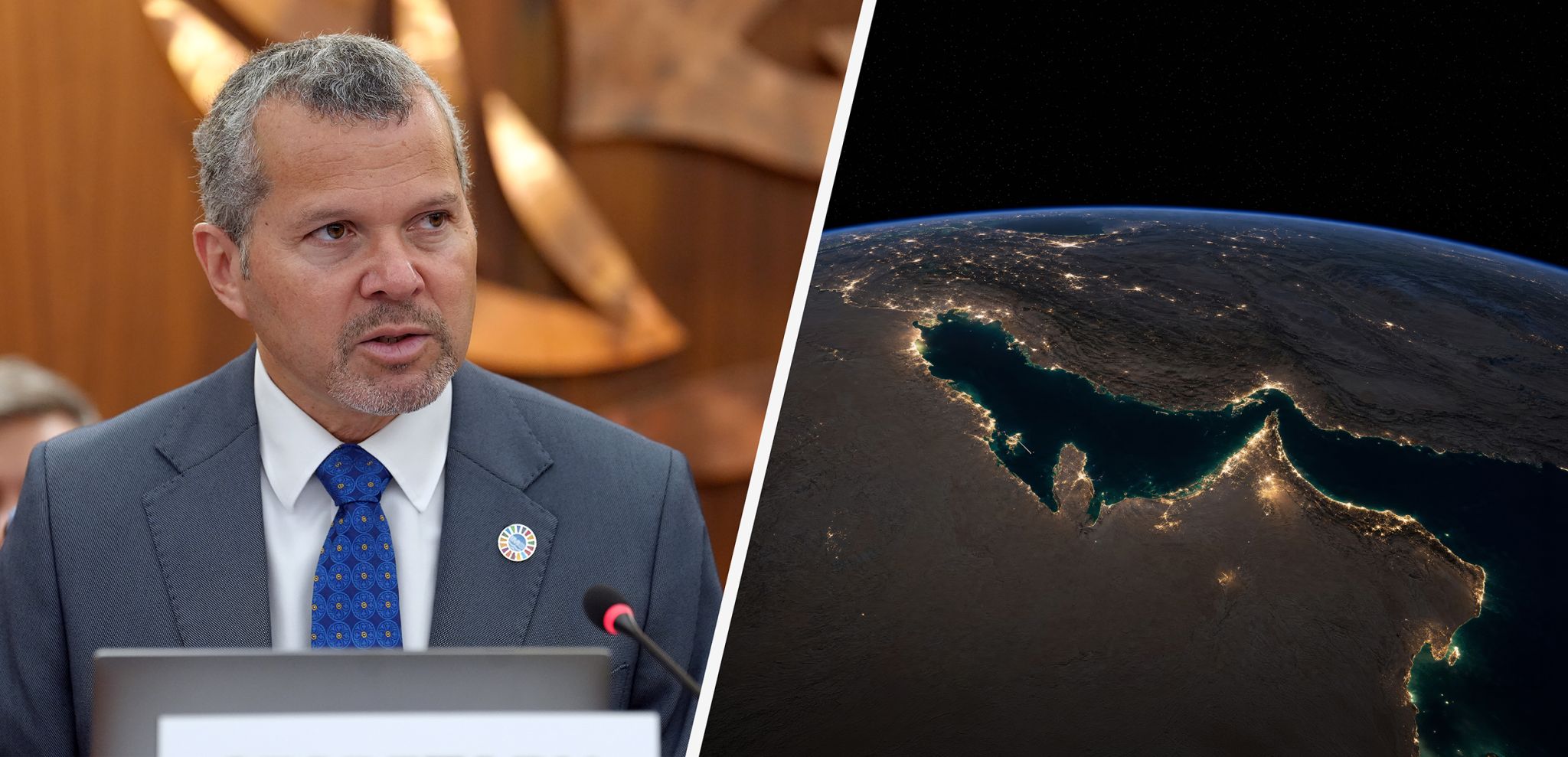
The International Maritime Organisation (IMO) has temporarily suspended its evacuation plan for vessels trapped in the Persian Gulf after an attack on a merchant ship in the Gulf of Oman, raising fresh concerns for seafarers, shipowners and major maritime centres such as Cyprus and Greece.
The UN shipping agency said the decision was taken after a vessel that had passed through the Strait of Hormuz was attacked. The vessel was not travelling under the IMO evacuation framework, but the incident was enough to halt an operation that had only just begun moving stranded ships and crews out of the region.
IMO Secretary-General Arsenio Dominguez said several vessels had already been successfully evacuated, but that the organisation now needed to reconfirm that the necessary safety guarantees remained in place.
“I have always reiterated that the safety of the seafarers remains paramount,” Dominguez said, adding that the evacuation plan would remain paused “until further clarity is obtained”.
The move comes at a delicate point for international shipping. The IMO had launched the evacuation plan earlier this week in cooperation with member states and industry, after months of disruption around the Strait of Hormuz, one of the world’s most important energy and trade routes.
The plan was designed to allow vessels to leave the Persian Gulf in a controlled and sequenced manner, rather than creating congestion in a narrow and highly militarised waterway. According to the IMO, around 11,000 seafarers were expected to be evacuated under the framework.
Reuters reported that by Wednesday morning, around 57 ships carrying about 1,100 seafarers had already used the routes before the pause was announced.
However, the attack in the Gulf of Oman has changed the calculation. The UK Maritime Trade Operations agency said a vessel had been hit by an unknown projectile off Oman, causing damage to the bridge.
No casualties or pollution were reported. AP later cited a US official as saying the ship had been struck by an Iranian drone, although the IMO did not identify either the vessel or those responsible.
The incident has also exposed the political sensitivity around the evacuation plan. Iran has challenged routes developed without its full approval, saying safe passage through Hormuz can only take place through sea lanes recognised by Tehran. Iranian authorities have also told ships to maintain contact with naval forces through international maritime channels.
That position creates a difficult operational problem for the IMO, coastal states and ship operators. Any evacuation from the Persian Gulf depends not only on technical routing, but also on political consent, military coordination and a clear understanding of who is guaranteeing safety at each stage of the voyage.
For Cyprus, the issue is far from remote. The island is one of Europe’s most important maritime centres, with the government promoting Cyprus as the largest third-party shipmanagement centre in Europe and among the top three worldwide. More than a fifth of the world’s third-party managed fleet is handled by companies based in Cyprus.
The Shipping Deputy Ministry previously told the Cyprus Mail that 19 ships under the Cypriot flag were in the Arabian Gulf region, adding that both the vessels and the seafarers on board were safe. Most of those ships, it said, operate in the region on a permanent basis and mainly provide specialised or auxiliary maritime services.
That exposure matters. Cyprus may not be a Gulf energy producer, but it is deeply connected to the movement of ships, crews, insurance, compliance and technical management. A prolonged disruption in Hormuz therefore feeds directly into the work of Cyprus-based shipmanagement companies, maritime lawyers, insurers, crewing departments and chartering teams.
It also reinforces the role Cyprus has tried to play in international shipping discussions, particularly through the Shipping Deputy Ministry, the Cyprus Shipping Chamber (CSC) and the Cyprus Union of Shipowners (CUS). For Limassol, where much of the island’s maritime cluster is concentrated, the crisis is another reminder that shipping risk is no longer limited to freight rates and fuel costs. It is increasingly about security, sanctions, routes, crew welfare and real-time political judgement.
Greece is even more exposed. Greek shipping remains the world’s largest national shipping force, with the Union of Greek Shipowners reporting a fleet of nearly 5,800 vessels, representing more than 19 per cent of global tonnage and 61 per cent of the EU-controlled merchant fleet.
Earlier in the crisis, Greece’s shipping ministry advised Greek-flagged vessels to avoid the Persian Gulf, Gulf of Oman and Strait of Hormuz, warning of heightened risks to navigation. Reuters also reported in March that at least 10 Greek-flagged ships were in the Gulf, with five more just outside it, while more than 325 ships of Greek interest were in the broader area.
Greek Shipping Minister Vassilis Kikilias described the situation as “alarming and worrying”, stressing that global shipping should be kept out of armed conflicts. His point goes to the heart of the current crisis. Ships may carry oil, gas, containers or dry bulk cargoes, but those operating them are civilian crews who have little control over the geopolitical forces around them.
That is why the IMO’s decision to pause the evacuation plan is important. It is not a sign that the operation has failed. Rather, it reflects the central problem facing the maritime community: moving ships out of danger cannot itself become another source of danger.
The timing is also significant. The announcement came on the Day of the Seafarer, marked this year under the theme “Carrying world trade. Carrying the risks”. Dominguez said the day emphasised the need to ensure that thousands of seafarers stranded in the Persian Gulf are not turned into collateral victims of a geopolitical conflict.



Click here to change your cookie preferences