
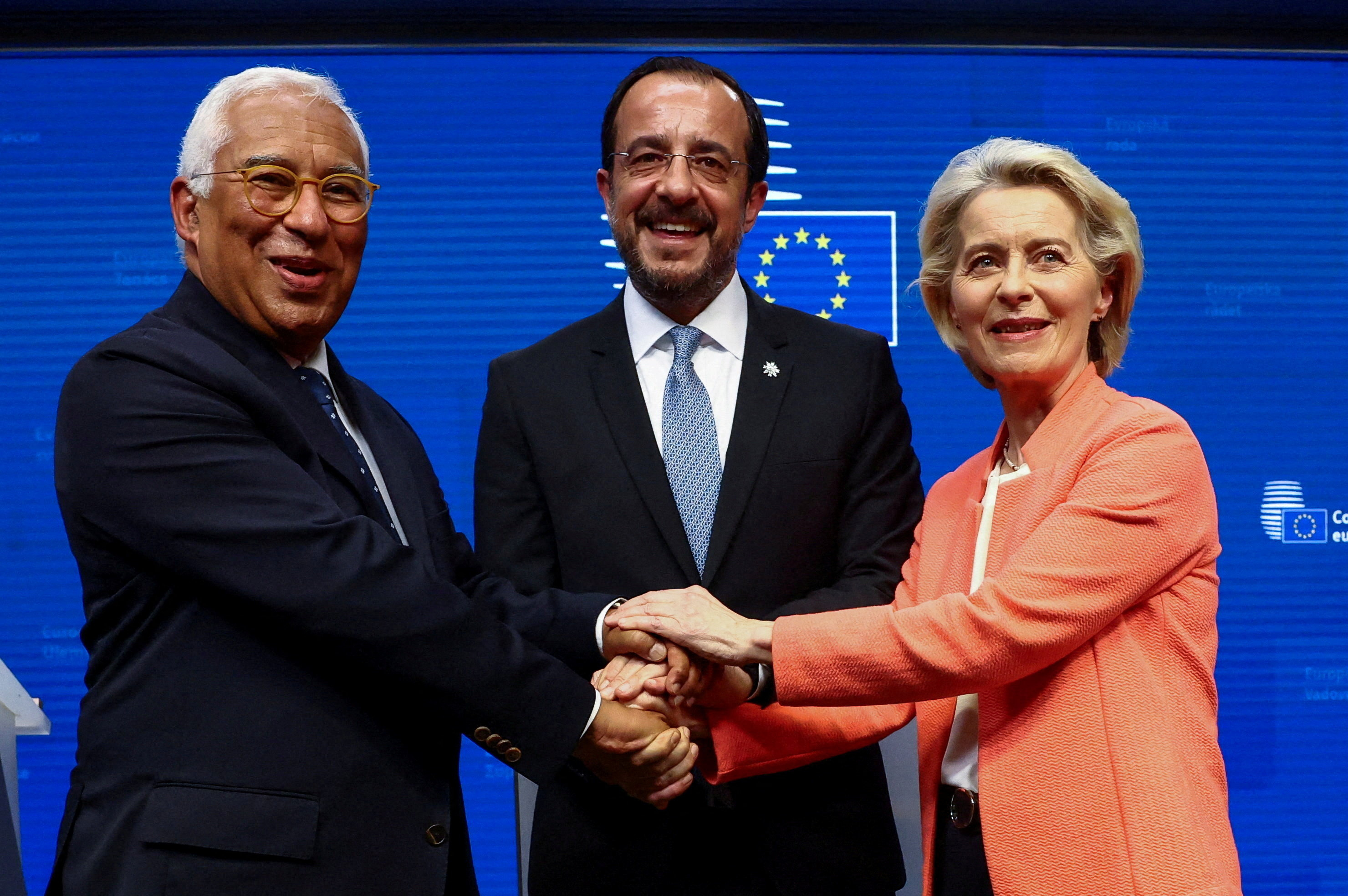
Cyprus’ presidency of the EU Council comes to an end today and will be taken over by Ireland from tomorrow. In the six months from January 1, the Cyprus presidency held three summits, 19 informal ministerial meetings and 52 formal ministerial meetings. The presidency went very smoothly, with President Nikos Christodoulides receiving congratulations and praise from the president of the European Council Antonio Costa and the president of the European Commission Ursula von der Leyen during a news conference after the conclusion of the European Council on June 19.
Costa praised the presidency for its achievements in the area of enlargement (such progress had not been seen in years, said von der Leyen) and for paving the way for budgetary negotiations. “You and your team can be very proud of what has been achieved,” said von der Leyen after giving a list of these achievements, which included agreements on a number of omnibuses, a common European system of returns, and air passenger rights. It was high praise indeed for the Cyprus presidency which got things done and showed that its public employees, when put under pressure, can work very efficiently.
When Cyprus took over the presidency, it announced that it would work for “a more autonomous union,” a rather nebulous objective. “This is Europe’s moment to define and reshape its future through an assertive autonomy trajectory,” said the presidency, explaining that it had set five “overarching priorities” that would lead to greater autonomy – security and defence readiness, competitiveness, open to the world, a union of values that leaves no-one behind, a long-term budget.
These were excessively ambitious plans, which would take a single state years to achieve and a union of 27 states with different agendas much longer than six months. There had been a tendency by Christodoulides and his spokesmen to exaggerate the plans and achievements of the Cyprus presidency, many of which existed in the realm of theory. Cyprus did not bring the EU closer to the Middle East, nor had it given practical effect to the mutual assistance clause. And if we carried out a realistic assessment, we would realise that the EU is not more autonomous now than it was on December 31, 2025.
These grand ambitions that could never be realised and the excessive importance attached to Cyprus’ administrative role was totally unnecessary. Our presidency did not reshape the future of Europe but it was extremely successful in ensuring everything went smoothly and providing a very competent administration of the presidency. It also had practical achievements to show, such as real progress on enlargement, the pact on migration and asylum and the revision of the Air Passengers Rights regulation, which had been in negotiation for 13 years.
These were real achievements, proof that Cyprus’ technocrats and ministers did an excellent job these last six months for which they deserve our congratulations.





Click here to change your cookie preferences