
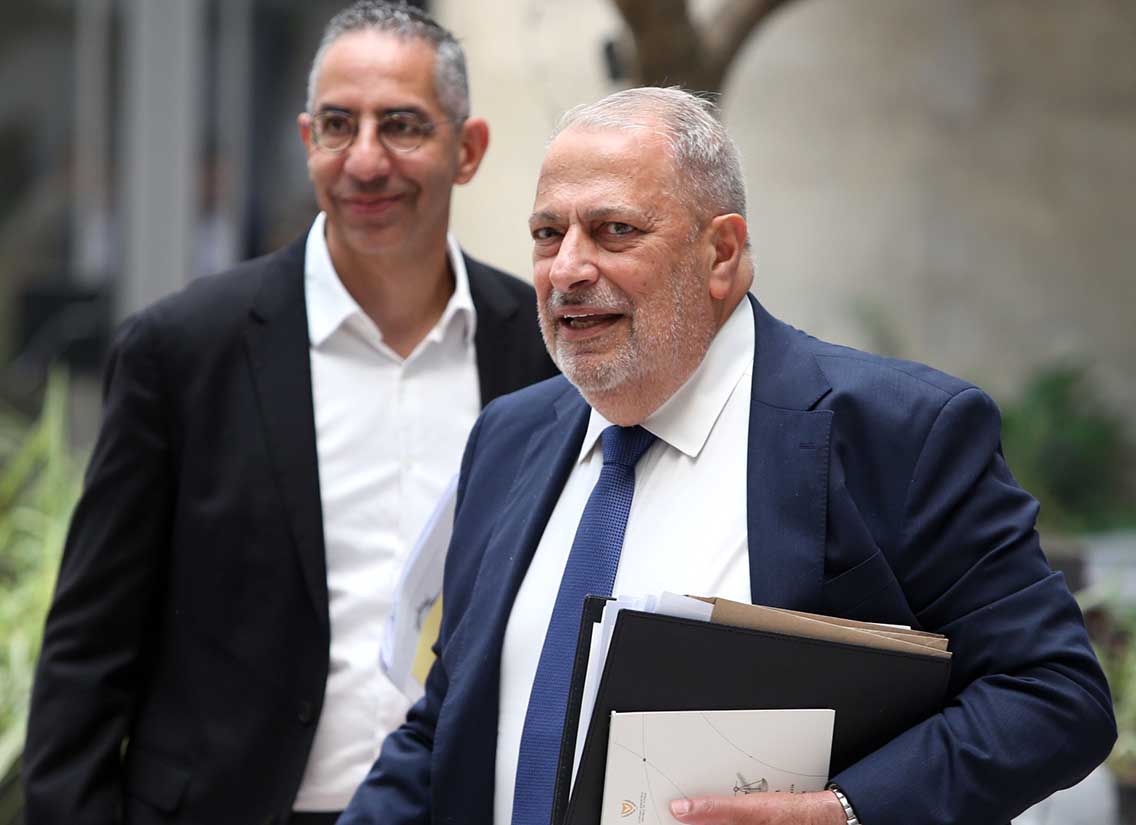
Attorney-general George Savvides on Wednesday defended his decision to recuse himself from the anti-corruption authority’s Mafia State report investigation, telling parliament that the move was necessary to preserve impartiality.
“If we had done the opposite, they would have hung us out to dry,” he said.
Appearing before the House legal affairs committee alongside deputy attorney-general Savvas Angelides, Savvides also confirmed that the file relating to the Sandy case is currently being examined by the Law Office, with prosecutors assessing the next steps, including whether criminal charges should be filed.
Responding to criticism over the handling of the Mafia State investigation, Savvides said the decision to step aside had been taken solely on grounds of objective impartiality.
His comments came after Akel MP Andreas Pasiourtidis argued that both the attorney-general and his deputy should resign to remove any perception of conflict of interest, saying the Law Office could not simply abstain from the process while acting as a “messenger”.
“The situation creates institutional deadlocks that cannot be broken,” Pasiourtidis said.
Savvides rejected the criticism, describing the office of the attorney-general as “a very lonely role” and insisting decisions are taken independently of public opinion.
“I have said from the first day we took office that, regardless of the noise, whether positive or negative, when we make decisions we completely isolate ourselves from the influence of public opinion,” he said.
Asked separately about the decision to release the convicted criminal Charalambos Chrysanthou, known as Hamburger, Savvides referred to a previous public statement issued by the Law Office, saying it addressed the questions that had been raised. While acknowledging the need for greater transparency, he said there were cases where full disclosure was impossible because of ongoing criminal proceedings and other legal interests.
He added that improving the Law Office’s public communication was currently under consideration.
The committee also discussed the long-running proposal to separate the constitutional roles of the attorney-general as legal adviser to the state and as public prosecutor.
Savvides said the issue was not one of personal preference but of constitutional design.
“If we were drafting the Constitution today, I could see the advantages of separating the roles,” he said. “At the same time, I believe there are significant advantages in keeping criminal prosecution together with the other legal functions of the Law Office.”
He confirmed that although he had signed the explanatory report accompanying the government’s draft legislation on the matter, he had explicitly recorded his reservations regarding its constitutionality and attached detailed legal opinions supporting that position.
“Had I refused to sign the explanatory report, I would have been accused of blocking the bill and creating an institutional deadlock,” he said.
Outlining the Law Office’s priorities, Savvides described lawful interception of communications as the most important tool in combating corruption and organised crime.
“There can be no effective fight against corruption without this tool, provided it is always used within the constitutional and legislative framework,” he said.
He added that protecting society from corruption and organised crime should not automatically give way to the rights of those accused of serious criminal offences.
Another priority, he said, is new legislation dealing with abuse on social media, online insults and the organised spread of false information.
Savvides said discussions with the justice ministry were continuing and that draft legislation would be submitted as soon as possible.
Regarding the Mafia State investigation, Savvides said the inquiry was progressing and that a substantial part of the process would be completed in the coming days.
Once investigators have completed their work and prosecutors have assessed the evidence, the Law Office will decide how to proceed strictly on the basis of the law and the available evidence, he said.
He added that any decision on appointing an independent public prosecutor would depend on the findings of the investigation.
Committee members also raised concerns over delays in the Cypriot justice system, the possible introduction of video recording in court proceedings and broader judicial reform.
Savvides replied that policymaking was not the responsibility of the attorney-general, whose role is limited to legal scrutiny of draft legislation, but noted that significant improvements had already been made in reducing delays, particularly in administrative cases.
Angelides said protocols had already been revised following rulings of the European Court of Human Rights and that training programmes for officials were being implemented.




Click here to change your cookie preferences