
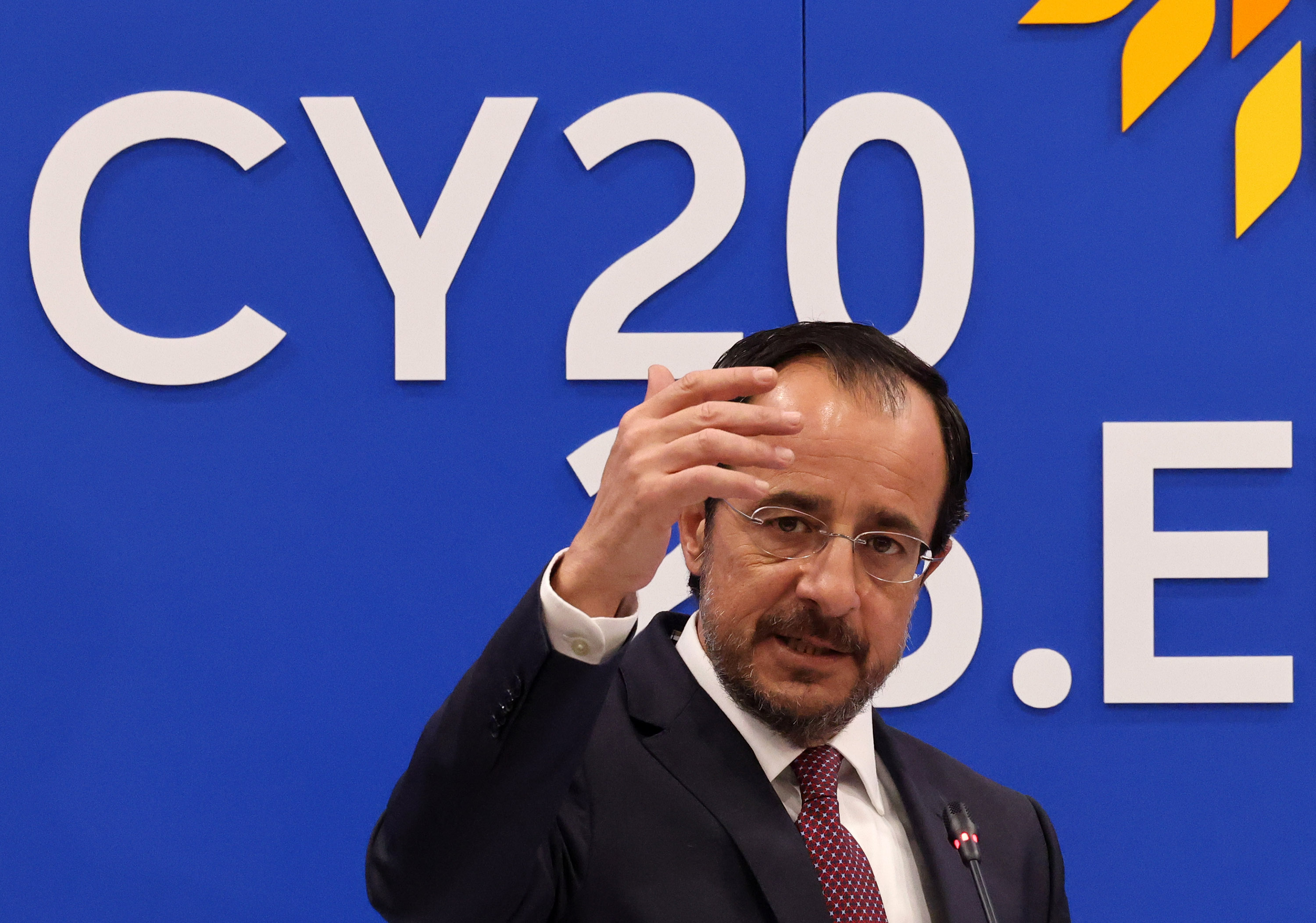
Cyprus has emerged from its presidency of the Council of the European Union stronger, more influential and better equipped to advance its national interests, President Nikos Christodoulides said on Wednesday, arguing that the six-month term had generated lasting political capital that extends well beyond its legislative achievements.
Presenting the government’s assessment of the presidency alongside Deputy Minister for European Affairs Marilena Raouna and Foreign Minister Constantinos Kombos, Christodoulides said the true measure of success was not the number of agreements reached but the credibility Cyprus had earned among its European partners, the institutional expertise developed across government and the stronger position from which it can now pursue both European and national priorities.
“The end of the presidency is not the end of our effort. It is the beginning of a new responsibility,” he said.
Christodoulides said Cyprus had assumed the presidency on January 1 during one of the most difficult geopolitical periods in recent years, marked by the wars in Ukraine and the Middle East, growing economic uncertainty and mounting pressure on Europe to respond more quickly and decisively to global crises.
Against that backdrop, he said Cyprus had done more than simply chair meetings of the Council of the EU, helping instead to build consensus on difficult decisions at a time when Europe required unity, strategic direction and effective leadership.
He said that the presidency had significantly strengthened Cyprus’ credibility within the European Union, creating political capital that the government now intends to use to advance the country’s strategic priorities, including efforts to reunify the island.
“We served the common European interest with consistency, credibility and a sense of responsibility,” he said. “That has strengthened, to a significant degree, our ability to pursue our national objectives, including the Cyprus problem.”
The president also announced that the legacy of the presidency would become permanent, saying the government would retain the Deputy Ministry for European Affairs while transforming the Presidency Secretariat into a permanent structure coordinating European affairs across government.
He said the expertise, cooperation and institutional culture developed over the past two and a half years should not be lost, describing them as “valuable national capital” that would continue serving Cyprus long after the presidency had ended.
Raouna said the conclusion of the presidency marked both the end of a major chapter in Cyprus’ European journey and the beginning of a new one, with the experience gained now becoming a lasting asset for the public service.
Among the presidency’s legislative achievements, Cyprus concluded negotiations on 27 of the 32 political trilogue files it inherited, representing a success rate of more than 84 per cent.
The presidency also secured agreement on 41 general approaches and 22 Council conclusions, completed 10 legislative simplification proposals and obtained negotiating mandates for another four.
Cyprus also hosted more than 230 official events across the island involving almost 25,000 participants, including the informal meeting of European leaders, 19 informal ministerial meetings, the visit of the College of Commissioners, the Conference of Presidents of the European Parliament and the high-level conference on islands and coastal regions.
She said the programme included visits to the Green Line, enabling senior European officials to witness first-hand the consequences of Turkey’s occupation on European territory, while more than 500 artists participated in cultural events held across 31 countries.
Kombos said the presidency had been exercised during a period of multiple international crises but had strengthened Cyprus’ diplomatic footprint and earned recognition from EU institutions, member states and international partners.
He said two priorities established before the presidency – strengthening relations with neighbouring countries and highlighting the strategic importance of maritime transport – had become central issues for the European Union itself as geopolitical tensions intensified.
Among the presidency’s diplomatic successes, he highlighted regional participation in the informal European Council meeting and the Gymnich meeting of EU foreign ministers, as well as progress on enlargement, including advances involving Montenegro and Albania and the opening of negotiating chapters for Moldova and Ukraine.
The president also pointed to progress made during the presidency on defence mobility, implementation of the EU’s mutual assistance clause under Article 42.7, the Safe defence financing instrument, measures to boost European competitiveness, reforms on air passenger rights, critical medicines, affordable housing, island policy and efforts to strengthen Europe’s strategic autonomy.
He said the presidency had also reinforced Cyprus’ role as a bridge between Europe and the wider Middle East, helping persuade European partners of the region’s strategic importance while strengthening Cyprus’ own diplomatic standing.
“The greatest success is not only what we achieved during these six months,” he said. “It is that we proved to ourselves that our country can achieve ambitious goals when it works with planning, coordination and self-confidence.”





Click here to change your cookie preferences