
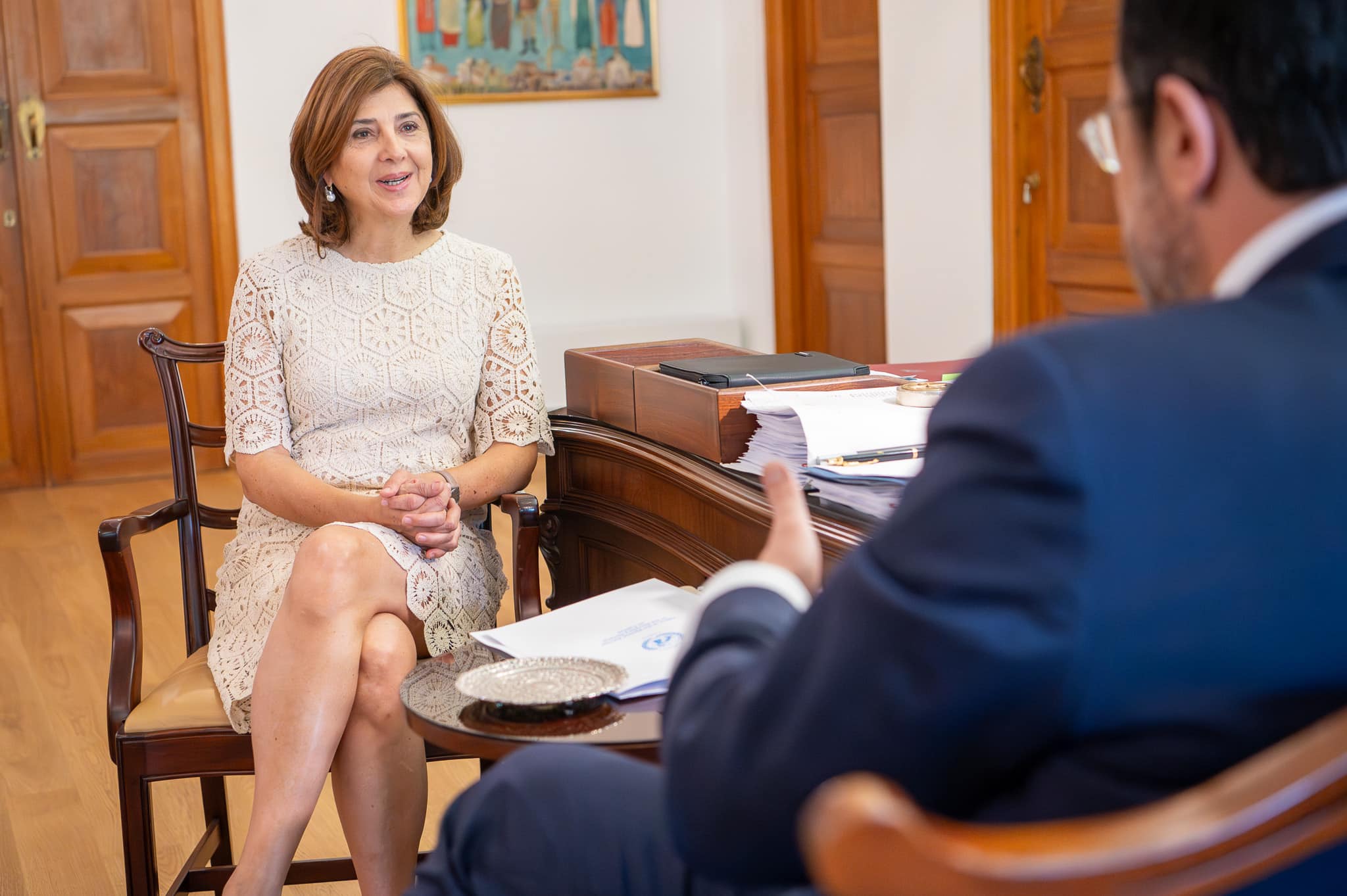
UN Secretary-General Antonio Guterres’ personal envoy on Cyprus Maria Angela Holguin Cuellar, is exploring ideas for a new Cyprus settlement framework aimed at bridging the gap between the two sides, Britain’s Independent newspaper said on Monday.
It stressed that the proposals do not constitute an official United Nations plan but rather ideas being considered to help revive negotiations.
According to the report, the framework would be based on two constituent states enjoying political equality, while significantly limiting the powers of the federal government.
Most day-to-day governance would remain with the two constituent states, with a small central administration responsible only for competencies that could not be exercised separately.
Among the ideas outlined are an alternating presidential council headed by the two leaders, with a 2:1 or 3:1 rotation in favour of the Greek Cypriot side; a supreme council made up of Greek Cypriot and Turkish Cypriot representatives instead of a directly elected federal parliament; a joint cabinet comprising five or six ministries, including foreign affairs, defence, interior and citizenship, finance and European affairs; a requirement that at least one Turkish Cypriot minister cast a decisive vote on key cabinet decisions as a guarantee of political equality, a proposal the newspaper says is likely to prove contentious.
The report also says one of the most difficult issues remains security.
It notes that the Republic of Cyprus continues to seek the withdrawal of Turkish troops from the island, while the Turkish Cypriot side maintains that their presence remains essential for the security of the Turkish Cypriot community.
Regarding the 1960 system of guarantees, the newspaper claims one option under discussion is replacing the roles of Britain, Greece and Turkey with a NATO-backed security mechanism, potentially involving a small multinational military presence on the island.
According to the report, the UN is also considering a transitional period of two or three years, beginning with the return of territory starting from Varosha, alongside the gradual implementation of the Turkish Cypriot side’s longstanding demands for direct trade, direct flights and direct international contacts. The proposals reportedly also envisage easing Turkish restrictions, including allowing Cypriot-flagged ships access to Turkish ports.
The newspaper further suggested that progress on exploiting the island’s offshore natural gas resources could be linked to a broader package involving EU-Turkey relations, including the possible modernisation of the EU-Turkey Customs Union.
Citing unnamed sources, the report claimed Turkish Cypriot leader Tufan Erhurman appears more willing to negotiate such a framework, while President Nikos Christodoulides is portrayed as more cautious.
However, Cyprus’ deputy high commissioner in London Spyros Miltiades told the newspaper that no official UN proposal exists.
“As far as I am aware, there is no official United Nations proposal to which either side has been invited to respond,” he said.
“The ideas circulating appear to be more hypothetical than a concrete proposal or plan. Any meaningful progress must emerge through the established UN-led process and within the agreed United Nations parameters.”
Holguin herself dismissed similar reports earlier this month.
Speaking on July 1, she said there was “not a single written word” originating from her, describing previous reports as “the product of rumours and misunderstandings”.
She added that her focus remains on listening to both sides and exploring options that could create the conditions for the resumption of formal negotiations.




Click here to change your cookie preferences