
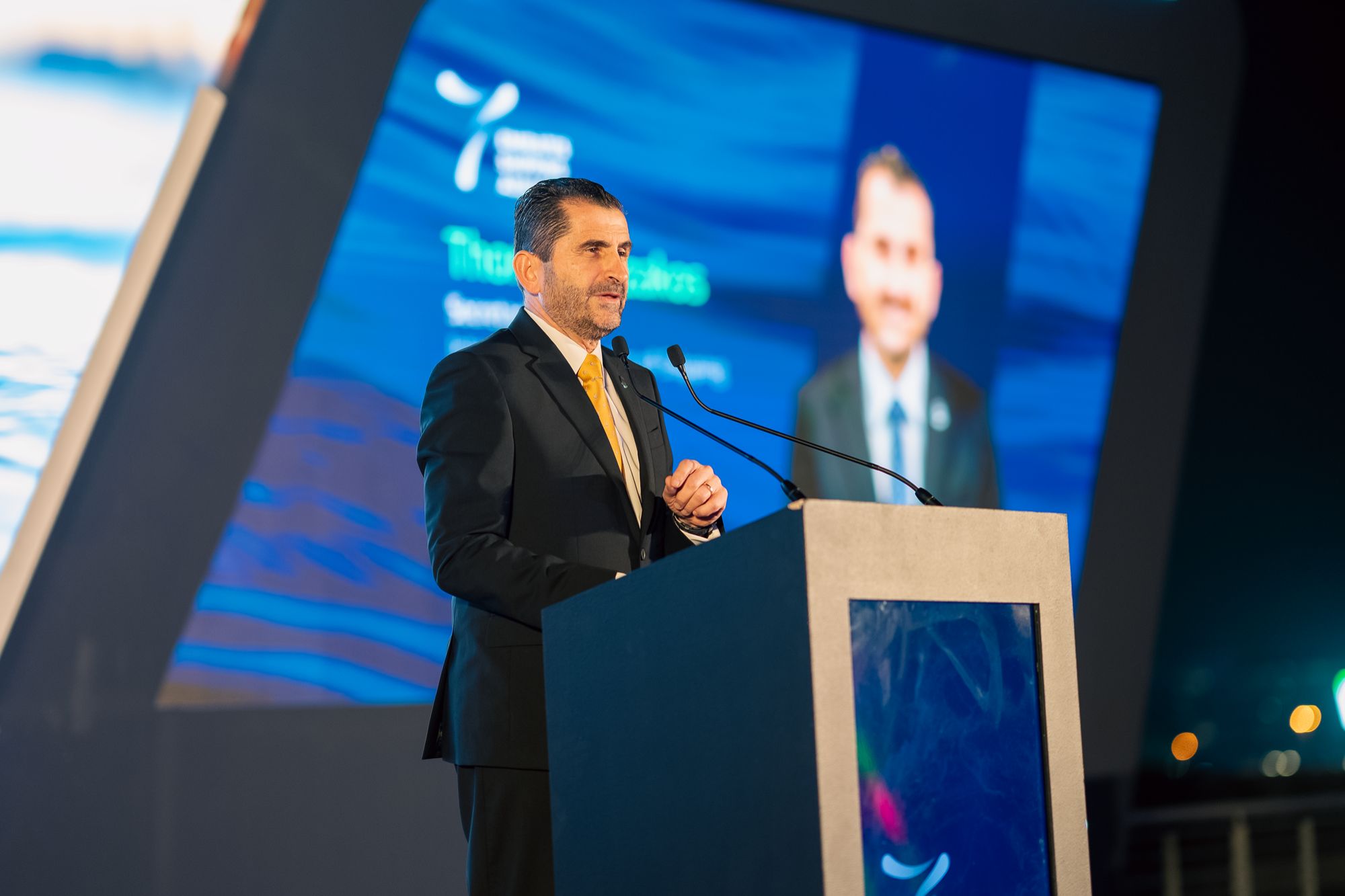
Cypriot shipping executive Thomas Kazakos, Secretary General of the International Chamber of Shipping (ICS), has called for an immediate end to attacks on commercial vessels in the Strait of Hormuz, warning that seafarers are once again paying the price for a conflict in which they have no involvement.
Kazakos issued the warning following the latest attack on shipping in the strategic waterway, during which one Indian seafarer was killed and eight others were injured, four of them seriously, after two Emirati oil tankers were struck by Iranian cruise missiles.
The very large crude carriers Mombasa B and Al Bahyah, operated by the shipping arm of Abu Dhabi state oil company ADNOC, sustained significant damage after fires broke out while they were transiting the southern lane of the Strait in Omani territorial waters. The fires were subsequently brought under control, while Iran’s Islamic Revolutionary Guard Corps claimed responsibility for striking two tankers that it said had ignored repeated warnings.
Responding to the loss of life, Kazakos said that “once again seafarers have, through no fault of their own, been placed in harm’s way and sadly another seafarer has lost their life,” adding that “these unjustified attacks on commercial shipping must stop.”
The incident marked another escalation in the Strait, where shipping conditions have remained highly volatile since the conflict began on February 28. Several commercial vessels have been struck in recent weeks, while tanker and gas carrier traffic has fallen sharply as shipowners assess the risks facing their vessels and crews.
At the same time, Kazakos strongly rejected attempts to impose charges, restrictions or new clearance requirements on vessels passing through the waterway. His intervention followed US President Donald Trump’s announcement that Washington would reinstate a blockade on Iranian shipping and seek a 20 per cent charge on cargo passing through the Strait in return for US protection.
Kazakos said “the principle of freedom of navigation has been sidelined during the war, hindering global trade and crucial energy supply routes,” stressing that “there is no legal mechanism by which a toll or restrictions can be placed on vessels passing through the strait.” He therefore encouraged all countries to uphold what he described as a fundamental principle of maritime law.
The IMO Council has taken a similar position, reaffirming that passage through the Strait must remain free from tolls and charges under international law. It also stressed that any arrangement introduced by states in the region must guarantee the non-discriminatory and unimpeded right of transit passage for all vessels using the internationally recognised shipping lanes.
Concluding his statement, Kazakos said “everyone must now focus on a permanent return to vessels being able to pass through the Strait of Hormuz unimpeded without paying a toll or other clearance mechanism.”
The waterway remains central to international energy markets. Around 20 million barrels of oil per day passed through the Strait in 2024, equivalent to approximately 20 per cent of global petroleum liquids consumption and more than one-quarter of worldwide seaborne oil trade. Around one-fifth of global liquefied natural gas trade also passed through Hormuz, primarily from Qatar.
Meanwhile, hundreds of ships and around 6,000 seafarers remain stranded in the Persian Gulf, according to the IMO, further emphasising the human and commercial consequences of the continuing instability.




Click here to change your cookie preferences