
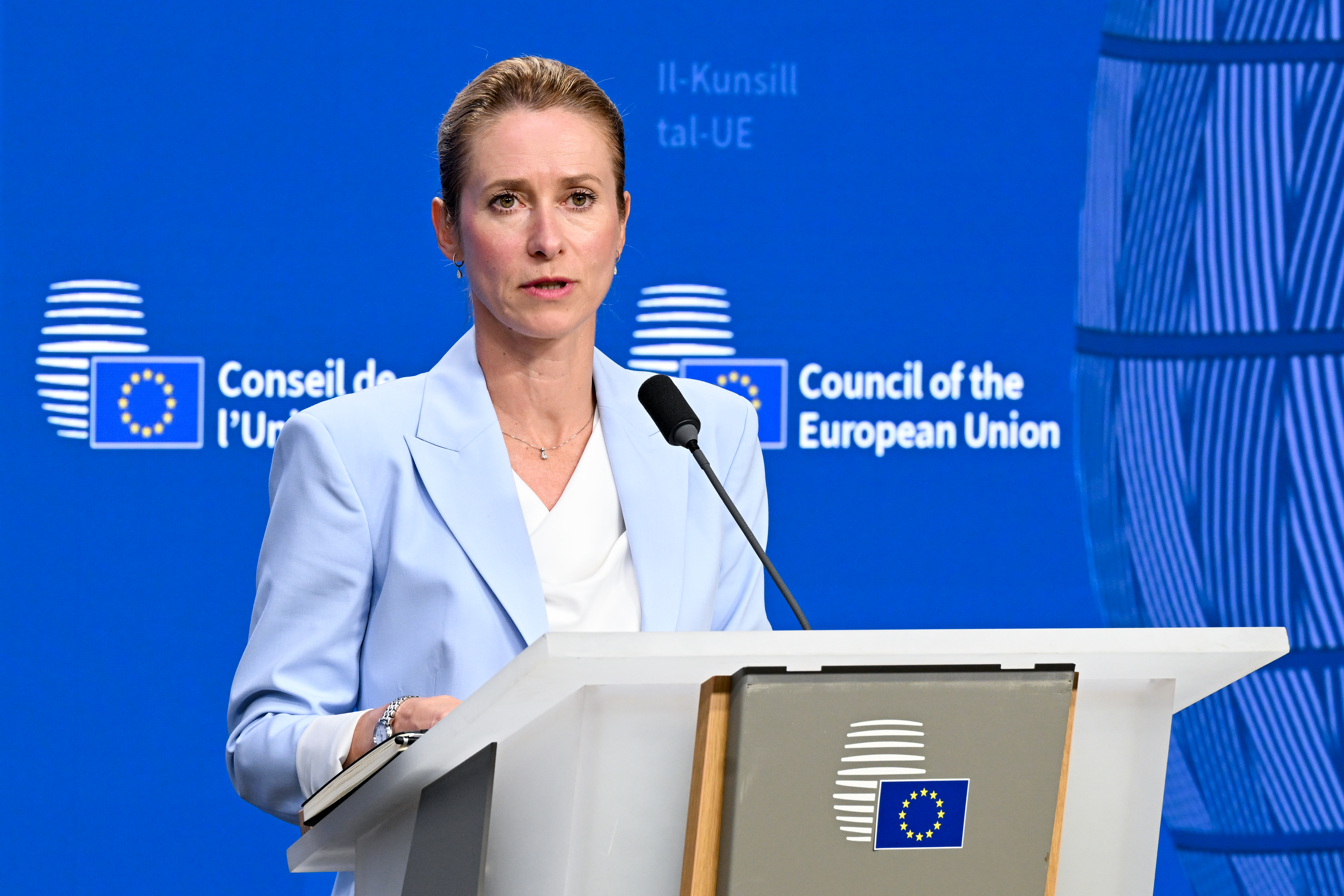
The European Union’s foreign policy chief Kaja Kallas on Monday called on Turkey to “respect” the Republic of Cyprus’ sovereignty, after Turkey and the Turkish Cypriot authorities had last week signed an agreement which foresees the construction of a natural gas pipeline between Turkey and Cyprus.
“On the eastern Mediterranean, Cyprus raised Turkey’s plan for a gas pipeline with the island. The EU expects Ankara to respect the sovereignty and sovereign rights of all member states,” she said at the conclusion of the day’s meeting of the EU’s 27 foreign ministers.
Her comment comes after the Cypriot foreign ministry had said that Foreign Minister Constantinos Kombos would raise the matter of the natural gas pipeline agreement at the meeting, saying that he would “denounce Turkey for its new illegal actions”, having already declared the agreement “illegal” within hours of it being signed last Friday.
“The ‘memorandum’ in question, which was signed during the illegal visit of [Turkish Vice President Cevdet Yilmaz] to the occupied territories of the Republic of Cyprus, constitutes yet another manifestation of Turkey’s revisionist policy in the eastern Mediterranean,” it said at the time.
It added that the agreement is “part of ongoing efforts to consolidate faits accomplis of the occupation and the further integration of the occupied areas with Turkey”.
Hours earlier, Yilmaz had said that “Turkey will continue to support the TRNC in achieving a strong infrastructure and a highly competitive and sustainable economic structure”.
“This step taken in the energy sector will be a historic turning point in cooperation between the two countries,” he said.
Meanwhile, Turkish Cypriot ‘prime minister’ Unal Ustel had said that “the project is not for today, but for future generations”, and that “it is a demonstration of our will to leave a stronger, more sustainable, and more competitive country for our children”.
On the political front, he said that the signing of Friday’s agreement “sent a strong message to the eastern Mediterranean”,
“The Turkish Cypriot people are present in this region, have deep roots, and are building their future with their sovereign will. With the strong support of their motherland, Turkey, they will continue on their path. We know that where Turkey is, there is security, and where Turkey is, there is strength,” he said.
Turkish Energy Minister Alparslan Bayraktar had explained the technical aspects of the pipeline, saying that t will stretch from the town of Anamur, which sits on Turkey’s Mediterranean coast in the Mersin province, to the Teknecik power station, located just outside Kyrenia.
Anamur is located between the cities of Mersin and Alanya, with work currently underway to connect those two cities with a natural gas pipeline. At present, Mersin is supplied by natural gas flowing from Azerbaijan via Georgia, and from Turkmenistan via Iran.
Bayraktar also said that the project would in fact consist of two parallel pipelines, each 22 inches (56 centimetres) in diameter, thus allowing the system to be “bidirectional”, meaning that natural gas will be able to be transported to Cyprus from Turkey, and to Turkey from Cyprus.
The pipelines will stretch a total of 101 kilometres, of which 97km will be under the Levantine Sea.





Click here to change your cookie preferences