
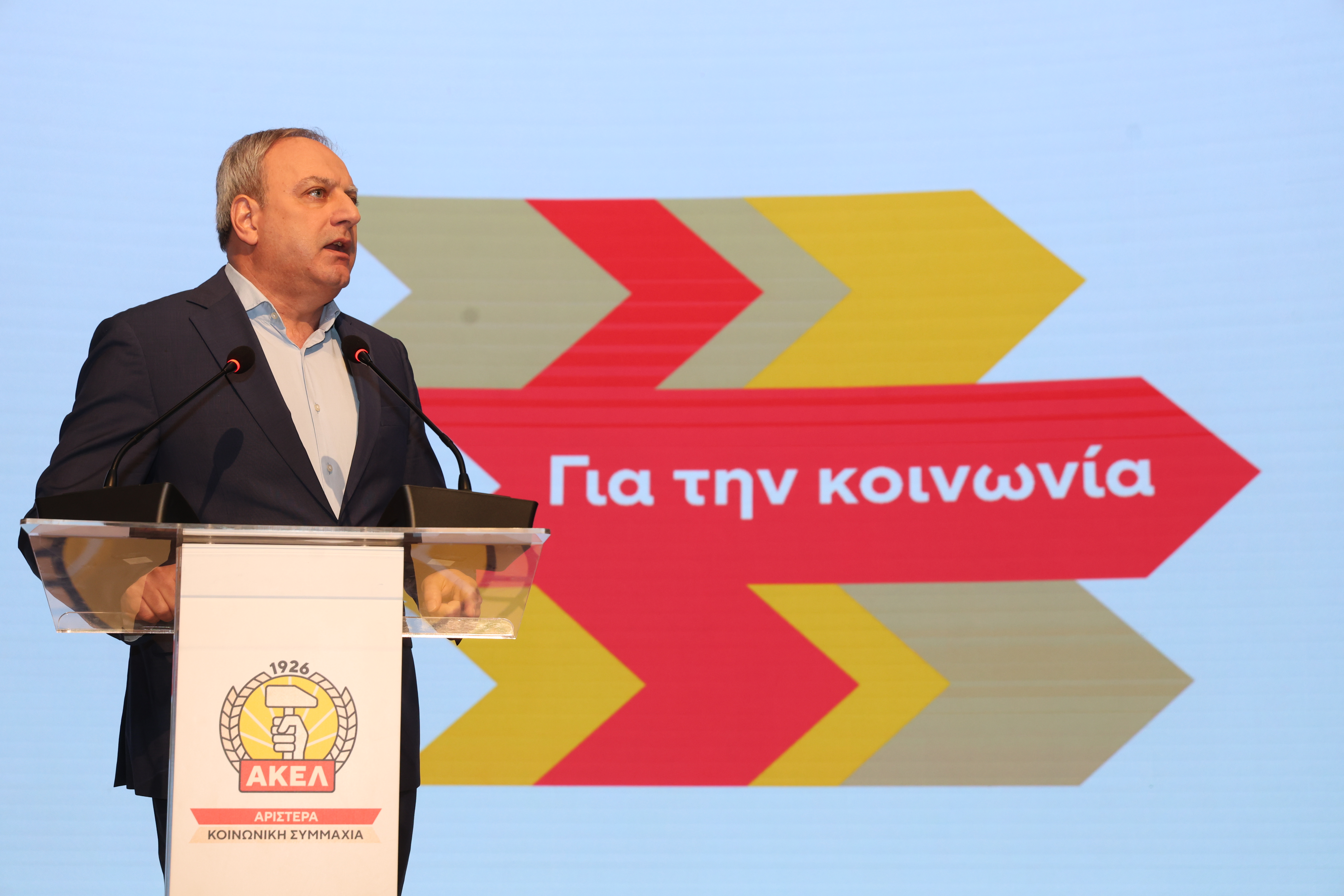
Akel secretary-general Stefanos Stefanou said on Wednesday that a bizonal, bicommunal federation (BBF) remains the only realistic framework for ending the Turkish occupation and reunifying Cyprus, warning that abandoning the agreed basis for a settlement would lead to the permanent partition of the island.
Speaking at an event in Idalion marking the anniversaries of the 1974 coup and the Turkish invasion, Stefanou said the slogan “We do not forget” means continuing the struggle against the occupation until justice is achieved for all Cypriots.
“Our struggle against the Turkish occupation will continue until the final vindication of our people – Greek Cypriots, Turkish Cypriots, Maronites, Armenians and Latins,” he said.
He added that the struggle would continue until justice is delivered for refugees, the missing, the enclaved, the wounded, prisoners of war and all those who suffered as a result of the invasion.
“The vindication of our people can only come through ending the consequences of the Turkish invasion and ongoing occupation. This can only be achieved through a solution that liberates and reunifies our country and our people,” he said.
Stefanou said Akel has consistently supported a settlement based on a bizonal, bicommunal federation with political equality, describing it as the historic compromise reached with the Turkish Cypriot side.
He warned that abandoning the agreed framework would not lead to a better outcome.
“Abandoning the agreed basis for a solution will not produce something better; it will lead to the consolidation of partition. That is precisely what Turkey is seeking through its proposal for a two-state solution,” he said.
Stefanou argued that a BBF could safeguard human rights and fundamental freedoms while ensuring a single sovereignty, single citizenship and single international personality for Cyprus.
He also said such a settlement would allow Cyprus to move beyond what he described as the outdated system of guarantees established under the Zurich and London agreements and build “a modern, democratic, functional and viable state” jointly governed by Greek Cypriots and Turkish Cypriots.
He criticised proposals to introduce what he described as “new ideas” on issues that have already been agreed during previous rounds of negotiations, saying such an approach would only create new disagreements and move a settlement further away.
Stefanou also described as “damaging and dangerous” any proposal to retain the current system of guarantees or expand it to include Nato.
He reiterated Akel’s support for United Nations Secretary-General Antonio Guterres’ position that negotiations should resume from the point where they broke off at Crans-Montana.
Stefanou said a roadmap should be developed setting out the process for confirming the convergences already achieved, as well as timelines and confidence-building measures capable of breaking the current deadlock and creating momentum for renewed negotiations.
He said Akel remains ready to support efforts to reach a settlement regardless of whether it is in government or opposition.
“The interests of Cyprus and its people come above everything else,” he said.
Turning to domestic politics, Stefanou accused the right and far right of attempting to rewrite history, arguing that the memory of the 1974 coup and invasion must be preserved.
“At a time when fascism is once again raising its head through the strengthening of the far right, the message of ‘never again fascism’ is more relevant than ever,” he said.
He concluded by saying Akel would continue its struggle until the occupation ends, the division of the island is overcome and Cyprus becomes “a free and peaceful homeland” for all its communities.





Click here to change your cookie preferences