
By Dr Kim Economides
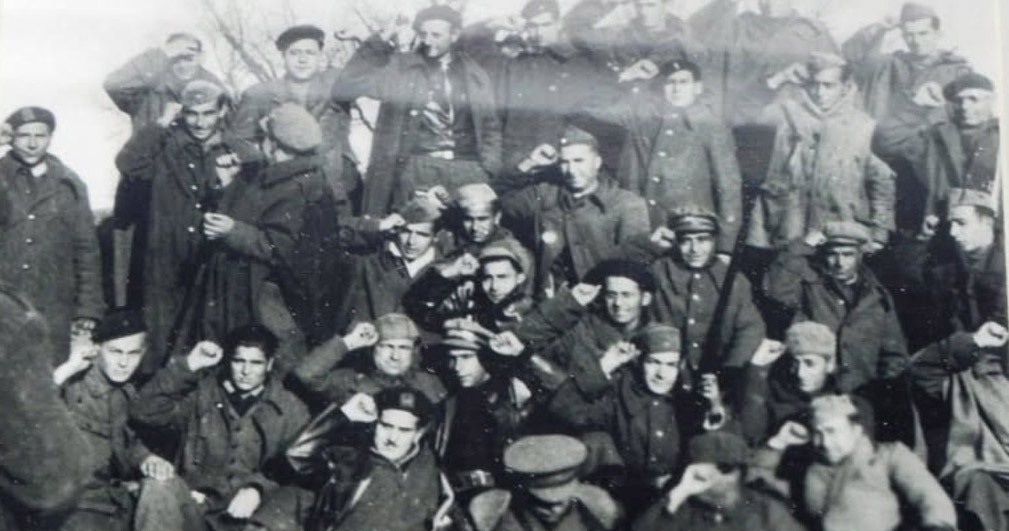
Last year I was granted Spanish citizenship under Spain’s Democratic Memory Law, not because I sought another passport or any material advantage, but because I wanted to honour my father and the other Cypriot volunteers who travelled to Spain to defend democracy against fascism.
For me, that citizenship represents something far greater than nationality.
It is recognition of a generation whose sacrifice has never been properly acknowledged in the country of their birth.
Spain has chosen to remember those who fought for its democracy. Cyprus, by contrast, continues to ignore its own volunteers.
The Democratic Memory Law allows descendants of members of the International Brigades to acquire Spanish nationality.
I believe I am the first Cypriot, and perhaps the first Australian, to receive Spanish citizenship through this route.
While Spain has gone to considerable lengths to preserve the memory of those who defended the Republic, Cyprus has yet to erect a single public monument to the Cypriots who fought and, in many cases, died in that same struggle.
This absence is remarkable given Cyprus’ extraordinary contribution.
Relative to its population, Cyprus sent more volunteers to the International Brigades than any other country.
Yet there is no national memorial, no official commemoration and little public awareness that these volunteers even existed.
My father, Michael Economides, was one of them. Born in Nicosia in 1910, he grew up during British colonial rule before moving first to Trikomo and later to London.
There he experienced poverty, unemployment and discrimination during the Great Depression, became politically active, joined the Communist Party and the trade union movement and, with fellow Cypriots including Ezekias Papaioannou, decided that Spain’s struggle was also their own.
When Franco launched its rebellion against Spain’s democratically elected government, my father saw the conflict for what it was. He believed the Spanish Civil War was the first battle of the Second World War and understood that defeating Franco also meant resisting Hitler and Mussolini.
He often explained that his decision to volunteer was not an emotional impulse but a rational one. He fully understood the risks involved and coolly calculated his chances of survival but still decided to go.
He left London in December 1936 and served with the International Brigades. He fought at Jarama, where he was wounded, later became a political commissar and returned to combat at the Battle of the Ebro, where he was seriously injured.
Despite everything he endured, he never regretted going to Spain.
He believed the volunteers had set an example that extended well beyond Spain itself. As he said many years later, they represented “an example and a challenge in our fight for peace, democracy and freedom.”
Spain eventually recognised that contribution when in 1996, shortly before his death, my father was granted honorary Spanish citizenship at a ceremony which he was able to address.
Cyprus, however, has remained silent, as for more than 25 years I have tried to secure official recognition for the Cypriot volunteers who fought in Spain.
There have been gestures of remembrance outside Cyprus, as in 1995 a commemorative plaque to the Cypriot volunteers was unveiled in the London borough of Camden.
In 2011 another plaque was installed in Madrid’s Fuencarral Cemetery through the efforts of Cyprus’ then ambassador to Spain, Antonis Toumazis.
Within Cyprus itself however, no monument stands for these men.
My father received personal recognition from the late Demetris Christofias, who presented me with commemorative plaques in 2005 and again in 2006, recognising my father’s anti-fascist struggle.
While those plaques are meaningful to my family they are not a substitute for official recognition by the Republic.
Throughout Cyprus there are monuments, museums, memorials and roads dedicated to other chapters of our history. Eoka fighters are commemorated through statues, museums, public squares and place names.
More recently, new monuments have continued to appear celebrating artists, historical figures and other aspects of Cyprus’ cultural heritage.
There is nothing comparable for the Cypriots who volunteered in Spain. This is particularly striking because memorials to the International Brigades exist across Britain, Australia and many other countries. More than 100 have been erected in British towns and cities alone.
As to why Cyprus has never done the same, I can only speculate. In my view, the principal reason is political, for many of the volunteers were communists or were perceived as such, and this undoubtedly shaped how they were remembered after the war.
But there is another reason. Too many people simply do not know this history. Most people, even on the left, do not even know that there were Cypriot volunteers.
That ignorance persists despite important historical research by scholars including Paul Strongos and Giannis Pantelakis, both of whom have documented the contribution of Cypriot and Greek volunteers to the defence of the Spanish Republic.
Remembering these volunteers is not about reopening old ideological battles or diminishing the sacrifices of others. It is about acknowledging a neglected chapter of Cypriot history.
These men left a British colony to fight in a foreign country because they believed democracy itself was under attack. Their story also reminds us that Cypriots have never been isolated from wider struggles for democracy and freedom.
They believed that injustice in one country mattered beyond its borders and that ordinary people had a responsibility to act. The values my father and his comrades defended – freedom, democracy and the rule of law – continue to face challenges across the world.
Spain has acknowledged their sacrifice; it is time that Cyprus did the same.
Kim Economides is an Emeritus Professor of Law at Flinders University, and an Honorary Professor of law at University of Southern Queensland


Click here to change your cookie preferences