
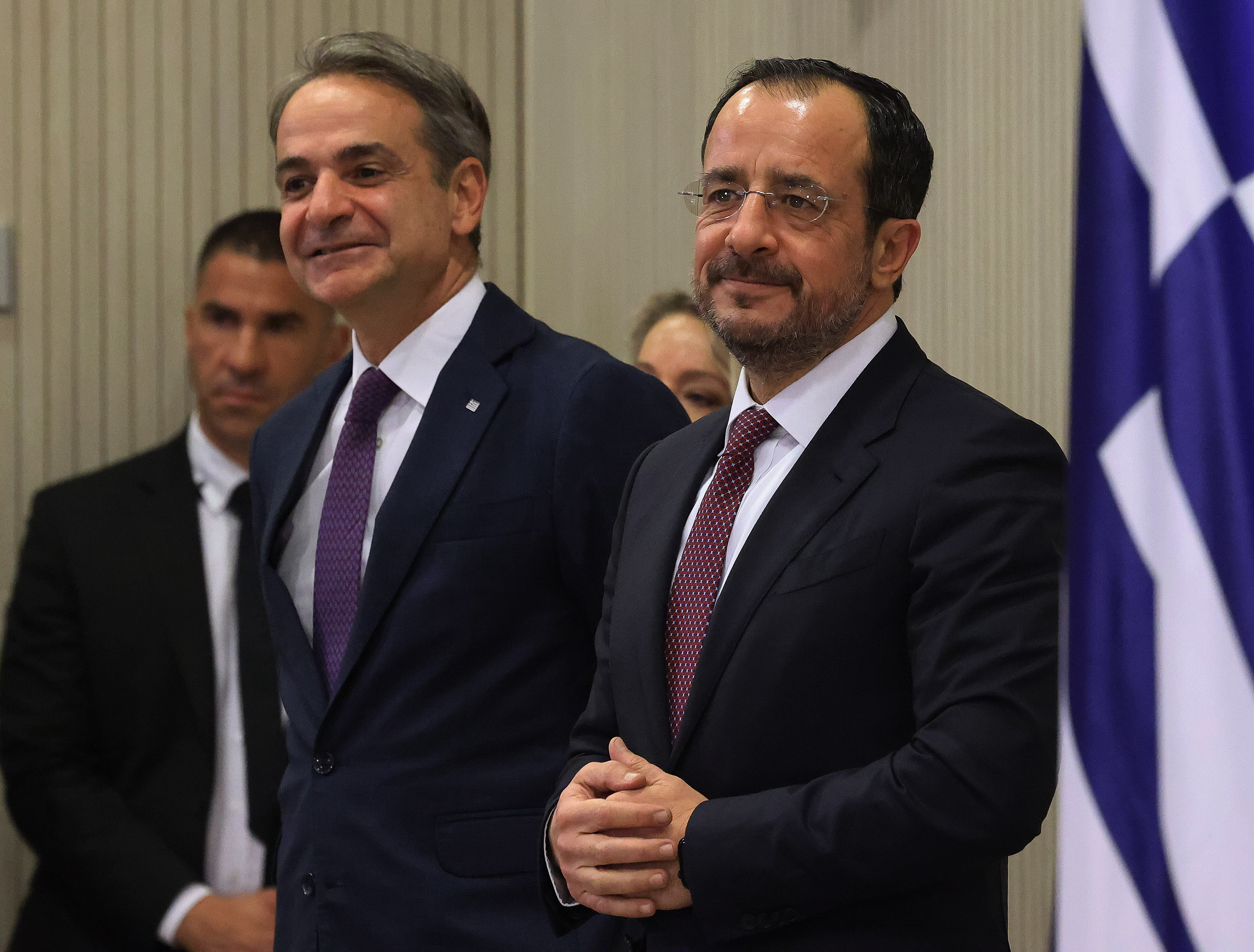
Greek Prime Minister Kyriakos Mitsotakis said that Cyprus will join Europe’s border-free Schengen zone on July 1 next year, the day his country takes over the Council of the European Union’s rotating presidency, at the end of Wednesday’s intergovernmental summit of Greece and Cyprus.
“We … are looking forward to Cyprus joining the Schengen zone officially on July 1, with this potentially being the first significant decision taken under the Greek presidency,” he said, echoing Cypriot President Nikos Christodoulides’ remarks to the Cyprus Mail last week.
Christodoulides had also said last week that “the objections expressed by member states” to Cyprus’ accession “have been largely overcome”, though he is yet to specify whether and how the Schengen zone’s new digital entry/exit system for third country nationals will be implemented at the soon to be 11 crossing points which connect the island’s two sides.
The issue of the entry/exit system is that were people to arrive on the island via Ercan (Tymbou) airport and then cross the Green Line at a crossing point, or arrive on the island from a Schengen zone member state and leave from Ercan (Tymbou), their entry or exit would not be recorded in the system.
Were this to be implemented in practice as things currently stand, Europe’s borders would face an administrative breakdown, given that one of the Schengen zone’s member states would not be able to record a proportion of arrivals and departures of third country nationals.
Nonetheless, Christodoulides had insisted to the Cyprus Mail last week that “Turkish Cypriots and members of their families who have the right to use the crossing points will not be affected” should Cyprus join the Schengen zone, and that they will maintain the same rights to cross between the island’s two sides that they have today.
JHA council did not discuss Cyprus’ Schengen accession at last meeting
Meanwhile, the Council of the EU’s justice and home affairs (JHA) council elected not to include the matter of Cyprus’ potential accession to the Schengen zone on its agenda when it most recently met at the beginning of last month.
The next JHA council meetings will take place on December 3 and 4, though it is expected that that meeting may focus more on some EU member states’ plans to set up a return hub for irregular migrants in Rwanda – a scheme which Cyprus has expressed interest in joining.
On the opposite side of the Schuman roundabout, the European Commission had in July set out its stall in favour of Cyprus’ accession, and a month prior, the Cyprus Mail was informed that European Commission President Ursula von der Leyen has personally been one of the main driving forces behind the push for the island to join the Schengen zone.
“For years and years, the view across Europe was that Cyprus can never join the Schengen zone without the Cyprus problem being solved. Now, however, von der Leyen has told each member state that Cyprus must join the Schengen zone, and that they must acquiesce to it,” one diplomat, speaking on the condition of anonymity, said.
Erhurman warned of ‘complications’ for Turkish Cypriots
Previously, Turkish Cypriot leader Tufan Erhurman has said that it is “extremely important” for the Turkish Cypriot side to be involved in Cyprus’ accession to the Schengen zone, given the potential impact of accession on Turkish Cypriots.
To this end, he warned that Schengen accession “has the potential to bring about many complications, especially in the area of freedom of movement” regarding Turkish Cypriots, especially those who are not citizens of the Republic of Cyprus.
Cyprus is one of just two EU member states which remain outside the Schengen zone, with Ireland, the other, electing not to fully join the zone so as to not prejudice its common travel agreement with the United Kingdom, which is outside the EU, the Schengen zone, the European single market, and the European customs union.





Click here to change your cookie preferences