
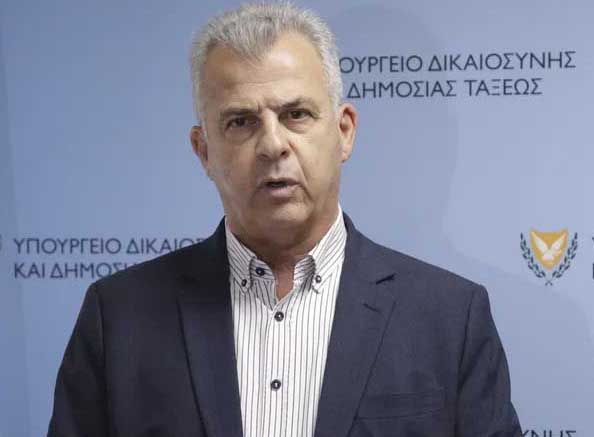
Costas Fitiris speaks out on unions and the urgent need for both a new prison and continued legal reform
Justice Minister Costas Fitiris has mounted a strong defence of his handling of an escalating dispute with the police union, insisting that while dialogue remains essential, operational decisions must ultimately rest with the leadership of the police and his ministry.
In a wide-ranging interview with the Cyprus Mail he also highlighted the urgent need for a new prison and acknowledged the justified public anger over a recent non-fatal road accident that caused traffic gridlock lasting hours in the sweltering heat.
His remarks are timely as they follow a statement by the prison guards’ branch of the police union Isotita (Equality) on Thursday that the central prisons are facing a growing security crisis marked by violence, drugs, overcrowding and staff shortages. Isotita’s vice president Giorgos Maltezos said the prison had become increasingly difficult to manage and accused the state of failing to ensure the safety of both inmates and staff. His intervention came days after his own dismissal from the prison service
Fitiris said that organised labour plays an important institutional role but cannot determine how the security forces are run.
“Trade unionism is a protected right and the ministry fully respects it,” he said. “Institutional dialogue with the unions is useful and necessary, particularly on matters concerning working conditions, staff welfare and safety.”
However, he stressed that the boundaries between consultation and decision-making must remain clear.
“The unions represent employees and have every right to express positions, suggestions and disagreements,” he said. “But the administration of the security forces, their operational function and decision-making belong to the competent institutional bodies, which are also accountable for those decisions.”
Fitiris said consultation should be meaningful and conducted in good faith. But once decisions are lawfully taken, “they must be implemented.”
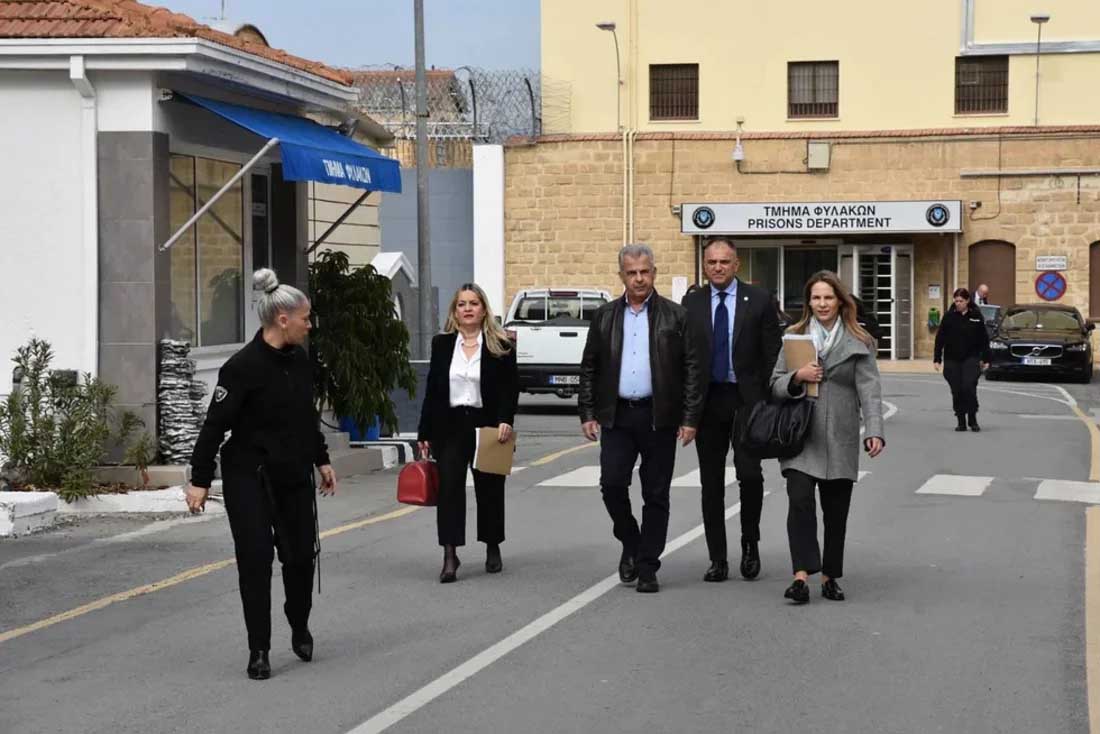
On one of the government’s biggest long-term infrastructure projects, the construction of the new central prisons, Fitiris highlighted that the existing facilities are no longer fit for purpose after more than a century in operation.
“The current prisons were built around 135 years ago for an entirely different number of inmates and a completely different correctional philosophy,” he said.
Rather than simply increasing capacity, he said the new complex is intended to modernise Cyprus’ prison system through better inmate classification and expanded education, rehabilitation and reintegration programmes.
He said reducing reoffending requires rehabilitation rather than simply new infrastructure, including addiction treatment, education and preparation for reintegration.
Alongside the new prison project, the ministry is strengthening rehabilitation programmes while examining alternatives such as open prisons and electronic monitoring for suitable offenders.
On the location of the new prison complex, Fitiris said the government’s primary plan remains to build the facility at Mathiatis, despite objections raised by residents.
He said substantial preparatory work had already been carried out and a master plan is being prepared, which will be presented to affected communities before any final decisions are taken.
At the same time, he said it would be irresponsible not to prepare alternative options for a project of such national importance.
“We are examining more than one alternative location based on specific criteria,” he said, adding that while Ayios Sozomenos is among the locations publicly mentioned, it would be premature to discuss individual sites before the evaluation process is complete.
“I do not believe it is right at this stage to prejudge either the abandonment of Mathiatis or the selection of any other location,” he said.
Fitiris said the country could no longer afford further delays to a project he described as essential for modernising Cyprus’ prison system.
“Our goal is to take the best possible decision based on objective criteria so that the project can proceed properly and without further unjustified delays,” he said.
Turning to the government’s response to the hours-long disruption on the Limassol-Nicosia highway that paralysed traffic last month because of the complexity of recovering an overturned heavy goods vehicle and clearing tonnes of gravel from the road, Fitiris said the incident exposed weaknesses in inter-agency coordination that prompted the development of the new “Nestor” emergency response plan.
“In a serious road incident it is not enough for each service to perform its own role correctly,” he said. “There must be unified coordination from the very first moment, clear responsibilities and simultaneous mobilisation of all necessary resources.”
The framework defines operational command and the responsibilities of each participating agency. It also introduces contractual response-time obligations for private contractors and requires regular exercises to test preparedness.
Fitiris said that a national exercise involving all participating agencies will take place during August.
“I have always believed that a plan should never be tested for the first time during a real crisis,” he said. “It must first be exercised so weaknesses can be identified and corrected.”
“Nestor will not be judged by how good it looks on paper,” he said. “It will be judged by how quickly and effectively the state responds to the next serious incident.”
Organised crime is another area undergoing major reform.
Fitiris explained that the new Directorate for Combating Organised Crime (DAOE) – the Cypriot FBI as it has become known – represents a different way of tackling criminal networks rather than simply increasing police powers.
“The problem cannot be addressed through isolated investigations and individual arrests,” he said.
Instead, the new structure brings together operational, financial, analytical and digital expertise under one command, allowing investigators to target criminal organisations as complete structures rather than individual offenders.
Particular emphasis will be placed on drug trafficking, money laundering, the use of corporate structures to conceal criminal proceeds and international cooperation with Europol and Eurojust.
Fitiris said the directorate had already produced results through targeted operations, major drug seizures, financial investigations and asset-freezing procedures.
But he insisted success should not be measured simply by arrest numbers.
“It will be measured by how many criminal networks are dismantled, how much illicit income is identified and confiscated, and whether these organisations lose the ability to continue operating,” he said.
On justice reform, the minister acknowledged that delays in the courts remain one of the country’s most persistent institutional problems despite significant progress. He pointed to reforms including the Court of Appeal, digital case management and programmes aimed at clearing longstanding cases.
The success of the reforms, he said, would ultimately be judged not by legislation passed but by measurable improvements.
“It will be judged by how much hearing times are reduced, how many old cases are completed, whether postponements decrease and how quickly citizens receive final judgments.”
He acknowledged that legislation alone is insufficient, arguing that additional judges, legal officers, administrative staff, technology and modern court management are equally essential.
The European Commission, he noted, has recognised progress while continuing to identify delays and staffing shortages as major concerns.
Fitiris also defended the government’s proposed constitutional amendment to Article 17, which would expand the circumstances under which communications data may be accessed during investigations into serious crime. He stressed that the proposal is designed to address modern encrypted communications used by organised criminal groups rather than introduce mass surveillance.
“We are not seeking uncontrolled powers or generalised surveillance,” he said.
Instead, any lifting of communications privacy would continue to require judicial authorisation, specific evidence, strict limits to serious offences and compliance with the principles of necessity and proportionality.
The amendment is necessary, he said, because the Constitution itself currently defines the circumstances under which privacy may be restricted, meaning ordinary legislation alone cannot expand those powers.
The minister also highlighted the growing challenges posed by artificial intelligence, cryptocurrencies and increasingly sophisticated online fraud.
While Cyprus’ legal framework already criminalises most relevant offences, he warned that technology continues to evolve faster than legislation.
He said law enforcement increasingly requires specialist investigators, digital forensics and closer international cooperation.
Public awareness, he added, remains equally important because preventing online fraud is often far easier than recovering stolen funds afterwards.
Asked about the police’s almost nightly operational campaigns, Fitiris said they should never become exercises in generating arrest statistics.
Operations, he explained, are based on intelligence, risk analysis and crime patterns, with their effectiveness measured by reductions in serious crime, disruption of organised networks, seizures of illegal goods and the quality of intelligence gathered.
“The goal is not simply more arrests,” he said. ” It is less crime and greater safety in citizens’ everyday lives.”
On public confidence in policing, he acknowledged that trust cannot be restored through statements alone.
“It is built when citizens see professionalism, equal treatment, consistency and accountability,” he said, arguing that complaints against officers must be investigated quickly while mistakes should be acknowledged and corrected wherever necessary.





Click here to change your cookie preferences