
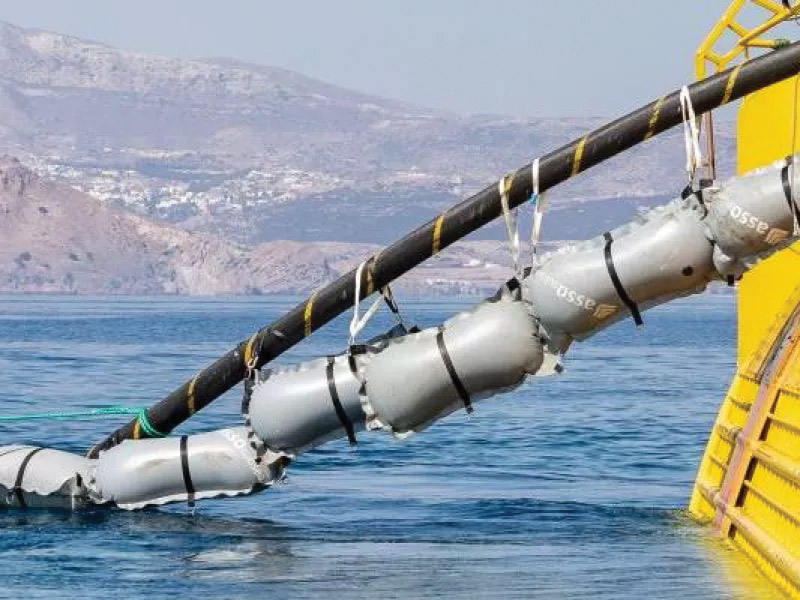
The section of the Great Sea Interconnector which linking the energy grids of Cyprus and Greece will be complete by the end of 2031, Greece’s independent power transmission operator Admie said on Saturday.
Greek public broadcaster ERT quoted the latest version of Admie’s 2027-2036 development plan as saying that 60 per cent of the required seabed surveys have now been completed, and that a contractor has been selected for the construction of converter sections at either end of the cable.
In Greece, this will entail an expansion of the Damasta converter station on the island of Crete, which is used to convert direct current electricity being sent to it from the Greek mainland via the Crete-Attica electricity interconnection, while in Cyprus, a brand-new converter station will be built.
The report also said that the feasibility study for the construction of the interconnector’s second leg, between Cyprus and Israel, has been completed “with positive results”, and that “Israel will strengthen its security of supply, gaining the ability to further and more rapidly increase the participation of renewable energy sources” in its own mix.
It also quoted a study conducted by the Aristotle University of Thessaloniki, which found that the interconnector’s completion will bring about savings ranging from €123 million to €138 million per year, with this amounting to a 19 per cent decrease in energy prices for Cypriot consumers.
The report comes with the French research vessel Abeille Marengo having set sail from the Cretan port of Heraklion with the aim of completing the remainder of the seabed surveys for the first leg of the interconnector, amid a flurry of navtexes from Cyprus, Greece and Turkey.
Seabed surveys to take place in disputed waters
The areas of the seabed in which surveys have not been conducted are disputed, with Turkey claiming that the cable’s planned route passes through Turkish waters, and Cyprus and Greece claiming that it does not.
A navtex is a message sent to seaborne vessels to warn them of activity in their vicinity, and the Abeille Marengo had initially set sail on Tuesday night, pursuant to the issuing of a Greek navtex clearing it for the surveys.
It was still in Greek waters when Turkey issued its own navtex, also clearing the Abeille Marengo to commence seabed surveys, and saying that the boat’s activities would be carried out “along lines coordinated with and consented to by the competent Turkish authorities”.
That navtex did bring to an end a months-long saga over whether or not Turkey would disrupt the construction of the interconnector, and did come after Greek government spokesman Pavlos Marinakis acknowledged that Turkey had been informed of the planned surveys.
He nonetheless stressed that the communication “does not constitute recognition” of Turkey’s claim to the seas in which the surveys are due to take place, and that the formal request for permission to conduct the surveys was only sent to the governments of Greece and Cyprus.
Turkish navtex did not satiate Cypriot govt
Given this position, the issuing of the Turkish navtex, and with it the announcement of Turkish consent for the seabed surveys, served to aggravate rather than satiate the Cypriot government.
Spokesman Konstantinos Letymbiotis told the Cyprus Mail on Tuesday night that the Turkish navtex is “of no consequence”, and that “Greece and Cyprus are the only countries to which a request for permission for work to be carried out was submitted”.
“The Turkish navtex, which was issued after the vessel had already set sail based on previously publicised information, is of no consequence. Furthermore, the Turkish navtex makes no mention of any ‘granting of permission’, as no such request was ever submitted to the Turkish side,” he said.




Click here to change your cookie preferences