
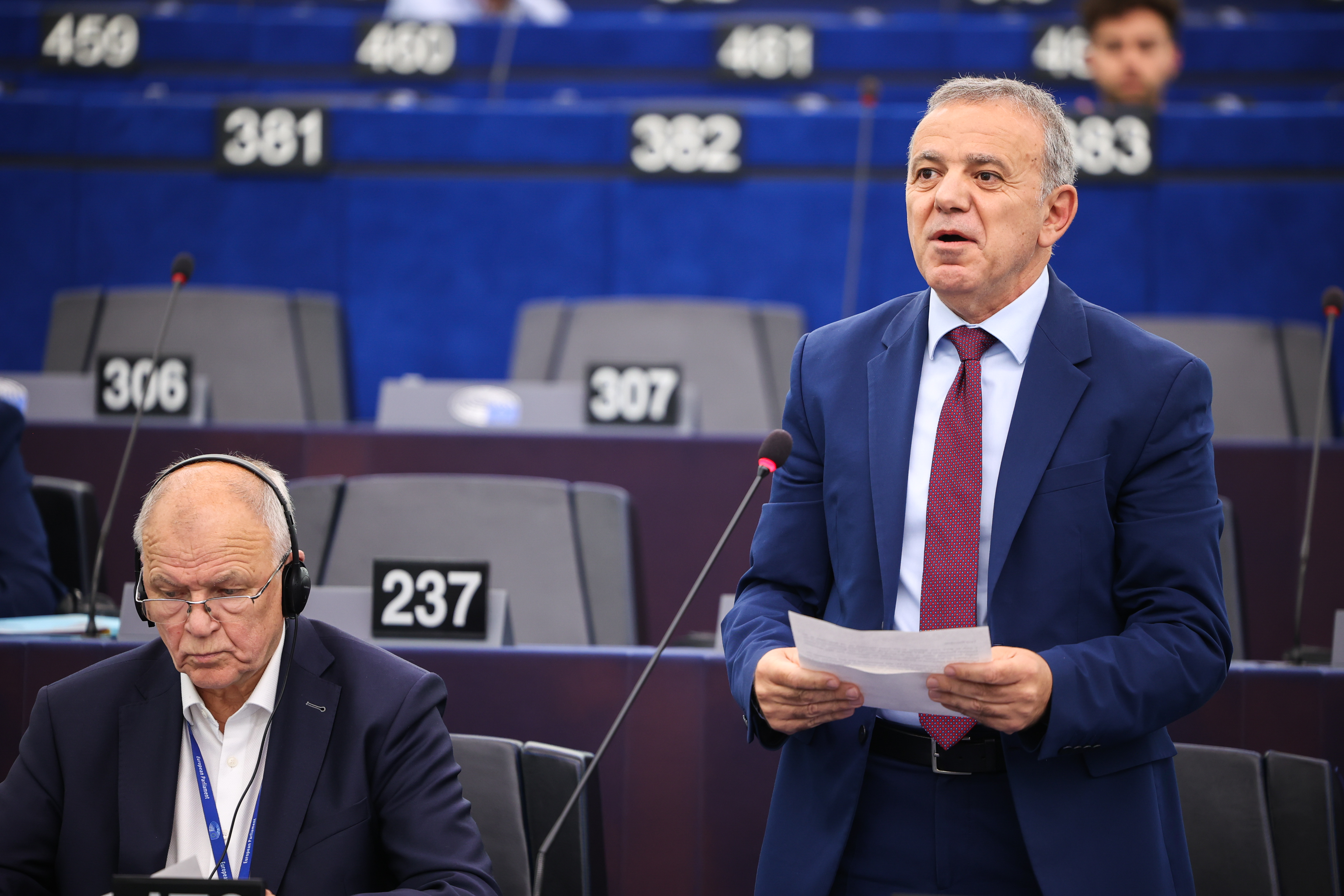
Diko member of the European Parliament Costas Mavrides has called for the International Criminal Court to intervene on the Cyprus problem, accusing Turkey of “war crimes and crimes against humanity” on the island.
“The International Criminal Court deals with war crimes and crimes against humanity. Two such crimes have been taking place for years on European Union territory,” he told the European Parliament’s plenary session in Strasbourg on Monday night.
Those two crimes, he said, are the “illegal settlement through the transfer of population from Turkey and the organised usurpation of Greek Cypriot properties in the occupied territory of the Republic of Cyprus”.
“Upholding the court’s jurisdiction is a paramount obligation for the European Union. For this reason, I have submitted a detailed document to the court calling for the perpetrators to be indicted,” he said.
On this front, he said that there is “self-evident proof regarding these two crimes”, as “the population in the occupied territory of Cyprus and the organised usurpation clearly demonstrate the criminal acts”.
However, he said, “the International Criminal Court has taken no action since 2014”.
In light of this, he said that “if the court fails to act in the face of such a clear-cut crime, its impartiality will be called into question”.
Mavrides was one of the parties to file the case against Turkey in 2014, accusing the country of “directly and indirectly transferring civilian population of an occupying power into occupied territory”, with the complaint having been drafted in part by the Tel Aviv-based Shurat HaDin Israel Law Centre.
Figures from across Cyprus have raised population concerns
Though the state-sponsored population transfer from Turkey to Cyprus has not been in place since the 1980s, figures from across Cyprus have warned of large influxes of people moving to the island in recent years.
Turkish Cypriot Kyrenia mayor Murat Senkul, for example, said that his town’s population is likely more than 150,000.
“Looking at concrete data like water consumption, meter numbers, households, and the amount of rubbish collected, Kyrenia’s actual population is between 150,000 and 160,000. Nationwide, the actual, de facto population is around 800,000 during the quietest periods and 900,000 during the busiest,” he said.
On the question of why the population of Kyrenia and other Turkish Cypriot-administered towns has grown to such an extent, he said that “people are coming from Turkey, Pakistan, Bangladesh for individual economic reasons because they think the country is European Union territory”.
The Turkish Cypriot statistics institute had in February announced the number of people living under its jurisdiction stood at 489,308, despite mobile communications data suggesting the figure is more than double that.
According to the Turkish Cypriot telecommunications authority, there were at the end of September last year 1,133,583 mobile subscribers, of which 945,810 were active.
The telecommunications authority stated that this corresponds to a mobile penetration rate of 276 per cent – a figure which would, if true, leave the Turkish Cypriot community with the second-highest mobile penetration rate on earth.



Click here to change your cookie preferences