
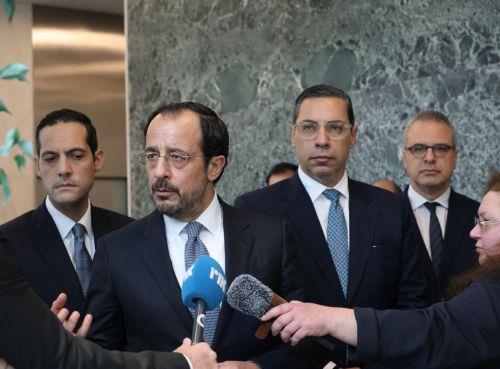
President Nikos Christodoulides insisted on Tuesday that efforts to resolve the Cyprus problem are not at a deadlock, despite acknowledging difficulties and challenges in attempts to restart negotiations.
“We do not overlook any of the difficulties and challenges in the Cyprus problem, but under no circumstances are we at a deadlock,” Christodoulides said on arrival at the Cyprus Forum.
He was responding to a question about comments by UN Secretary-General’s personal envoy Maria Angela Holguin that the favourable opportunity on the Cyprus problem was gradually being lost, and whether he shared that assessment.
Christodoulides said he wanted to respond to those who were speaking of a deadlock.
“I don’t know where they get their information from. We are certainly not at a deadlock. Tomorrow, I will first brief the members of the National Council and then we will be able to say much more [on the issue],” he said.
The president said UN Secretary-General Antonio Guterres remained fully committed to restarting negotiations and was working towards that goal.
He said the Greek Cypriot side supported Guterres’ efforts “through specific ideas concerning methodology, substance and confidence-building measures, with continuously new, creative proposals”, which he said had received a positive response from the UN chief.
Christodoulides said he was not attempting to paint an overly positive picture of the situation and acknowledged the issue posed by the Turkish side’s position in favour of a two-state solution.
“But under absolutely no circumstances are we at a deadlock,” he said.
“We are working. There are problems, there are difficulties, there are challenges. We are working so that we can achieve the goal of reunification.”
Asked about the next steps, Christodoulides said Holguin would be coming to Cyprus, while on the EU side, the bloc’s special envoy for Cyprus Johannes Hahn was active, particularly in relation to Turkey.
“The European Union plays an important role. It was an issue discussed between the Secretary-General and the president of the [European] Commission and the president of the [European] Council,” he said.
“We expect meetings to take place between European Union and Turkish officials.”
Efforts, he added, were directed towards achieving the resumption of negotiations, while not overlooking “difficulties and problems which focus on the Turkish side’s insistence on a two-state solution”.
Christodoulides again stressed that “we are not at a deadlock”, pointing to Holguin’s upcoming visit to Cyprus and saying a major effort was under way.
From the Greek Cypriot side, he said, this effort was being pursued “not with words, but with actions, with very specific steps concerning all three issues which, if you like, the Secretary-General himself has raised”.
“We are working so that we have developments,” he said.
Click here to change your cookie preferences