
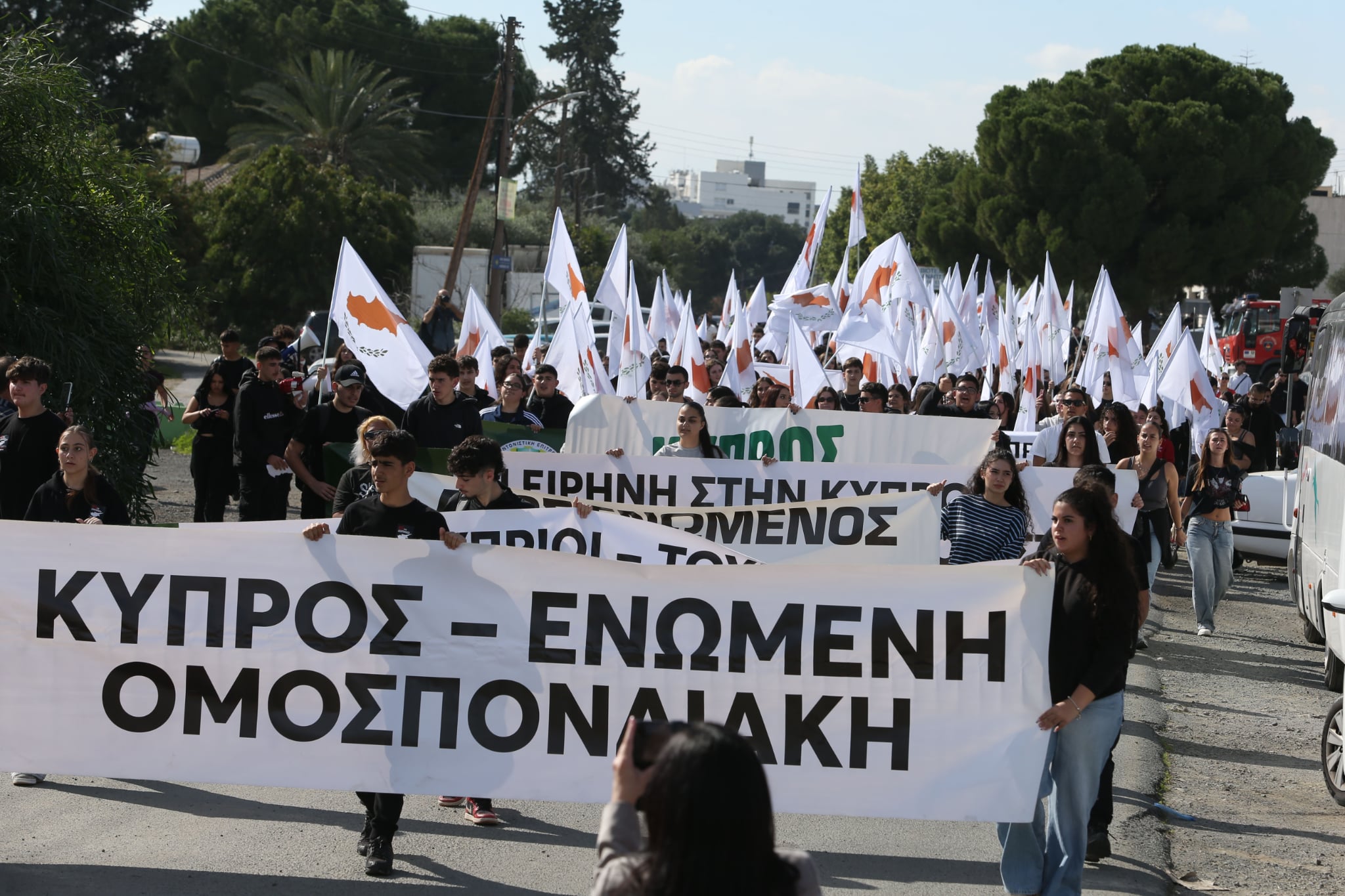
Schoolchildren left their classes on Friday morning for the annual condemnation of Rauf Denktash’s unilateral declaration of independence (UDI), which set up the so-called ‘Turkish Republic of Northern Cyprus.’ The actual declaration was made on November 15, 1983, when none of the underaged protesters were alive – some of their parents had not even been born yet – but the protests were held today as the kids are not at school on Sunday and they probably felt it was preferable to leave school early on Friday to prepare for the weekend rather than on Monday.
The student marches condemning UDI have become such a fixture over the years that no education minister would dare to try to put an end to them. It is, after all, the only opportunity for schoolchildren to protest against the continuing occupation as they are on their summer holidays on the anniversary of the Turkish invasion. So, they are out protesting – those that bother to march – about a diplomatic move that was the first Turkish step towards formalising partition. Although partition has not yet been formalised, 43 years after UDI, because the breakaway entity has only been recognised by Turkey, the division of Cyprus is a fact.
In a way, the schoolchildren’s marches are encouraged by the politicians because they serve as a reminder of the sole success they have had in the ongoing Cyprus problem – preventing the recognition of the breakaway entity. The foreign ministry’s primary objective in all the years since UDI had been to prevent any event that could be construed as a form of recognition of the regime in the north. It has been successful in this regard, doing everything in its power to minimize the north’s contact with the outside world, for fear – unjustified in most cases – that this would lead to the ‘upgrade’ of the regime.
Of course, recognition or even an upgrade, would not happen because a techno-music festival was held in the north or because the Barcelona academy set up training camps there, but we are still determined to prevent them, presumably because if we did not other events would take place there. The main reason the north has not been recognised is because the international community has never considered this an option as it had done in the case of Kosovo. Conditions were different in former Yugoslavia, which is why Serbia’s not unjustified claims to the territory were ignored.
The Cyprus Republic is now a full member of the EU and as such is in a much stronger position to prevent the recognition of the north. It is shame, however, that for successive governments this has become an end in itself. They have come to terms with the breakaway regime and Turkey controlling 40 per cent of Cyprus’ territory so long as it is not formally recognized. Students will carry on protesting every year about UDI, although most people are comfortable with the status quo it has created.




Click here to change your cookie preferences