
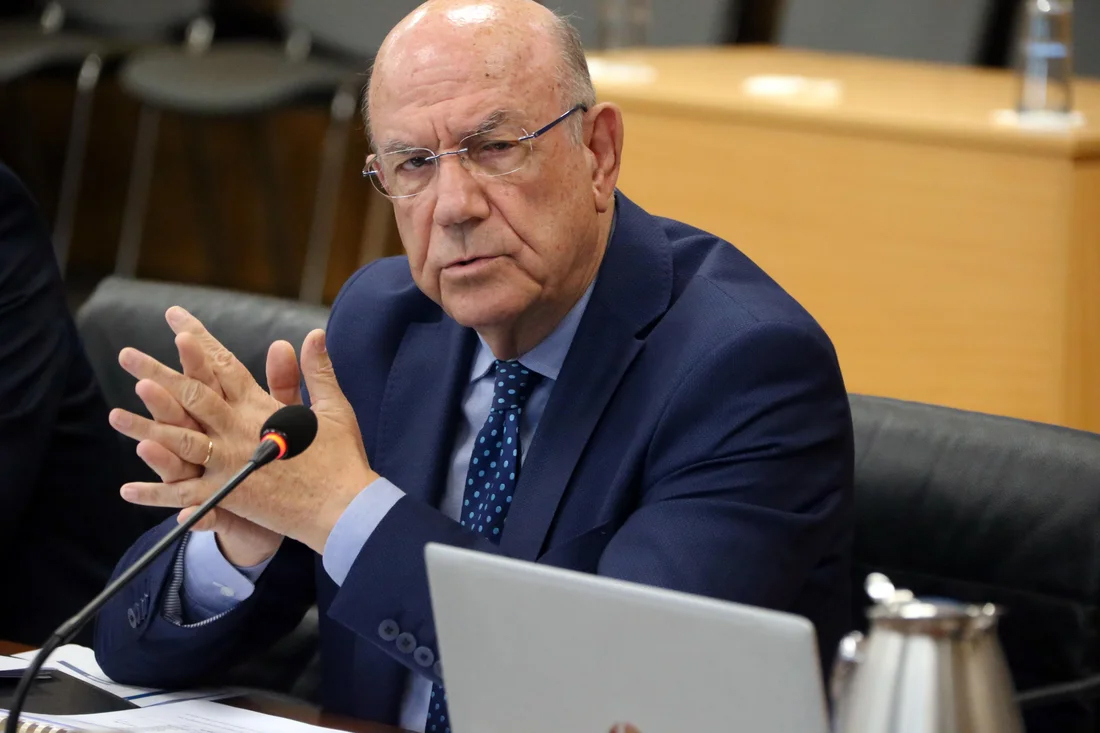
The top priority of Finance Minister Makis Keravnos seems to be to use government budgets to produce and record large fiscal surpluses, rather than utilising budgets as a key instrument for fostering the economy’s potential and serving the public.
Unnecessary government surpluses
Most notably, in presenting the government budgets for 2027 to 2029 to the House of Representatives Keravnos, highlighted that it was “the third consecutive year in which budgets featured fiscal surpluses”.
But it can be argued that the generation of a large budget surplus for Cyprus in 2027 is unnecessary and could potentially curb economic growth and the well-being of households.
More specifically, in view of the sizable government surpluses generated in recent years and the resultant reduction in the public debt to GDP ratio to well below the Maastricht criterion of 60 per cent as well as its abundant financial reserves, there is no need for the Cyprus government to budget for a large surplus equal to 4 per cent of GDP or €1.6 billion for 2027. That is, Cyprus unlike many other EU countries has the fiscal space to undertake considerably more spending on worthwhile investment projects and on socio/economic protection measures to support lower-income households and vulnerable persons.
Notably, government surpluses take money out of the economy and result in lower incomes and domestic demand that hinders economic growth. Besides, the increasingly austere budget proposed for 2027 comes at a time when many households are struggling with cost-of-living expenses and when public investments in meeting the economy’s infrastructure needs for reliable and affordable energy supplies are falling way short.
Indeed, one wonders whether the restrictive government budgets of Cyprus with sizable surpluses are being prepared and implemented mainly to impress credit rating agencies. In truth, these surpluses are being used to a large extent to pile up excessive reserves or deposits at banks, which at end-August 2026 totalled €6.2 billion.
Inadequate and unfair budget
As an additional or supplementary comment Keravnos stated that the budget for 2027 is “balanced and people-centred”.
This statement is far from the truth as more than one-half of the increase in budgeted expenditure for 2027 is accounted for by a rise of €262 million for payments on defence and the police, while expenditure on personnel including pensions is only budgeted to rise by a mere 1.2 per cent or €44 million.
Surprisingly, expenditure on salaries and wages of government employees is budgeted to increase by just 0.4 per cent in 2027, although the rate of inflation is officially forecast at 2.5 per cent for the year. And furthermore, such compensation of government employees in 2028 is budgeted to rise spectacularly by 7.6 per cent in a year of a projected lower inflation rate of 2.0 per cent. Undoubtedly, the timing of the rises in the remuneration of government employees blatantly looks like a pre-presidential election ploy.
In addition, despite promises that the proposed social security reform will bring the incomes of many pensioners to adequate levels, social benefits are budgeted to rise by only 3.1 per cent or €71 million in 2027 and even decline by 1.6 per cent in 2028
Besides, capital expenditure on infrastructure projects is budgeted to rise by a pitiful 0.7 per cent to €595 million in 2027, that includes mainly road building projects and outlays for the new Cyprus museum. This relatively low level of public investment raises concern that the government is not very interested in addressing the infrastructure needs of the economy, particularly in sustainably supplying adequate and affordable energy and water to all businesses and households. In this connection, the funds earmarked for the energy, trade and industry ministry for 2027 have been reduced by over 30 per cent to a paltry €84 million.
Also, the government does not appear to be delivering on its promises to promote entrepreneurial activity and innovation so as to raise the productivity and competitiveness of the Cyprus economy. Notably, funds allocated to the deputy research and innovation ministry for 2027 have been decreased by 13 per cent to €150.2 million.
On the revenue side, the budget for 2027 is to be funded to a greater extent by regressive taxes such as VAT that unfairly burden lower income households. In fact, revenue from indirect taxes is estimated to increase by 5.6 per cent in 2027 and account for over 44 per cent of total government revenue compared with an estimated 42 per cent for 2026.
In marked contrast, direct tax revenues are budgeted to increase by just 1.1 per cent in 2027, implying that the tax burden on high income earners will be much less.
Strikingly, the average income tax payments of presumably richer and tax-evading self-employed persons for 2026 is estimated at €1,550, yet the average personal tax payment of employees is estimated at a much higher €2,550. Moreover, the budget projections for the years 2027 to 2029 show personal income tax receipts from the self-employed falling by 2.5 per cent to a low €80 million, whereas tax receipts from employees, though forecast to decline in 2027, are to rise by over 6 per cent to €1,260 million by 2029.
And what is difficult to understand in view of the ongoing boom in property sales is that budget projections show that property tax revenue is estimated to decline by 7 per cent in 2026 and is projected to be still below the 2025 level of €233.8 million by 2029.
Undeniably, these personal income and property tax projections make a mockery of government promises to combat tax evasion and address income and wealth inequalities.
In concluding MPs should not vote for budgets that disproportionately and unfairly tax lower and-middle income households so as to just satisfy the government’s overriding goal of recording large fiscal surpluses. Instead, MPs should amend substantially the budgets presented by Keravnos to enable surpluses to be used efficiently for greater and adequate spending on essential infrastructure projects and on deserving lower-income households and social beneficiaries. Only thereafter, should MPs approve a substantially amended budget for 2027.





Click here to change your cookie preferences