
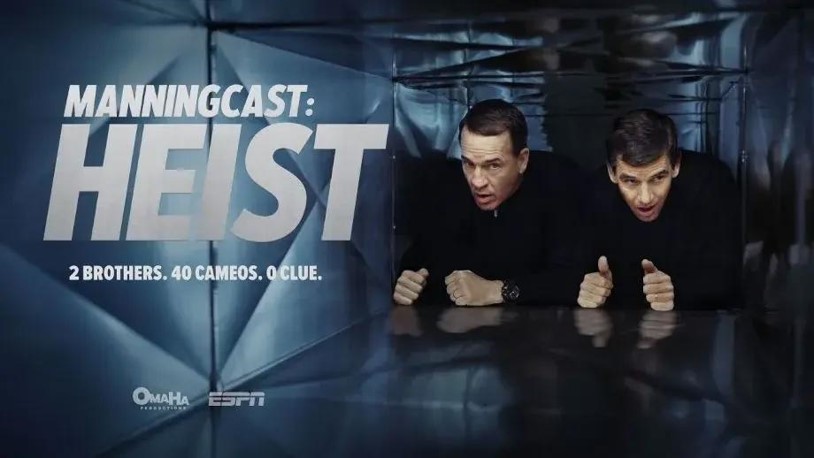
Last week, Peyton and Eli Manning needed to announce the schedule for the sixth season of the ManningCast.
Omaha Productions could have issued a press release or posted a graphic.
Instead, it made a 15-minute heist movie.
ManningCast: Heist features roughly 40 cameos, including Anne Hathaway, Jon Hamm, Paul Rudd, Larry David, Glen Powell, Jason and Travis Kelce and NFL commissioner Roger Goodell. The elaborate short culminates with the revelation that Peyton and Eli will call their first Super Bowl together this season.
For Omaha president Jamie Horowitz, the absurdly ambitious video is actually a pretty good representation of what the company has been trying to build.
“This video is trying to be just a joyride of fun,” Horowitz told The Hollywood Reporter.
It is also the latest evidence that Peyton Manning and Horowitz may have figured out something increasingly important in the sports business: how to make an athlete production company actually work.
Athlete-backed media companies are everywhere. LeBron James has SpringHill. Stephen Curry has Unanimous Media. Tom Brady and Michael Strahan co-founded Religion of Sports with Gotham Chopra. Tennis star Coco Gauff, still only 22, is now building iROC Media Group.
But turning an athlete’s celebrity into a sustainable company is far more difficult than launching one.
As The Hollywood Reporter and Sportico recently explored, the long-term challenge is building a business that eventually becomes bigger than its famous founder. Omaha is particularly interesting because it has already made significant progress toward that goal. Peyton and Eli Manning appeared in more than 70 percent of Omaha projects early in the company’s life. Today, they appear in only about a quarter.
That evolution began with a partnership between two people with very different skill sets.
Manning brought one of the most trusted personalities in American sports, extraordinary relationships and an instinct for what feels authentic to athletes. Horowitz brought more than two decades of television experience, including developing personality-driven programming at ESPN and Fox Sports.
That combination points to a larger lesson in the athlete-media business: behind many successful athlete production companies is not simply a famous athlete, but an experienced operator.
LeBron James built SpringHill alongside longtime business partner Maverick Carter. Stephen Curry’s Unanimous Media is run with Erick Peyton, a veteran producer and entrepreneur. Religion of Sports paired Tom Brady and Michael Strahan with filmmaker Gotham Chopra. And Gauff has partnered her new iROC Media Group with Religion of Sports, giving the young tennis star an established production infrastructure while she remains focused on her playing career.
The athlete supplies something a traditional media executive cannot manufacture: authenticity, access, relationships and a direct connection with fans.
The operator supplies something equally important: the ability to turn those advantages into a repeatable business.
That means understanding what networks and streamers will buy, developing formats rather than simply one-off projects, hiring producers, managing budgets, working with advertisers and, perhaps most importantly, knowing when a project should not require the athlete to appear at all.
For Manning and Horowitz, the idea was never simply to make Peyton Manning television shows. It was to use Manning’s credibility and access as the foundation for a broader media company.
ManningCast became the breakthrough. Its combination of elite football analysis, sibling humor and unexpected celebrity guests turned an alternate ESPN2 telecast into a franchise. It won a Sports Emmy and helped establish a template that other networks have since tried to replicate.
But Omaha kept expanding.
Peyton’s Places became an entire Places franchise built around other athletes. Netflix’s Quarterback expanded into Receiver and other athlete-driven documentary storytelling. A bit created for Eli’s Places, in which Eli Manning disguised himself as a college quarterback named Chad Powers, became a scripted Hulu series starring Glen Powell.
That last example may be especially important.
In 2025, Omaha signed a first-look scripted television deal with Disney’s 20th Television covering comedies, dramas, limited series and adult animation. What began as sports content was becoming intellectual property capable of traveling into entirely different genres.
Investors noticed.
Patrick Whitesell’s new Silver Lake-backed venture chose Omaha as its first investment in 2025, joining Peter Chernin’s North Road as a minority investor. The transaction valued Omaha at more than $750 million, according to The Hollywood Reporter/Sportico. When the transaction was announced, industry sources said Omaha had increased both its revenue and profit every year during each of its first five years.
The company has also diversified beyond traditional television economics.
Omaha now produces commercials and branded entertainment involving athletes including Baker Mayfield, Brock Purdy and Jordan Spieth. Branded content and commercial campaigns have grown to roughly a quarter of Omaha’s revenue, the highest level in the company’s history.
That is another important distinction between an athlete’s production label and an actual media company.
The celebrity may get the first meeting. It cannot be the entire business model.
Horowitz has described Omaha’s strategy in simpler terms: “Find ways to bring people together. Make content that uplifts and unifies. Celebrate what unites us.”
That philosophy helps explain something else about the company. Omaha has resisted making Peyton Manning the subject of everything. Instead, his sensibility becomes a filter for deciding what Omaha should make.
That is precisely the challenge facing the newest generation of athlete entrepreneurs.
Gauff has said she hopes to build a company capable of sustaining itself after she stops playing tennis. That may be the right ambition. The best athlete media companies ultimately have to reach a point where the athlete remains incredibly valuable but is no longer required for every piece of content.
There is a paradox to the model. An athlete’s fame is often the reason the company can exist in the first place. But if that company is going to become truly valuable, it eventually has to prove it can exist beyond that fame.
Six years after Omaha’s launch, Manning and Horowitz appear closer to that goal than almost anyone.
And ManningCast: Heist is a fitting reminder of why.
Peyton Manning is still standing right in the middle of the picture.
But the company around him has become much bigger.



Click here to change your cookie preferences