
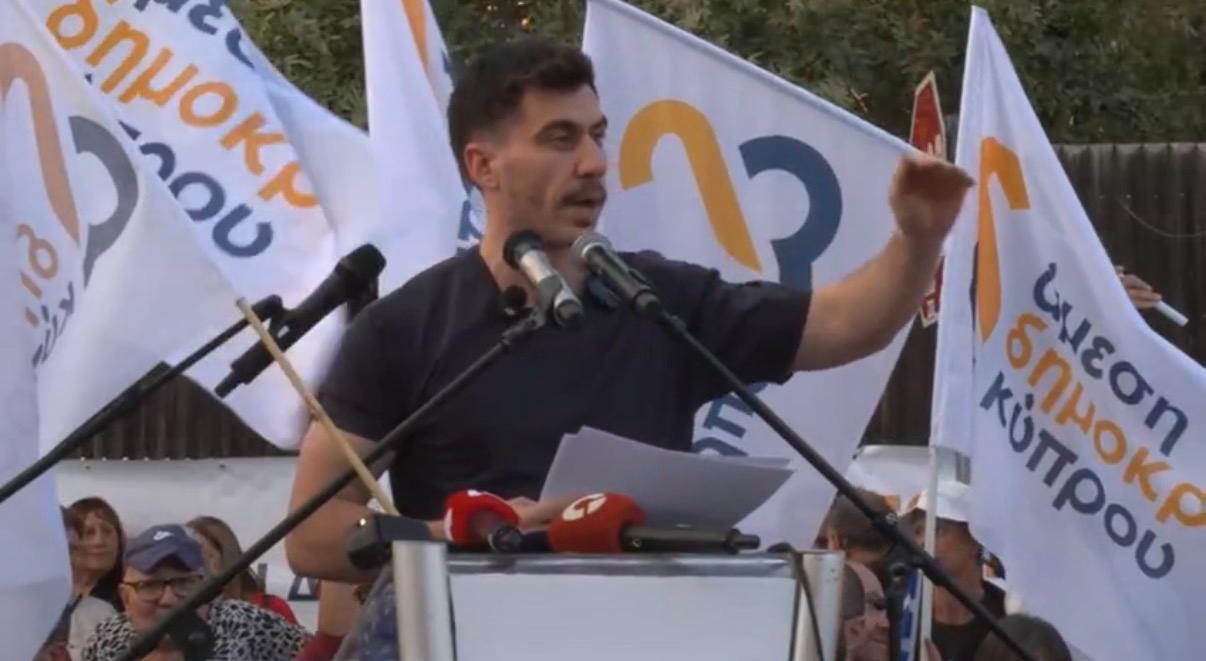
Direct Democracy Cyprus leader Fidias Panayiotou on Saturday led a march to the presidential palace to demonstrate against high and rising electricity prices, with the protesters submitting a letter to President Nikos Christodoulides demanding that electricity and fuel be recognised as basic necessities.
“The nationwide protest for the reduction in the price of electricity expresses a fair demand and a common request: that no household and no small or medium-sized business be deprived of basic necessities due to unbearable energy costs,” the letter read.
It added that electricity is “not a luxury, but a basic requirement for decent living and social wellbeing”, but that “its cost continues to significantly burden family budgets and the competitiveness of local businesses”.
On this front, it pointed out that according to figures released by the state statistical service, Cystat, energy prices rose by 15 per cent between August last year and August this year.
“For a worker paid the minimum wage, electricity bills, rent, food, and transportation absorb a significant amount of their disposable income,” it said, before adding that 1,000 kilowatt hours of electricity can cost consumers up to €295 in a household bill.
The letter also said that consumers in Cyprus are “being punished for policies which are not their own fault, for high electricity production costs, expensive fuel, renewable energy sources without storage, high value added tax, and the state being limited to temporary and inadequate half-measures towards consumers”.
Demands include illegal reduction of VAT, spending of ETS funds
It then listed its policy demands, which began with a “permanent reduction in VAT to five per cent”. This would be illegal under European Union law, which stipulates a minimum VAT rate of 15 per cent on most products sold within the bloc, with limited exceptions, none of which concern electricity or fuel.
The second policy put forward was “a review of the costing of pollutant rights” under the EU’s emissions trading system (ETS), though this system works with a market principle, meaning that the effective “right” to emit CO2 in the EU is auctioned off to member states rather than sold at a set price determined by any national government.
Additionally, the letter called for “direct targeted subsidies from pollutant revenues for vulnerable households and investment in the network”.
The first part of the policy would, again, be illegal under EU law, given that, according to the European environment agency, funds generated by the ETS system can be spent in six ways: for industrial decarbonisation, energy transformation, clean technology, adaptation to climate change, decarbonisation of the transport sector, and actions for just transition.
However, in this sense, it would be legal to use those subsidies to invest in Cyprus’ electricity network.
The letter also called for the “readjustment of proper pricing to take advantage of renewable energy prices”, “targeted support for vulnerable households and small and medium-sized businesses”, “the immediate installation of batteries for energy storage”, and “transparency in the process of adjusting production costs, network costs, and supply costs”.
In addition, it called for “effective measures to limit energy costs”, “transparent electrical interconnection” with other countries, “natural gas without delays”, “substantial long-term strategic planning”, and “market liberalisation”, though the latter of these points would appear to contradict many demands made in the letter.
Then, it called for “the end of cartels and the strengthening of real competition”, “market restructuring with real options for cheap electricity for households”, “mandatory transparency”, and “regular information on prices and the benefit of renewable energy”.




Click here to change your cookie preferences