
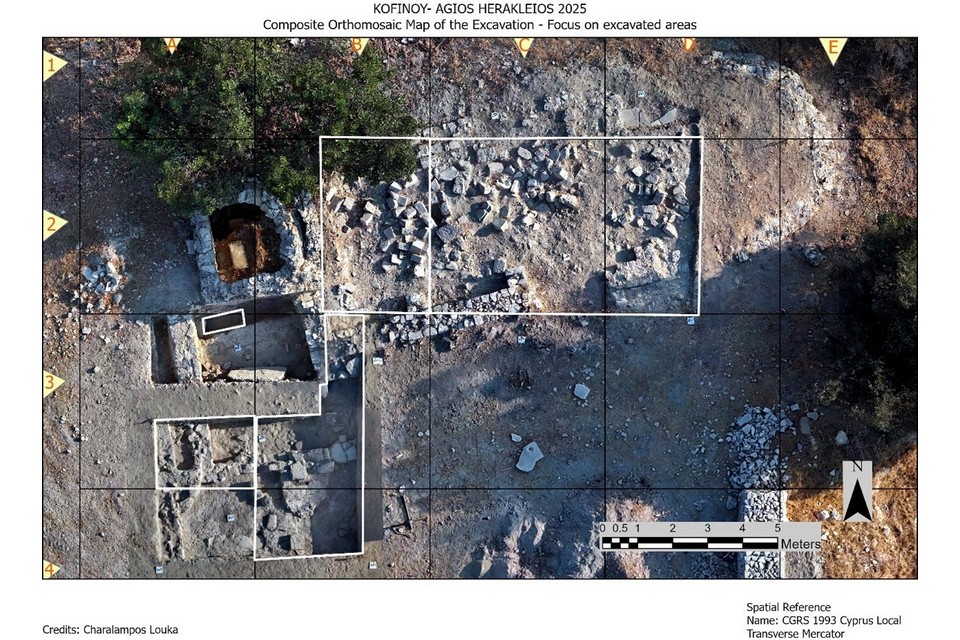
A Byzantine church temple and a clay-processing tank were uncovered during excavations at Kofinou-Ayios Heraklios and Menoyia-Limnes, in the Larnaca district.
“The excavation uncovered a near-complete floor made of large gypsum slabs and identified the position of the templon (sanctuary screen), marked by lime-mortar strips on the floor”, the antiquities department said on Monday.
Among “significant findings” inside the previously uncovered single-aisled church, the department lists “a dome […] characterised by curved voussoirs forming part of the dome’s drum and a square bay from the second and third pilaster pairs”.
The excavated single-aisled structure comprises a six-column compact cross-in-square church, built between the 8th and 10th centuries AD.
Fragments of non-figurative frescoes, resembling marble revetment with red and green bands on a white background, were revealed on the lower sections of the south wall, indicating widespread decoration. A smaller, secondary apse, built within the former larger apse of the original early Byzantine basilica, was also revealed in the sanctuary area.
The ceramic evidence from the collapse layers dates the abandonment and partial collapse of the church to the mid-14th century, while hearths, cooking vessels and animal bones found within the collapse indicate a different, non-liturgical use of the ruined space from the late 14th to the mid-16th century.
Furthermore, a trench south-east of the church exterior confirmed the funerary character of the surrounding area during the Late Middle Ages, with scattered human bones, a grave slab and ceramics of the 15th and 16th centuries.
The preliminary dating of the complex now proposes four successive building phases: an early Byzantine three-aisled basilica from the late 6th to early 7th century, a domed compact cross-in-square church built over the central nave of the basilica from the 8th to 10th century, a phase of funerary and domestic activity following the church’s collapse from the mid-14th to the mid-16th century, and the small barrel-vaulted chapel of Ayios Heraklios, built over the middle section of the basilica narthex from the post-16th century.
“It is for the first time in Cyprus that an organised cemetery, in continuous use from the 6th to the 16th century, together with evidence for cult activity during the troubled 8th to 10th centuries, are being documented archaeologically,” the department said.
“At Menoyia-Limnes, five new trenches significantly expanded our understanding of the early Byzantine pottery workshop. The most outstanding discovery of the season was a built clay-processing tank constructed directly on the natural rock, with alternating layers of pure clay and sieved earth in its interior, providing, for the first time in Cyprus, direct archaeological evidence for part of the production process in a pre-modern pottery workshop,” it added.
A water channel, formed by two parallel rows of upright stones, was found feeding into the basin, completing the picture of an organised production facility. Trenches revealed further architectural remains of storage and working spaces, including piles of wedged clay body and a large storage pithos in situ, fragments of pottery wheels and abundant production waste (wasters and over-fired sherds).
“The results of the 2026 season reinforce the exceptional significance of both sites for our understanding of rural and religious life, funerary customs and pottery production in Byzantine and medieval Cyprus, while continuing to shed light on the so-called Dark Ages of Byzantine Cyprus (8th to 10th century AD), a period that remains largely invisible in the island’s archaeological record,” the department said.
The excavations were conducted by the field project of the archaeological research unit and the archaeological summer field school of the department of history and archaeology at the University of Cyprus, from June 15 to July 24.


Click here to change your cookie preferences