
By Dina-Perla Portnaar
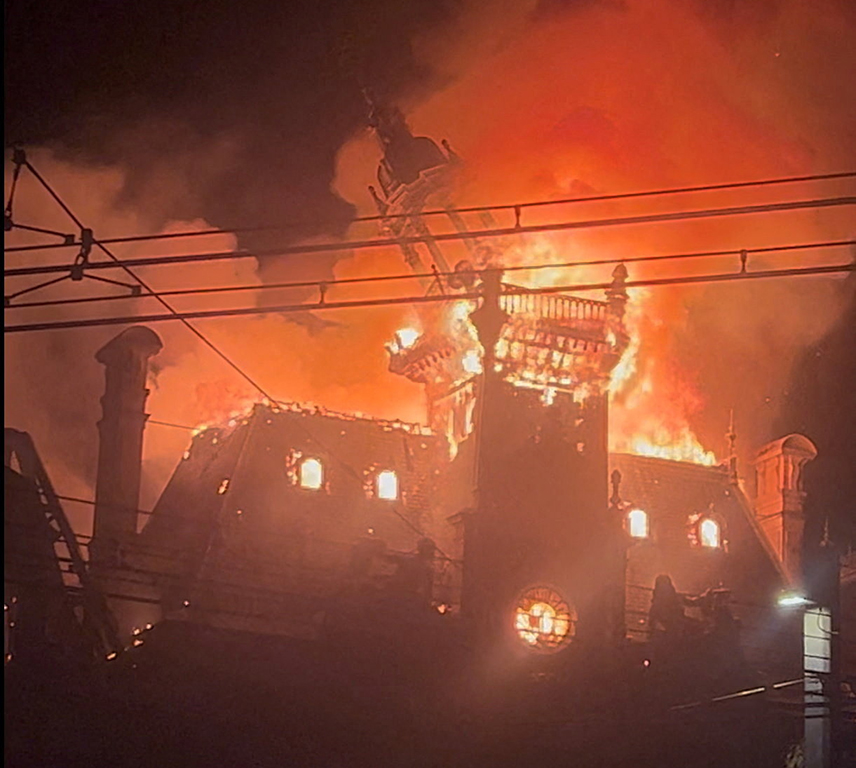
We all saw the destruction in France and other places recently. Let’s focus on France, which has been struggling with a crisis of authority, social resentment, economic pressure and political legitimacy.
Anger over policing, inequality, immigration and the perceived distance between government and ordinary citizens has helped produce an explosive climate.
The precise causes differ from one episode to another. What matters for Cyprus is the lesson beneath them. Once public order collapses, the damage extends far beyond the immediate political dispute. Because the occasion is used by those who hate and want to destroy the current civilisation.
Among the disturbing consequences is the destruction of irreplaceable heritage. An ancient object, a historic interior or an archaeological trace can be lost forever. Such destruction isn’t merely a financial expense but an assault on the continuity between the living and the dead, and between those who built the society and those who inherited it.
Cyprus should take this seriously. It can think five steps ahead to protect its heritage.
Cyprus possesses a density of inheritance. Churches, monasteries, archaeological sites, traditional settlements and historic urban centres are woven into its landscape. They’re evidence of the extraordinary human labour through which a place acquires its character. Their survival reflects centuries of faith, craftsmanship, sacrifice and adaptation.
A lot of those places are open to the public. In other words, unprotected. That’s charming and how a civilisation is supposed to run. But with its recent traumatic and complex history, still significantly present in people’s daily lives, Cyprus is fragile.
Cyprus isn’t secure because the present moment feels manageable and its society is run differently from countries such as France. Security also consists of anticipating what could happen when the political atmosphere changes, when crowds become uncontrollable, or when a local incident acquires symbolic significance far beyond its original setting. Politics isn’t only the management of today’s agenda. It’s the preparation of tomorrow’s.
Europe has now seen how governments can create the conditions for unrest through arrogance, incompetence or indifference. But grievances have become pretexts, leading to destruction that has nothing to do with protesting for a better tomorrow.
Some people don’t want to reform institutions. They direct their hostility towards the inherited structures of society itself, including its traditions, religious monuments and cultural achievements. Destruction is their statement of power to make everything that previous generations have built disappear. Recognising this isn’t an extremist position.
Cyprus cannot assume that its circumstances make it immune. It now has benefited from substantial European investment intended to support development and modernisation. But that isn’t a long-term security system. Images of disorder in France and elsewhere travel digitally, not just via the news gatekeepers. Tactics can be copied, grievances migrate across borders, and the spectacle of impunity can encourage people elsewhere to test the limits of their societies.
Cyprus has its precious quality of life to lose, shaped by landscape, scale, local enterprise, historical depth, and an intimacy between people and place. The small businesses that I adore are part of this texture. Small businesses were targeted the most in France. And thus, when violence destroys everything and compensation is inadequate or absent, where destruction recurs and accountability fails, the danger of further violence grows. That’s a lesson about escalation, not a public call for retaliation.
When governments lose control of public space, pressure grows for exceptional security measures, including the deployment of military personnel in domestic settings. The normalisation of this in Europe would reveal a serious failure of civilian institutions.
Meanwhile, instability within Europe serves the strategic interests of Russia, whose leadership draws on imperial ambitions and Soviet historical symbolism to challenge the cohesion of European states. The lesson for Cyprus of all of this is: internal disorder can become an external advantage.
That’s why political silence matters. When the crisis erupted in France, President Emmanuel Macron’s public response was criticised as insufficiently immediate and effective, and rightly so. Cyprus can already learn from it to think five steps ahead. It can start to audit the security of vulnerable heritage sites, establish rapid response protocols, protect small businesses, clarify responsibilities between police and civil authorities, and prepare credible systems for compensation and prosecution. Prevention is never panic. It’s the practical expression of historical intelligence.
A civilisation is rarely destroyed in one decisive moment. More often, its defences are neglected because each warning appears manageable in isolation. Cyprus has the advantage of foresight. There’s time to protect what cannot be rebuilt. So let’s think five steps ahead.


Click here to change your cookie preferences