
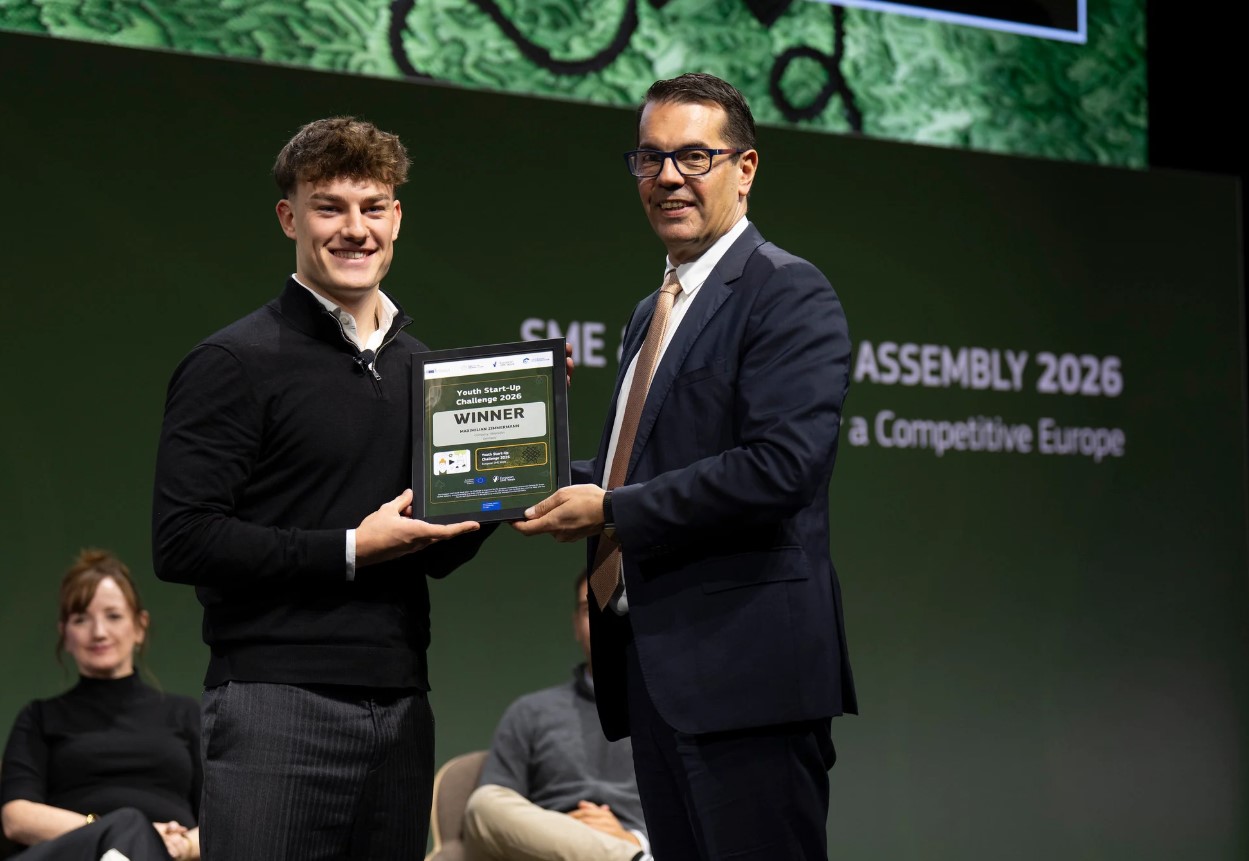
An 18-year-old German entrepreneur who is still at school has won the European Commission’s Youth Start-Up Challenge 2026 with an artificial intelligence tool designed to give care workers something they rarely have enough of – time.
Maximilian Zimmermann, co-founder and chief executive of Darmstadt-based StepSafer, took the top prize at the SME and Clusters Assembly in Dublin this week, after beating competition from a record 135 applications across Europe.
His winning idea, StepSafer Flow, addresses a problem familiar to care providers across the continent. Staff spend considerable time filling in reports, updating patient records and dealing with administrative tasks when they could be looking after people.
Zimmermann and his co-founder, Jonathan Burchard, believe AI could change that without forcing care providers to replace the software they already use.
Their technology allows carers to operate existing systems simply by speaking to them, with support for more than 99 languages.
A spoken instruction can retrieve medical information, prepare patient documentation, assign tasks to colleagues working later shifts or send updates to relatives.
Crucially, the system works with the software already installed at care facilities, rather than requiring expensive replacements or complicated data migrations.
According to the company, carers currently lose around one-third of their working time to administration, a problem made more pressing by Europe’s growing demand for long-term care.
StepSafer estimates that its technology could reduce the administrative work associated with a home visit from 19 minutes to around four minutes.
Those figures remain company projections, but the potential business opportunity is considerable.
The European Commission has estimated that the EU will need more than 1.6 million additional long-term care workers by 2050 simply to maintain existing levels of coverage.
With Europe’s population ageing and care providers struggling to recruit enough staff, technology that reduces paperwork could offer a practical way to make better use of an increasingly stretched workforce.
For StepSafer, the attraction is also commercial. Rather than competing directly with established healthcare software providers, its technology is designed to work alongside them, potentially reducing the cost and disruption of adoption.
The company has already secured commitments from 26 care services to participate in testing phases, covering more than 4,700 clients.
What makes that particularly striking is that the business has reached this stage without external investment or a marketing budget.
Zimmermann launched his first business at 14 and is now developing StepSafer while completing his education. He is due to sit Germany’s Abitur school-leaving examinations in 2027.
His age was certainly unusual in a room filled with experienced investors, European policymakers and business executives, but the competition was decided on more than youthful ambition.
The three finalists were selected by a jury assessing creativity, originality and the ability to communicate a convincing business idea.
The jury was chaired by Igor Kalinic, head of sector for competitiveness and internationalisation at the European Innovation Council and SMEs Executive Agency (EISMEA).
It also included Teri Smith of Enterprise Ireland, Vincent Jocquet, managing partner at RDY Ventures, and Goncalo Ribeiro, chief executive of RTBeamTech and a winner of the 2025 competition.
After the finalists presented their ideas live in Dublin, the audience cast the deciding votes.
Zimmermann’s victory earned him an invitation to the European Innovation Council Summit 2027 in Brussels, where he will have the opportunity to meet investors, entrepreneurs and policymakers who could help his business expand beyond Germany.
He was not the only young entrepreneur presenting a business with practical applications.
Gabriela Cosmina Ursache, representing Italian start-up Labby, reached the final with a portable diagnostics platform designed to bring laboratory testing directly to farms.
Its first product, CalCow, allows farmers and veterinary professionals to measure blood calcium levels in dairy cows, helping identify hypocalcaemia before it develops into a more serious health problem.
The technology is intended to make testing faster and more accessible, reducing reliance on conventional laboratory procedures.
The third finalist, Jonas Helfen from Germany, presented ecoverity, a spin-off from RWTH Aachen University.
His company is developing technology to automate the preparation of Environmental Product Declarations, which provide verified information about the environmental impact of construction materials.
The business aims to reduce a process that can take months to just hours, helping manufacturers meet increasingly demanding European sustainability requirements.
Unlike many early-stage concepts, ecoverity has already attracted more than 30 paying customers and operates without external funding.
The three businesses reflect the growing variety of opportunities emerging across Europe’s start-up economy, from healthcare and agricultural diagnostics to construction technology.
Established in 2023, the Youth Start-Up Challenge is part of European SME Week and offers entrepreneurs aged between 18 and 25 an opportunity to present their ideas to an international audience.
The competition is open to eligible young entrepreneurs from EU member states, including Cyprus, and countries associated with the SME pillar of the Single Market Programme.
Applicants submit a short video and business plan, with the strongest proposals shortlisted for the final presentation.
For Europe’s next generation of founders, the prize is less about a trophy than the opportunity to secure connections, visibility and potential business partners.
And for Zimmermann, who still has his school-leaving exams to complete, winning a European start-up competition may turn out to be only the beginning.



Click here to change your cookie preferences