
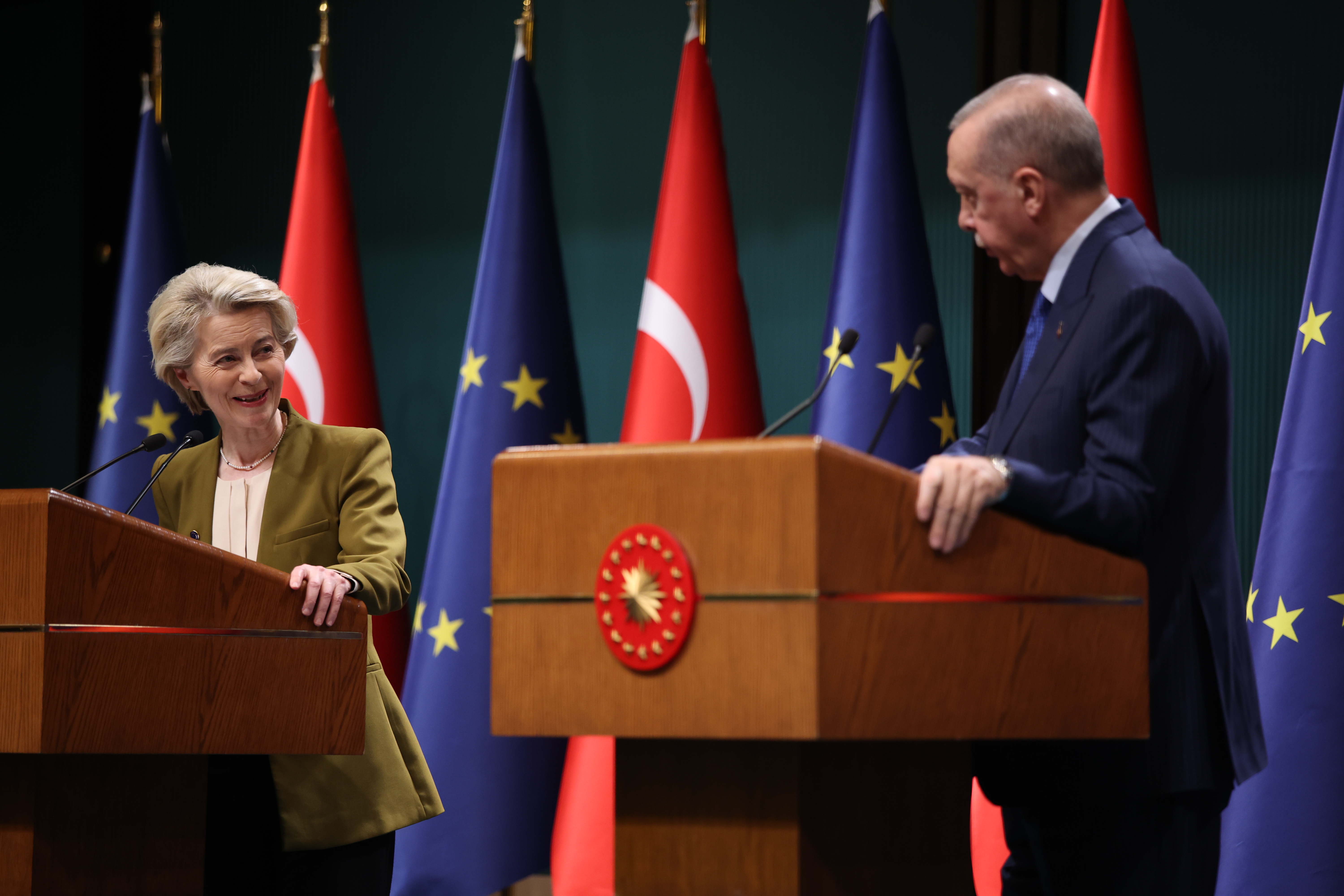
The European Union is “ready” to discuss the updating of its customs union with Turkey in exchange for “cooperation” on the Cyprus problem, the Cyprus Mail understands.
Sources close to the matter informed the newspaper that Brussels is now willing to consider altering the deal, which first entered into force in 1996, should it deem Turkey to be an active participant in efforts to bring about a resumption of negotiations in earnest on the Cyprus problem, and then in efforts to solve the Cyprus problem.
At present, Turkey has a customs union agreement with the EU, but given that Turkey is not a full EU member, it does not enjoy the full benefits of the union. As such, when the EU signs a trade deal with a third country, imports to Turkey from that third country can no longer be tariffed, but that third country can continue to place tariffs on Turkish exports.
Given this to be the case, Ankara has long been campaigning for either a revised customs union deal, or full membership of the customs union – something which is currently only enjoyed by the EU’s 27 member states and Monaco.
In April, Turkish Foreign Minister Hakan Fidan used a joint press conference with his Austrian counterpart Beate Meinl-Reisinger to press for better terms.
“Given the numerous geostrategic, geopolitical and geoeconomic benefits Turkey could offer, why is this membership not happening? Of course, every story has two sides. We have never demanded that membership conditions not be met or that Turkey join without fulfilling them,” he said.
Fidan: Turkey-EU relations being ‘held hostage by one country’
He also lamented that Turkey’s relations with the European Union are being “held hostage by one country”.
“Unfortunately, there are some inherent rule-based dilemmas within the European Union. For example, 26 out of 27 countries, representing 400 million people, may want something, but the preference of less than a million people, or even a country with a population of less than a million, can render it sufficient,” he said.
Therefore, he added, “Turkey and the European Union – 500 million people – can be held hostage by one country”, before stressing that “the current system makes this possible”.
“While a common structure of 500 million people could achieve something in all these areas, a country with less than a million people can be a significant obstacle, and nobody can say anything about it,” he said.
In February, he had been more explicit, saying that “for issues such as the customs union to progress, the reservations of parties in the EU, such as the Greek Cypriot administration, need to be lifted”.
Kos: Clear interest from some EU countries in new customs union with Turkey
Some inside the EU have also called for an update to its customs union with Turkey, with Hendrik Wust, the president of the Bundesrat, Germany’s legislative council of representatives of its 16 constituent states, having been among them.
“No region is as closely connected to Turkey socially and economically as North Rhine-Westphalia,” he said, in reference to his native state, of which he also serves as minister-president, and which is Germany’s industrial powerhouse.
He added that “this close connection is a strength which we nurture”, and said that “to do that, we also need reform of the EU-Turkey customs union and must improve visa procedures”.
More recently, European Enlargement Commissioner Marta Kos said last week that “there is a clear interest from some of the European countries [which] want to update the customs union” as she presented the commission’s annual report on the country to the European Parliament’s foreign affairs committee (Afet).
However, others have expressed reservations regarding the prospect of an upgrade to Turkey’s customs union deal, with Cypriot government spokesman Konstantinos Letymbiotis saying in April that “if Turkey wants to look for the reasons why it does not see progress in relations with the EU, it must look in the mirror”.
Likewise, Cypriot member of the European Parliament Loucas Fourlas, of Disy, in April said of discussions regarding an upgraded customs union that “the message we are sending is wrong and dangerous”.




Click here to change your cookie preferences