
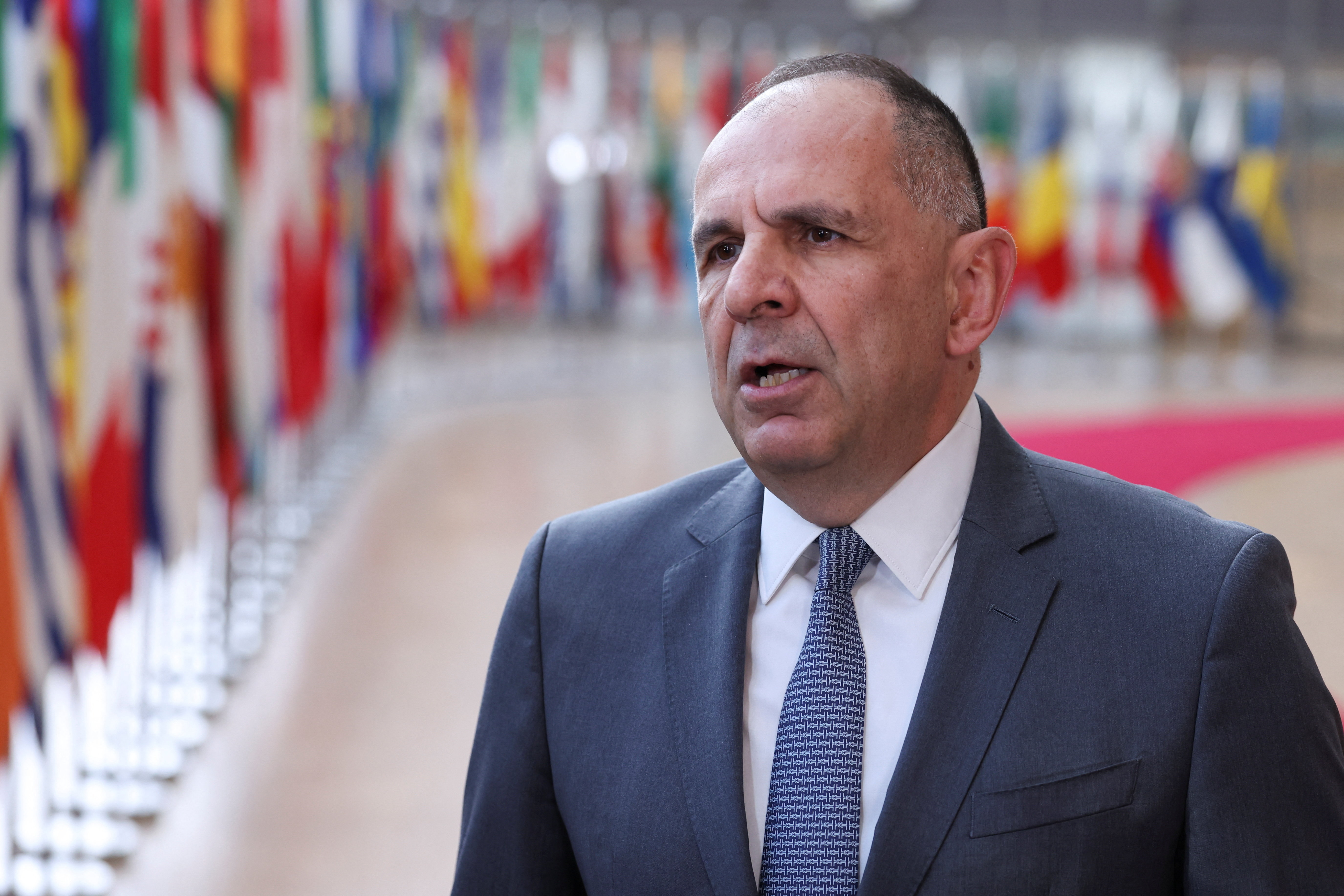
Greece has sent a clear message to Ankara that it will not tolerate interventions in its electricity interconnection with Cyprus.
On Friday, Greek Foreign Minister Giorgos Gerapetritis said from Kurdistan that the Great Sea Interconnector was proceeding and that the Greek side had already given permission for explorations and the submerging of the cable.
In an interview, in the framework of the Slemani Strategic Forum in Sulaymaniyah, Gerapetritis referred to past Turkish interventions and highlighted the European nature of the GSI.
“We have made it clear that this project is of European importance and we will not tolerate any intervention in this specific issue,” he stressed.
Gerapetritis explained that the project would connect Greece with Cyprus, and in the next stage with the Middle East, adding that its implementation would contribute towards restricting electricity overdependence.
The project’s importance, he added, extended beyond Greece and Cyprus to Europe, Africa and the Middle East.
He pointed out that the Mediterranean already had a large number of energy interconnections and that, despite the claims made by various states, there was no reason for confrontation in such projects.
Greece is an energy hub
Gerapetritis made special reference to enhancing Greece’s energy role in the eastern Mediterranean, saying that his country had evolved into an energy hub through pipelines, electricity interconnections and the Vertical Gas Corridor, which was developing through cooperation with US corporations.
He also touched upon the natural gas exploration and exploitation projects south of Crete, in collaboration with Chevron and Exxon, as well as the electricity interconnection of Greece and Egypt through GREGY project.
Gerapetritis explained that the aim was to transport green energy between Europe and Africa, in order to enhance energy security and limit dependence on third countries.
Referring to Europe’s previous excessive energy dependence on Russia, Gerapetritis said European countries should further develop their energy infrastructure and interconnections.
He also said the relationship between Greece and the United States was at its peak and highlighted the close cooperation of the two countries in regional and international matters.
Instrumentalisation of Straits of Hormuz ‘unacceptable’
Referring to developments in Iran and US President Donald Trump’s next moves, Gerapetritis advocated exhausting all diplomatic means to reach a solution.
“I do not believe that any military action at this point in time, in such an unstable region, could lead to sustainable peace,” he pointed out.
The Greek foreign minister said the instrumentalisation of the Straits of Hormuz was unacceptable, adding that obstructing free shipping caused energy and food insecurity at a global level.
Diplomatic efforts, he said, must include the Gulf states and neighbouring countries, in order to form a viable solution that will guarantee the regional security and free shipping.
He also underlined the need to strengthen European deterrence, pointing out that Europe can no longer take American security guarantees for granted.
“If you don’t have deterrence mechanisms in place, you cannot ensure peace,” he explained.
IMEC economic corridor of global importance
Gerapetritis said the India-Middle East-Europe economic corridor (IMEC) was a project of global importance, which could change the landscape of international transport and energy interconnections.
He said developments in the Straits of Hormuz, Bab al-Mandab and the Red Sea make it necessary to develop alternative routes for the transport of goods, electricity, data and telecommunications.
“We consider that Greek ports are the absolutely logical final destination of the corridor to Europe and the gateway to Europe,” he said.
Gerapetritis said Greece had the necessary port infrastructure in Piraeus, Thessaloniki and other ports, as well as the largest merchant fleet in the world, which represented almost 20 per cent of the global and over 60 per cent of the European fleet.
He added that access to eastern and central Europe, as well as to north Africa, could be guaranteed through Greek energy and transport interconnections.



Click here to change your cookie preferences