
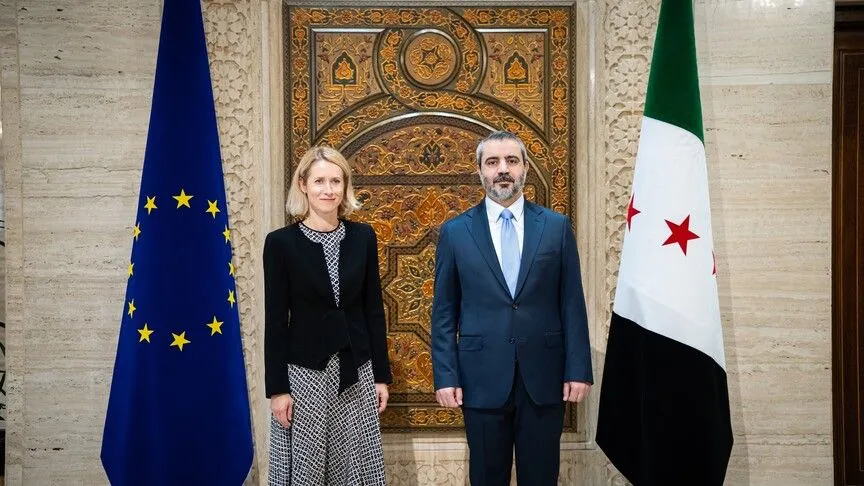
European Union foreign ministers agreed on Monday to move ahead with a deal to deepen ties with Syria, foreign policy chief Kaja Kallas said, reviving an accord first drafted in 2008.
A discussion paper, prepared by the bloc’s diplomatic service ahead of the meeting, sketched one of Brussels’ most ambitious efforts yet to normalise ties with Syria, less than two years after Bashar al-Assad’s fall ended decades of authoritarian rule and reshaped regional alliances.
“The EU seeks a major upgrade in its ties with Syria, and today ministers supported moving ahead with the EU-Syria Association Agreement,” EU foreign policy chief Kaja Kallas told reporters after a monthly foreign ministers’ meeting in Brussels. An association agreement typically paves the way for closer trade ties and economic and political cooperation.
She said diplomats would now work through the technical and legal details to finalise the agreement, which would create a framework for free trade, political dialogue and broader cooperation between Brussels and Damascus.
Syria faces enormous reconstruction needs after nearly 14 years of civil war that devastated infrastructure and crippled the economy. Its new authorities have sought foreign investment to rebuild the country and revive trade after years of international isolation.
“Everybody said that we need to engage with Syria because if we don’t engage, then this vacuum will be filled by other players,” Kallas said.
She added that once the 2008 accord was finalised, work would begin to negotiate revisions to the pact so that elements such as conditionality on human rights and Damascus’ previous support for Russia in the war against Ukraine were taken into consideration.
Russia’s intervention in Syria’s civil war helped keep Assad in power for years and secured Moscow’s strategic foothold on the Mediterranean. Since his overthrow, however, the Kremlin has been trying to secure a new deal with the current authorities to preserve access to the Tartous naval facility and Hmeimim air base, assets that underpin its military reach in the region.
The decision follows the resumption of the EU’s 1978 cooperation agreement with Syria and the first high-level political dialogue between Brussels and Damascus in May.
The EU has committed €620 million ($718 million) in support for Syria in 2026 and 2027, covering humanitarian assistance and socio-economic recovery.


Click here to change your cookie preferences