
International business has become increasingly interconnected. Companies routinely work with suppliers, customers and partners across different countries, while managing payments, payroll and operating expenses in multiple currencies. Yet, despite the technological progress that has transformed financial services, moving money across borders can still be surprisingly complicated and expensive.
New research published by the European Central Bank (ECB) in September 2026 highlights just how important payment infrastructure is for international economic activity. According to the ECB’s Research Bulletin, “Connecting payment systems, linking economies”, estimates suggest that countries whose fast payment systems are interconnected trade approximately 4 per cent more with each other than comparable countries without such connections.
The research also suggests that the benefits are greater in regions where cross-border payments are particularly expensive and where interconnected systems support the settlement of wholesale transactions. The findings suggest that improving international payment infrastructure is not simply a matter of reducing transaction fees or accelerating transfers. It can also contribute to international trade, strengthen economic integration and create new opportunities for businesses operating across borders.
For companies with international operations, the implications are significant. Payment costs, settlement times, currency conversion and administrative complexity can directly affect cash flow, operational efficiency and ultimately competitiveness.
The importance of payment infrastructure
The European payments landscape has undergone significant transformation, particularly through the development of the Single Euro Payments Area (SEPA) and the expansion of instant payments. SEPA has helped standardise euro payments across participating European countries, reducing many of the barriers traditionally associated with cross-border transactions within the region.
The introduction of the EU Instant Payments Regulation represents another important development. Since October 2025, banks in the euro area that provide standard euro credit transfers have also been required to offer the sending of instant euro payments, following the introduction of the corresponding requirement for receiving payments in January 2025.
These developments are helping establish a European payment environment in which eligible euro transfers can be completed within seconds, regardless of traditional banking hours.
The regulatory framework is also evolving for Electronic Money Institutions (EMIs) and Payment Institutions (PIs). Changes to European legislation enable these institutions to seek direct participation in designated payment systems, subject to the applicable requirements, while the regulatory deadline for EMIs and PIs in the euro area to offer both sending and receiving of instant euro payments is April 2027.
This evolution is expected to support greater competition and innovation in the European payments market, creating opportunities for specialised financial service providers to develop more efficient payment solutions.
Multi-currency accounts and businesses’ changing needs
As international business activity becomes more complex, companies increasingly require payment solutions that go beyond the ability to send and receive money.
For businesses operating across several markets, managing different currencies through separate banking relationships can create unnecessary administrative work. Finance teams may need to monitor multiple accounts, coordinate transfers between institutions and manage currency conversions at different stages of their operations.
Multi-currency corporate accounts offer an alternative by allowing businesses to manage funds in several currencies through a single financial platform.
This can be particularly useful for companies receiving revenues and making payments in different currencies. Rather than converting incoming funds immediately into euros and subsequently converting them again to meet foreign currency obligations, businesses may be able to retain balances in the original currency and use them for future payments.
Against this background, the role of Electronic Money Institutions in the European financial services market has become increasingly important. Operating within the European regulatory framework, EMIs provide businesses with alternatives for managing payments and electronic money.
Moneygate, an Electronic Money Institution licensed and regulated by the Central Bank of Cyprus, is among the institutions developing solutions to support businesses with international financial operations. Through our technology-driven approach, we provide corporate payment services designed to help companies manage transactions, currency requirements and financial processes more efficiently.
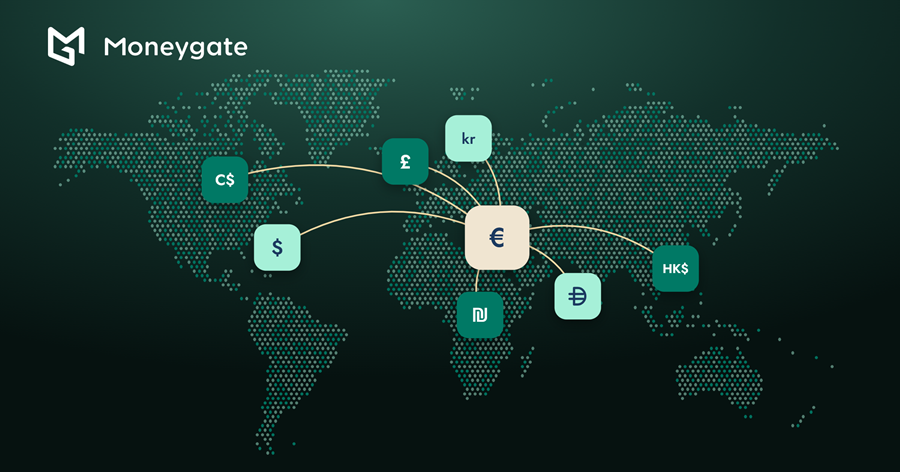
A recent development has been the expansion of our multi-currency corporate account capabilities, allowing customers to hold balances, send payments and convert funds across a wider range of currencies through a single account. These include the euro (EUR), US dollar (USD), British pound (GBP), Canadian dollar (CAD), UAE dirham (AED), Hong Kong dollar (HKD), Israeli shekel (ILS) and Danish krone (DKK).
The expansion reflects the growing need for financial services that accommodate businesses operating across multiple jurisdictions, rather than requiring them to organise their payment activities around separate national banking systems. For internationally active companies, the ability to manage several currencies within one environment may simplify financial administration and provide greater flexibility in handling payments and liquidity.
Moneygate’s approach also incorporates API-based connectivity and digital payment infrastructure, supporting businesses seeking to integrate financial services more closely with their everyday operations.
Contact us to discuss your needs and receive tailored-made solutions: https://moneygate.com/contact





Click here to change your cookie preferences