
COP31 in Antalya has entered its decisive phase. After a first week dominated by initiatives and technical discussions, governments must confront the political disagreements determining whether the summit delivers meaningful progress.
An ambitious draft agreement published on November 16 has brought these differences into sharper focus. Fossil fuels, electrification, climate finance and the future of international cooperation remain contested.
Meanwhile, wars, energy insecurity, economic pressures and competing national priorities are challenging governments’ willingness to compromise.
Can COP31 reconcile these interests, or will global challenges undermine another opportunity for progress?
An ambitious draft meets political resistance
Australia’s Chris Bowen, who leads the negotiations, presented an 18-page draft agreement on Monday, intended to narrow differences before Friday’s scheduled conclusion.
The document contains proposals that several countries have already opposed. Bowen acknowledged that agreement would require difficult compromises.
Its most contentious provisions concern fossil fuels. One option retains the COP28 commitment to transition away from fossil fuels, while another proposes stronger language calling for an accelerated phase-out.
The draft also addresses electrification, adaptation finance and responses to exceeding the Paris Agreement’s 1.5°C temperature threshold.
These are negotiating options, not agreed commitments. Some could be weakened or removed entirely.
The difficulty is that governments increasingly disagree not only about the transition’s pace, but also about who should bear its costs.
Fossil fuels expose deep divisions
A coalition of approximately 60 countries is pressing for clearer commitments to transition away from fossil fuels. Several producing and developing economies oppose stronger language, citing energy security, economic development and national sovereignty.
For exporters, oil and gas revenues remain essential to government finances. For developing importers, affordable energy is fundamental to industrialisation and improving living standards.
The Middle East crisis has reinforced these concerns. Disruptions to energy supplies and shipping have demonstrated the economic consequences of dependence on vulnerable supply routes.
Yet the crisis also strengthens arguments for reducing dependence on imported fossil fuels through domestic renewables, electrification and diversification.
These objectives do not produce identical policies everywhere. Countries with abundant renewable resources may accelerate electrification, while others prioritise domestic gas, nuclear power or existing infrastructure.
A credible agreement must recognise different national circumstances without allowing energy security to become an indefinite justification for postponing emissions reductions.
Electrification confronts infrastructure constraints
Turkey continues promoting its target of increasing electricity’s share of global final energy consumption to 35 per cent by 2035.
IRENA expects electrification to become a defining outcome of COP31, although resistance remains to incorporating the target into the final agreement.
More importantly, electricity networks have emerged as a major bottleneck. Renewable generating capacity is expanding rapidly, but transmission, distribution and system flexibility are not keeping pace.
Without sufficient infrastructure, additional renewable electricity cannot always reach consumers, while system costs increase.
The disagreement therefore concerns more than targets. It concerns the investment needed to deliver affordable, reliable and increasingly cleaner electricity.
Climate finance becomes a confrontation
Finance negotiations are becoming increasingly difficult.
Developing countries want stronger guarantees that wealthy economies will expand adaptation finance.
African countries are pressing for at least $120 billion annually by 2035, while alternative negotiating proposals would postpone agreement on a specific amount.
Reported adaptation finance declined from $81.5 billion in 2022 to $64.1 billion in 2024.
Even tripling available finance would cover less than 30 per cent of developing countries’ estimated needs, according to UN Secretary-General Antonio Guterres.
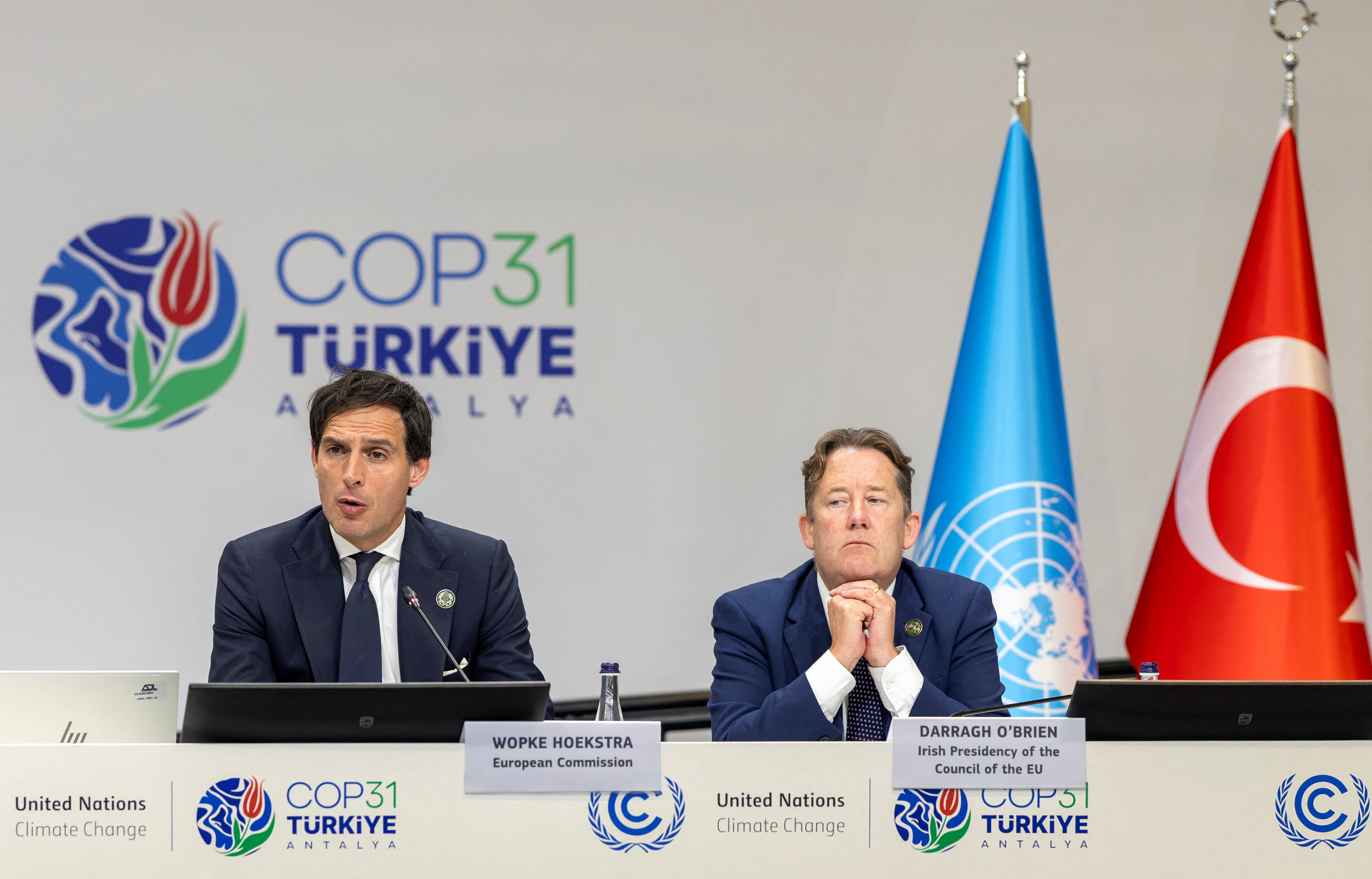
Developing economies want grants, affordable finance and greater accountability. Developed countries face fiscal constraints and increasingly seek private-sector participation.
A new initiative involving the UK, Norway and Canada aims to mobilise $10 billion for emerging-market projects by 2030.
Such initiatives are useful, but mobilising private capital is not equivalent to guaranteed public funding.
Without agreement on financial responsibilities, broader compromises will remain difficult.
Methane offers a possible breakthrough
Barbados, the UK and France are pressing for stronger methane provisions in the final agreement, potentially extending beyond voluntary commitments made at COP26.
Reducing methane emissions offers relatively rapid climate benefits because it is a powerful but shorter-lived greenhouse gas.
Existing technologies can address many emissions from oil and gas operations.
However, agreement remains uncertain. Major emitters, including China, Russia and India, did not join the original Global Methane Pledge.
There is also a contradiction within Europe. The EU is considering delaying and weakening aspects of its methane legislation for oil and gas following industry and US pressure.
This illustrates the difficulty of reconciling international climate ambitions with domestic economic priorities.
The 1.5°C dilemma
COP31 is confronting an uncomfortable reality: temporarily exceeding the Paris Agreement’s 1.5°C warming threshold is now widely considered unavoidable.
The emerging approach, known as “overshoot and return,” seeks to limit how far temperatures rise above 1.5°C and subsequently bring them below that threshold, potentially by the end of the century.
But returning to 1.5°C is not equivalent to avoiding overshoot.
Scientists claim that even temporary warming above that level could cause irreversible ecosystem damage, accelerate ice loss and commit the world to further sea-level rise.
Returning to lower temperatures would require sustained emissions reductions and potentially large-scale carbon dioxide removal, whose future costs and deployment remain uncertain.
This raises a fundamental question: Does acknowledging overshoot represent necessary realism, or could it provide another justification for postponing difficult decisions?
A credible strategy must minimise both the magnitude and duration of overshoot rather than rely on uncertain future technologies to reverse today’s emissions.
This also reinforces the importance of reducing methane emissions now.
Global challenges complicate negotiations
The absence of an official US administration delegation continues to affect the diplomatic environment, although American state and local representatives remain active.
China remains central, both as the largest current emitter and a major supplier of renewable technologies, batteries and electric vehicles.
Disagreements over trade restrictions, industrial competitiveness and technology access demonstrate that climate diplomacy increasingly overlaps with geopolitical competition.
Meanwhile, thousands of demonstrators marched through Antalya on Saturday demanding stronger action. Public pressure remains substantial, but it cannot substitute for agreement among governments.
Can COP31 deliver?
The second week has exposed the central contradiction facing international climate negotiations.
Governments recognise the urgency of climate change, but immediate priorities increasingly concern energy security, economic growth, fiscal stability and geopolitical risks.
Nevertheless, the draft agreement demonstrates that ambitious proposals remain under discussion.
A weaker agreement may preserve diplomatic consensus without accelerating implementation. An excessively ambitious agreement without financing or political support could prove equally ineffective.
COP31 must reconcile climate ambition with economic and geopolitical reality rather than treating them as competing objectives.
The decisive question is whether governments can agree on practical measures, credible financing and realistic implementation.
The coming days will reveal whether COP31 advances that process or becomes another example of international ambition constrained by national priorities.





Click here to change your cookie preferences