
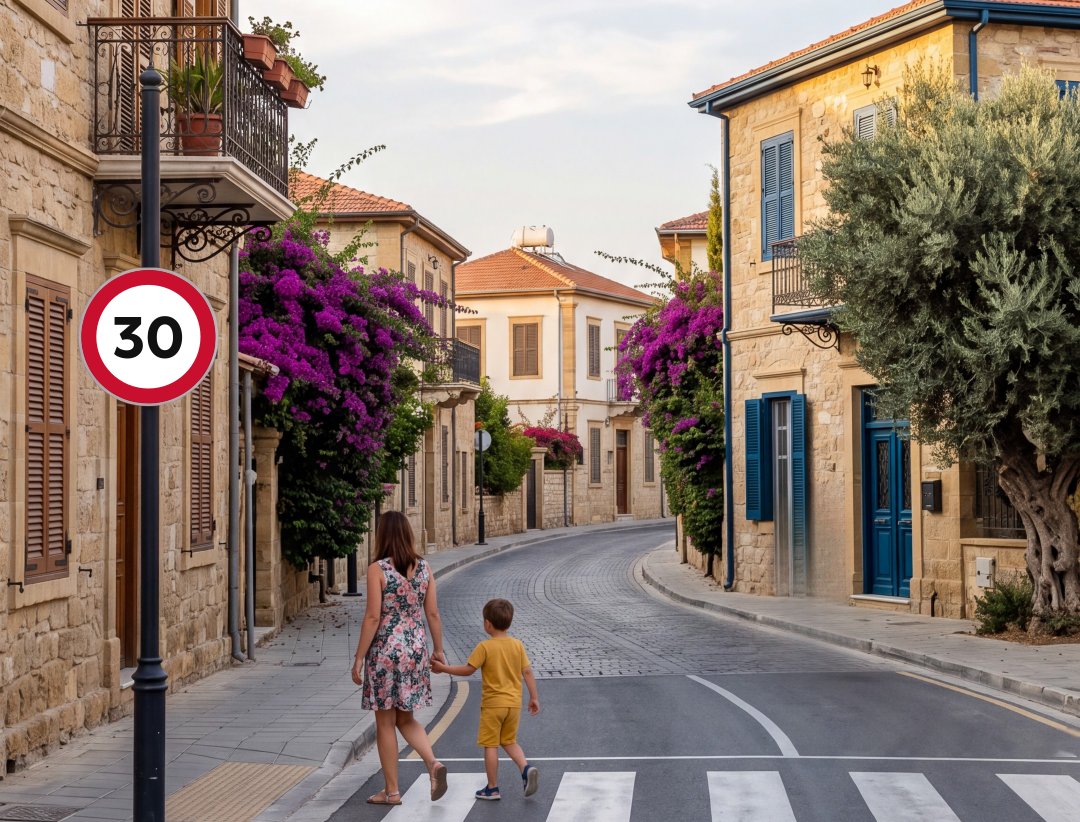
It is extremely difficult to comprehend the reasoning behind the Nicosia municipality’s decision to introduce 20 and 30km speed limit zones in different parts of the capital. In fact, the municipal council appears to have imposed these speed limits in all parts, from the walled city to Ayios Dhometios and Aglandjia and from Engomi to Kaimakli and Palouriotissa.
Parts of these old suburbs, the wise Nicosia councilors decided, must be protected from speeding cars, as if there was a problem of cars racing through the narrow streets of the Kaimakli and Engomi’s ‘historic’ centre. Even if a reckless driver wanted to speed in these parts of town, the narrowness of these roads makes it impossible.
Have there been many fatal accidents in these parts of town to justify the 20kmh speed limit? The truth is these are the safest roads of the capital because, even without absurdly low speed limits, cars do not speed in them. Would cyclists, who often go faster than 20kmh, be fined when going through these places or will the limit apply only to cars?
The danger is that the municipal council could eventually decide to extend this limit to other roads, making driving at such a low speed an ordeal for drivers. Could the municipal council be trusted not to place a 20kmh limit on more roads, after a year or two, as part of its ‘mobility’ plan?
This is not the worst of the municipality’s new plans. In its effort to protect the areas of particular historic or cultural importance, it will regulate the type of vehicles entering. For example, a big delivery truck would be allowed into these areas only by special permission. A truck delivering furniture to a house, for example, would be obliged to apply to the traffic warden’s office for permission to enter a ‘protected’ area. And a traffic warden would have to be present for the truck to enter the area.
The reason, apparently, is so that the roads in these parts of town are not over-used by heavy trucks, although refuse collection trucks would still have to enter every week. Would there be a traffic warden to supervise the refuse collection trucks which often work after midnight, or will these have a free pass to the areas of historic or cultural importance?
The general impression is that very little thought has been given by the municipal council to these unnecessary restrictions, which it claims would create ‘traffic-calming zones.’ What would be next? Banning cars altogether from the historic centres by lowering the speed limit to 10kmh?


Click here to change your cookie preferences