
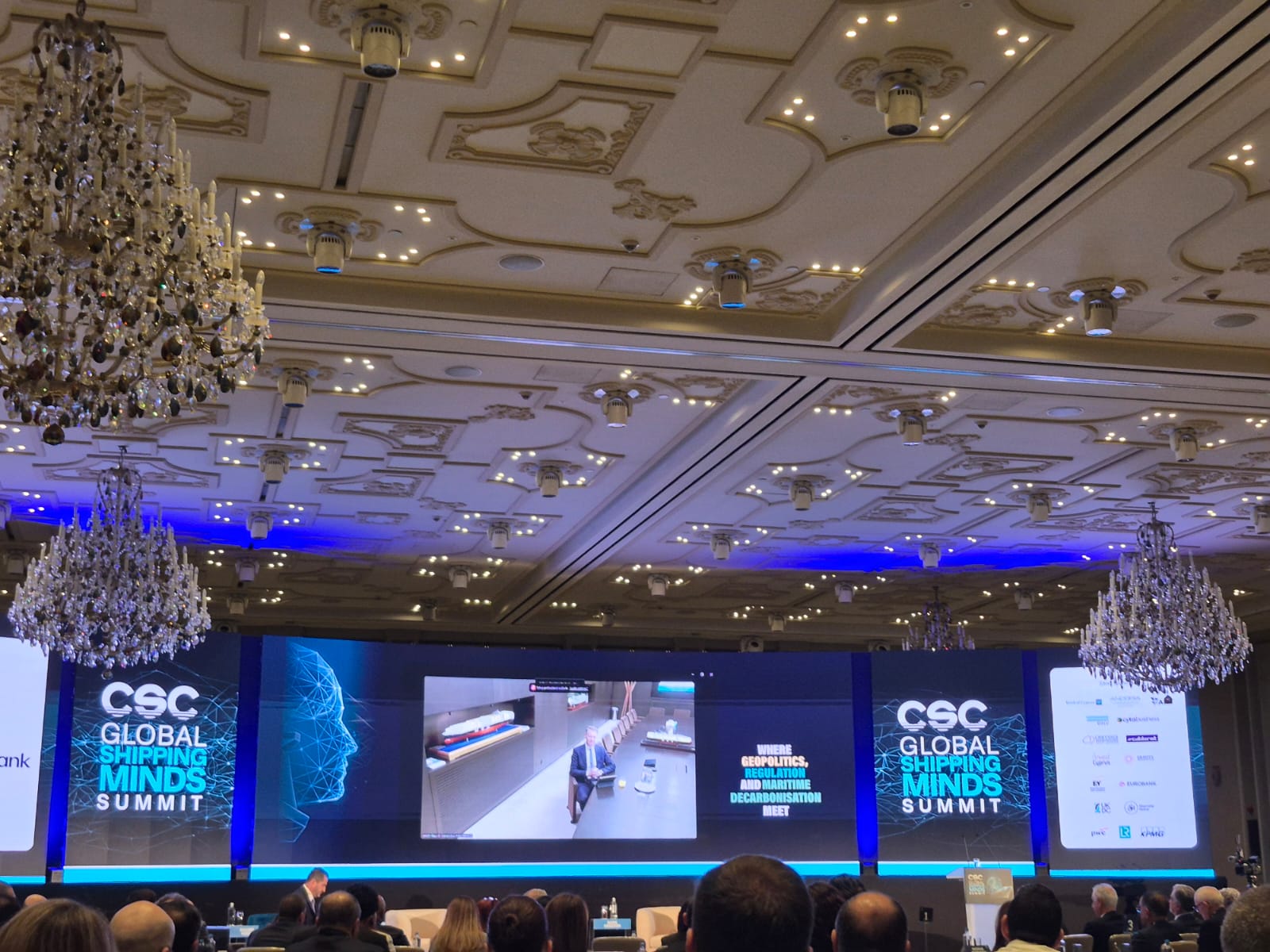
Mediterranean Shipping Company (MSC) chief executive Soren Toft on Friday warned that European emissions rules risk undermining the competitiveness of Mediterranean ports, threatening thousands of jobs and leaving European consumers to pick up the bill, as he revealed that the company’s Cyprus shipmanagement operations had grown to more than 750 vessels.
Speaking during a virtual interview at the inaugural Global Shipping Minds Summit in Limassol, Toft called for a single global regulatory framework for shipping, arguing that overlapping regional measures distort competition, increase costs and fail to deliver corresponding reductions in global emissions.
The MSC chief was interviewed by International Chamber of Shipping (ICS) secretary-general Thomas Kazakos at the event, organised by the Cyprus Shipping Chamber (CSC), just days before international negotiations on maritime decarbonisation resume in London.
Opening the discussion, Toft spoke of the importance of Cyprus to the family-owned shipping group, describing the island as the company’s principal location for shipmanagement activities.
“Cyprus has a special place in our family company,” he said, adding that MSC was proud of the development of its operations on the island and grateful for the support it had received over the years.
In recent years, the company’s Cyprus operations have expanded from just over 100 ships to well above 750 vessels, according to Toft.
His remarks follow MSC’s recently announced expansion plans, which include registering more vessels under the Cyprus flag.
The plans were outlined by MSC chief financial officer and co-owner Alexa Aponte Vago during a meeting with President Nikos Christodoulides in Nicosia earlier this month.
According to the Presidency, MSC Shipmanagement Cyprus employs more than 500 people, around 300 of whom are Cypriots.
Asked what regulatory framework would give MSC sufficient certainty to invest at scale, Toft pointed out that “the company and the wider shipping industry had already committed substantial sums to cleaner technologies.”
The industry, he estimated, had invested approximately $200 billion in dual-fuel containerships, with liquefied natural gas (LNG) emerging as its preferred option for the coming decades.
For MSC, however, the regulatory priority remains a practical and predictable global framework.
Ships operate across multiple countries and regions every day, Toft explained, making it difficult for companies to manage different carbon pricing mechanisms, competing fuel standards and regulatory environments.
A global framework must therefore apply equally to countries and shipping companies, ensuring fair competition.
Toft expressed his opposition to a patchwork of regional regulations, acknowledging that some might argue that regional measures accelerate short-term progress, but warning that overlapping systems create complexity and distort competition without necessarily reducing global emissions.
A successful agreement at the International Maritime Organisation (IMO), he said, must provide global measures, with revenue generated through carbon pricing directed towards developing future fuels.
The MSC chief was particularly critical of the EU Emissions Trading System (EU ETS), describing it as an example of regional regulation that puts Mediterranean shipping at a competitive disadvantage.
With Brussels expected to take important decisions concerning the regulation in the coming weeks, Toft expressed concern about its impact on the attractiveness of European transshipment ports.
European governments, he said, needed to address the issue because thousands of jobs at European ports, particularly in the Mediterranean, were potentially at risk.
Toft argued that “the additional cost imposed by the system would ultimately be passed on to European consumers without delivering the intended global environmental benefits.”
On the question of alternative fuels, the MSC chief acknowledged the uncertainty surrounding the industry’s long-term energy transition but said shipping companies could not afford to remain inactive while waiting for the ideal solution.
“We cannot sit back and wait,” he said, adding that the industry could not wait indefinitely for the perfect fuel.
Although fossil LNG is not a long-term net-zero solution, Toft said MSC regarded dual-fuel LNG technology as the most practical and credible option currently available for a company of its size.
The fuel is commercially available, the technology is relatively mature and safe, and global bunkering infrastructure is already in place, allowing companies to reduce emissions while maintaining the reliability of shipping services, he explained.
Toft also reminded delegates that shipping companies are fuel consumers rather than fuel producers.
The same dual-fuel engines currently running on fossil LNG could eventually operate using bio-LNG and potentially synthetic LNG, he said, describing conventional LNG as the starting point rather than the final destination of the energy transition.
Addressing concerns over methane slip, Toft said the company was working with fuel suppliers and technology partners, pointing to improvements in engine technology.
MSC’s fuel decisions, he explained, depend on four fundamental considerations, namely whether a fuel delivers meaningful emissions reductions, whether it is available and affordable, whether it can be used safely and whether it can be supplied reliably across the company’s global network.
Decarbonisation, he said, must not come at the expense of shipping’s ability to serve international trade.
Asked how MSC balances geopolitical risks, regulatory compliance and environmental objectives, Toft said the company’s foremost responsibility remained the protection of its employees and seafarers.
He referred to vessel rerouting in response to security disruptions as an example of the difficult choices shipping companies face.
Longer voyages and operational adjustments can increase fuel consumption, emissions and costs, but Toft stressed that the safety of seafarers would always take precedence over those considerations.
The same principle informed MSC’s position on Arctic shipping routes.
Despite their potential strategic advantages, Toft referred to environmental damage, operational risks, safety concerns and geopolitical pressures as reasons for the company’s opposition to using such routes.
For MSC, he explained, growing global trade and achieving net-zero emissions were not mutually exclusive objectives.
“We have to do both,” he said, calling for solutions that allow shipping to continue serving global trade while reducing its environmental impact.
The industry was already delivering investment and technology, Toft added, but governments and regulatory authorities now needed to provide a clear, predictable global framework.
Responding to Toft’s remarks, Kazakos reiterated the industry’s commitment to the IMO’s decarbonisation objectives, stressing that their implementation must be practical, realistic and supported by available and affordable fuels.
He also called for the concerns raised in Limassol to be heard during the forthcoming IMO negotiations in London.





Click here to change your cookie preferences