
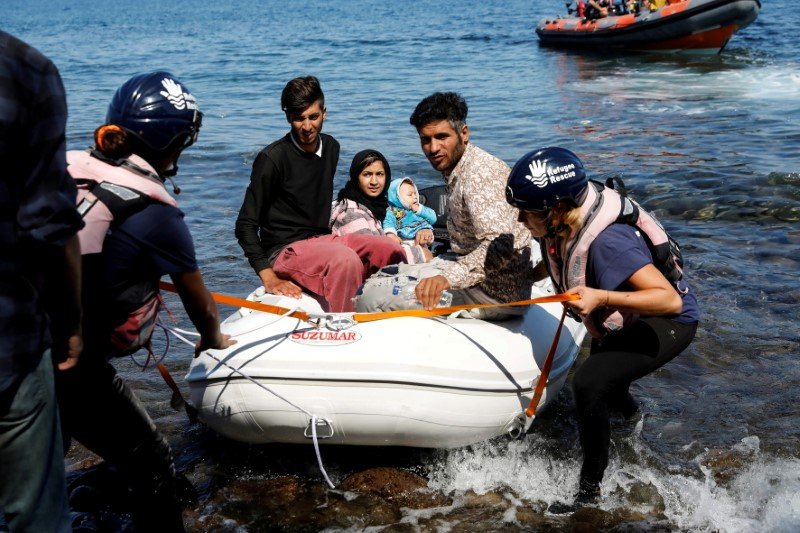
Two dozen aid workers went on trial in Greece on Thursday on charges including migrant smuggling, in a case that rights groups have dismissed as a baseless attempt to outlaw aid for refugees heading to Europe.
The trial on the island of Lesbos comes as EU countries, including Greece – which saw more than one million people reaching its shores during Europe’s refugee crisis in 2015-2016 – are tightening rules on migration as right-wing parties gain ground across the bloc.
The 24 defendants, affiliated with the Emergency Response Center International (ERCI), a nonprofit search-and-rescue group that operated on Lesbos from 2016 to 2018, face multi-year prison sentences. The felony charges include involvement in a criminal group facilitating the illegal entry of migrants and money laundering linked to the group’s funding.
Among them is Sarah Mardini, one of two Syrian sisters who saved refugees in 2015 by pulling their sinking dinghy to shore and whose story inspired the popular 2022 Netflix movie The Swimmers, and Sean Binder, a German national who began volunteering for ERCI in 2017. They were arrested in 2018 and spent over 100 days in pre-trial detention before being released pending trial.
“The trial’s result will define if humanitarian aid will be judicially protected from absurd charges or whether it will be left to the maelstrom of arbitrary narratives by prosecuting authorities,” defence lawyer Zacharias Kesses told Reuters.
Greece has toughened its stance on migrants. Since 2019, the centre-right government has reinforced border controls with fences and sea patrols and in July it temporarily suspended processing asylum applications for migrants arriving from North Africa.
Anyone caught helping migrants to shore today may face charges including facilitating illegal entry into Greece or helping a criminal enterprise under a 2021 law passed as part of Europe’s efforts to counter mass migration from the Middle East and Asia.
In 2023, a Greek court dropped espionage charges against the defendants.
Rights groups have criticised the case as baseless and lacking in evidence.
“The case depends on deeply-flawed logic,” Human Rights Watch said in a statement. “Saving lives at sea is mischaracterized as migrant smuggling, so the search-and-rescue group is a criminal organization, and therefore, the group’s legitimate fundraising is money laundering.”




Click here to change your cookie preferences