
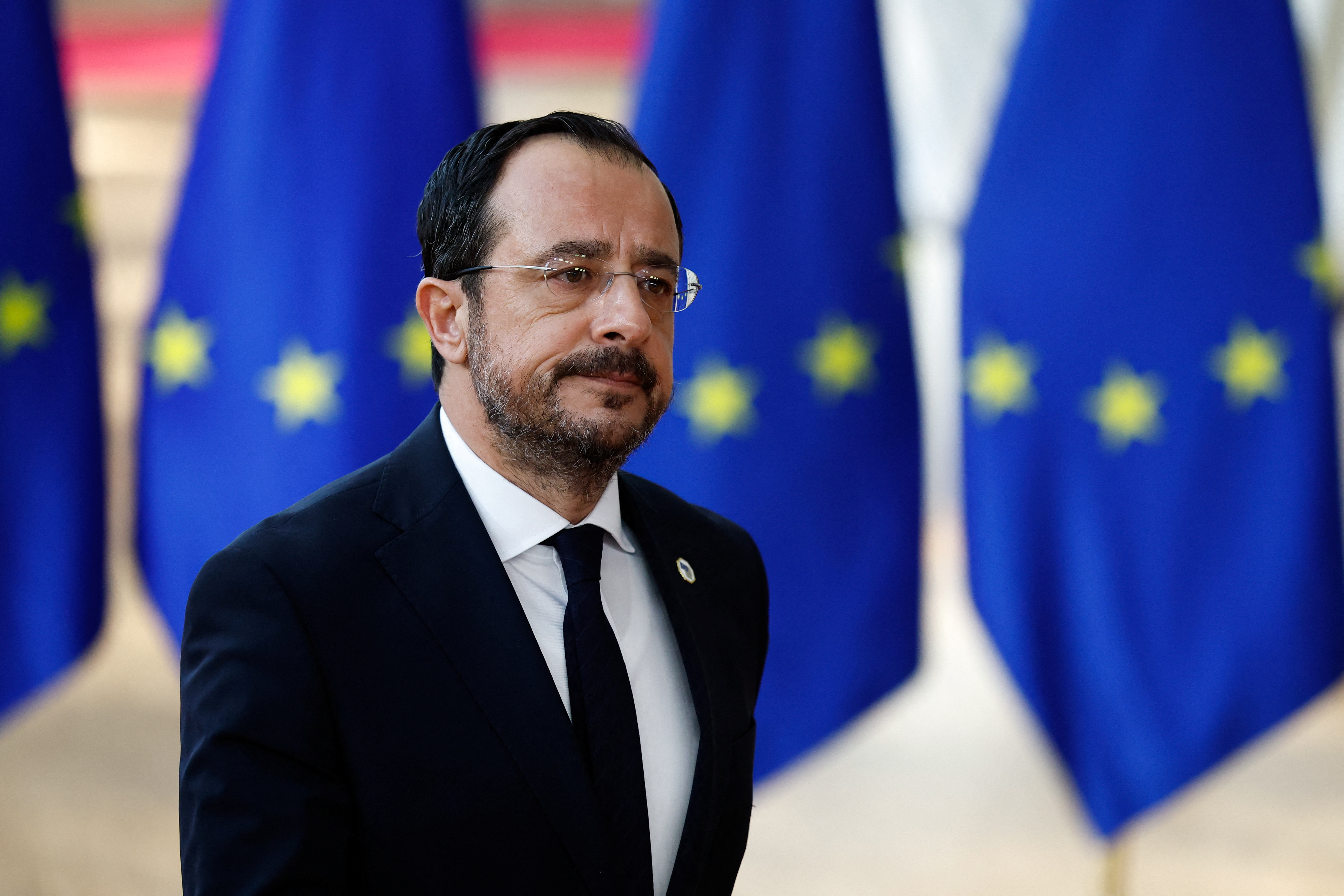
President Nikos Christodoulides said on Wednesday that Cyprus has demonstrated in practice that European strategic autonomy is achievable, as he addressed policymakers in Brussels while holding key meetings on the Cyprus issue and regional challenges.
Speaking at the European policy centre, he said “Cyprus has proven in practice that European autonomy is both feasible and real”, pointing to recent security cooperation with European partners following a drone incident on the island.
He stressed that “Cyprus is not part of the conflict unfolding in the region”, adding that there had been “a single, isolated incident with a drone at the British bases”.
Christodoulides described the response from EU member states as unprecedented, saying “Greece, France, Italy, Spain and the Netherlands immediately reacted positively to my request and deployed means and personnel to strengthen the defence and security of Cyprus”, adding that “Cypriots will never forget this act of brave solidarity”.
He argued that while the EU’s mutual defence clause under article 42.7 was not formally triggered, “Cyprus has essentially tried it. And successfully. This could be the beginning of something much bigger for our Union”, adding that “when one member state is attacked, the entire European Union is attacked”.
On the sidelines of the European council, Christodoulides was due to meet Antonio Guterres and Ursula von der Leyen, with the Cyprus problem, the US-Israeli conflict with Iran, and the island’s foot and mouth disease outbreak high on the agenda.
Ahead of his meeting with Guterres, he was expected to “clearly reaffirm our political will to immediately resume the talks from the point where they were interrupted in Crans Montana”, warning that “maintaining the current impasse cannot be an option”.
Discussions with von der Leyen were set to focus on support measures linked to the disease outbreak as well as tourism and broader regional developments.
Christodoulides also used his Brussels visit to outline priorities for Cyprus’ EU council presidency, saying it is “above all an opportunity” to strengthen Europe’s defence readiness and strategic autonomy.
He said efforts are under way to advance defence coordination, stressing that “the ability to rapidly and decisively deploy capabilities across Europe is essential”.
He added that enlargement remains “the Union’s most successful foreign policy tool”, pointing to progress in accession discussions with Montenegro and Albania, as well as ongoing preparatory work concerning Ukraine and Moldova.
The president said Cyprus’ role remains focused on stability and support, describing the island as “a safe haven” that is “always part of the solution, never part of the problem”, while emphasising the Levant’s importance to European security.

Click here to change your cookie preferences