
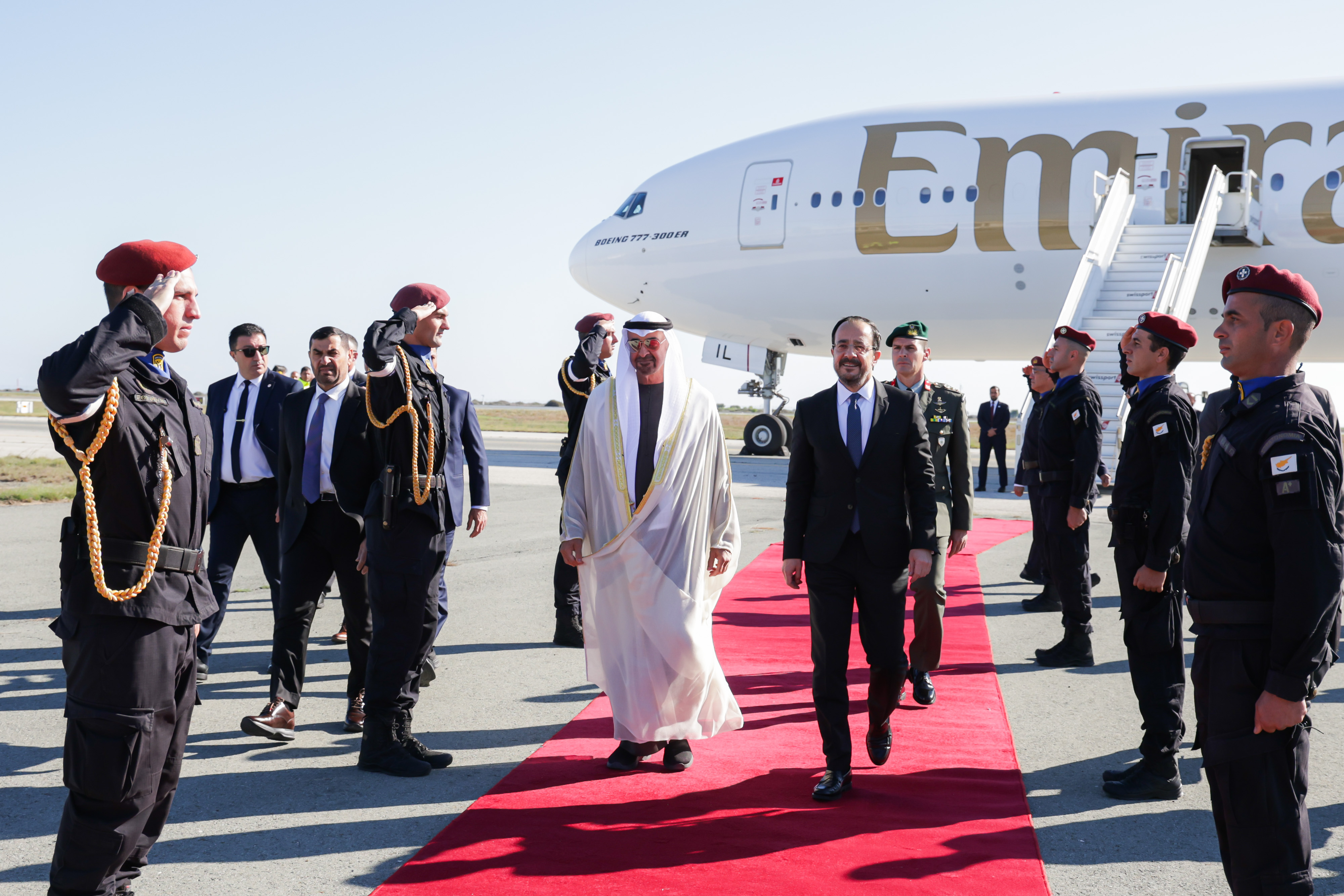
There is little doubt that since the election of President Nikos Christodoulides relations with the United Arab Emirates have been significantly strengthened and taken on another level. There was cooperation on the Amalthea humanitarian sea corridor, while earlier this year, when it became clear that Cyprus would face a serious water shortage crisis, the UAE came to the rescue, providing the island with desalination units, free of charge. The assistance, in a time of need, was greatly appreciated by Nicosia, which was in dire straits.
It is against this background that the President of the UAE Sheikh Mohamed bin Zayed Al Nahyan visited Cyprus on Sunday. It was the first ever visit to Cyprus by a UAE president, justifying the government’s use of the word ‘historic’ to describe it. “This visit constitutes the most formal confirmation that relations between Cyprus and the UAE have been substantially upgraded and the Comprehensive Strategic Cooperation of the two countries acquires yet greater depth and operational dynamic,” said government spokesman Konstantinos Letymbiotis. The two leaders, he said, agreed that the day of the visit “signified the transition of bilateral relations from strategic convergence to strategic implementation.”
The two countries also agree on the need for intensifying cooperation in “specific sectors of priority” such as the economy, trade, technology, renewable energy sources, education, culture, tourism and synergies that support mutual development. It was encouraging, however, to read that, according to government sources, energy cooperation appeared to be among the top priorities of the UAE with regard to investments in Cyprus. The UAE proposed, during the weekend meetings, the drafting of a Comprehensive Strategic Energy Partnership that aims, through cooperation with the UAE, to make Cyprus an “energy hub for the broader region and in the direction of the EU, including a broad range of actions, from RES to storage and natural gas.”
Even better news was that the UAE, according to government sources, expressed the desire to look at specific investments with priority being given to the LNG terminal, which it had classified as the “most mature project.” If it takes the initiative on energy matters and undertakes energy related projects as part of its Cyprus investment programme, it would be a help. Given our consistent failure to complete energy projects – the 20-year failure to import natural gas is an example – we should welcome outside investors taking over such projects because they would want to succeed and secure a return on their investment.
The strengthening of relations between Cyprus and the United Arab Emirates, underlined by Sunday’s visit and agreements, is good news for Cyprus. And it would be great news if the investments in energy projects materialise.





Click here to change your cookie preferences