
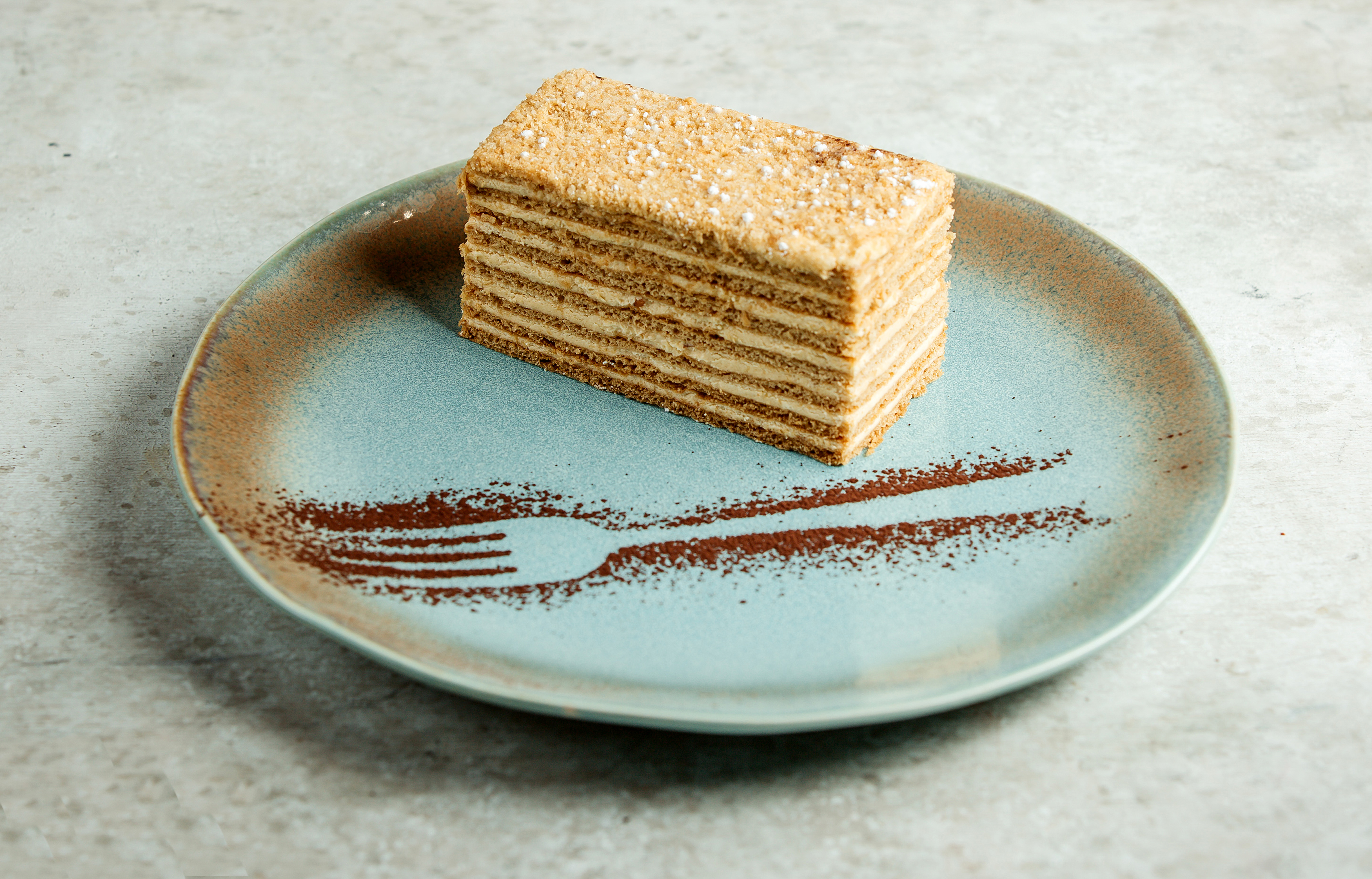
Medovik is a multi-layered honey cake closely associated with Russia and the wider post-Soviet space, where it became one of the most recognisable homemade desserts of the 20th century. Its name comes directly from the Russian word for honey, which defines both its flavour and structure.
The cake is built from multiple thin sponge layers made with honey, filled with sour cream or condensed milk-based cream, and left to rest so that the initially firm layers absorb moisture and soften into a cohesive whole.
The preparation is slow and deliberate. The baked layers harden quickly once removed from the oven, but over several hours, often overnight, the cream penetrates them, creating a texture that is neither dry nor heavy. The finished cake is usually coated with crumbs made from trimmed layers or with nuts, reinforcing its understated appearance. Although countless variations exist, honey remains essential.
A persistent legend places the cake’s origin in the 19th century Russian imperial court, where a young chef is said to have unknowingly served a honey cake to Empress Elizabeth Alexeievna, who allegedly disliked honey. The story ends with instant approval and lasting fame. Yet this tale does not withstand scrutiny. No 19th century Russian cookbooks mention such a cake, and honey was primarily used for gingerbread, during that era. The idea that a court kitchen would produce an unfamiliar honey cake, or that an inexperienced cook would misjudge imperial tastes, is historically implausible.
Documented evidence points elsewhere. The first recorded recipes for medovik appear only in the mid 20th century, notably in Ukrainian cookbooks published in Kyiv in the late 1950s and early 1960s. Its rise coincided with the Soviet period, when it became a cherished domestic dessert rather than a product of restaurants or state catering. It was absent from official collections and cafeterias, living instead in family notebooks and kitchens, where mothers and grandmothers prepared it for birthdays and holidays, often under affectionate names such as little bee or honey fluff.
Over time, professional chefs began to reinterpret the cake. In Moscow restaurants, additions have ranged from fruit purées and prunes to elaborate decorations involving meringue, honeycomb, or even gold leaf. More eccentric versions have also appeared, though the classic form remains dominant. Similar honey based layered cakes exist across central and eastern Europe and the Caucasus, reflecting shared tastes and culinary exchange rather than a single origin.
Today medovik continues to travel. Through Russian-speaking communities and specialist patisseries, it has reached Cyprus, where it appears quietly on bakery menus in Nicosia, Limassol and Paphos, especially around festive seasons.
Medovik endures because it balances simplicity with patience, and familiarity with restraint. It is a cake whose appeal lies not in spectacle, but simply in tasting good without ceremony or symbolic excess at the table.




Click here to change your cookie preferences