
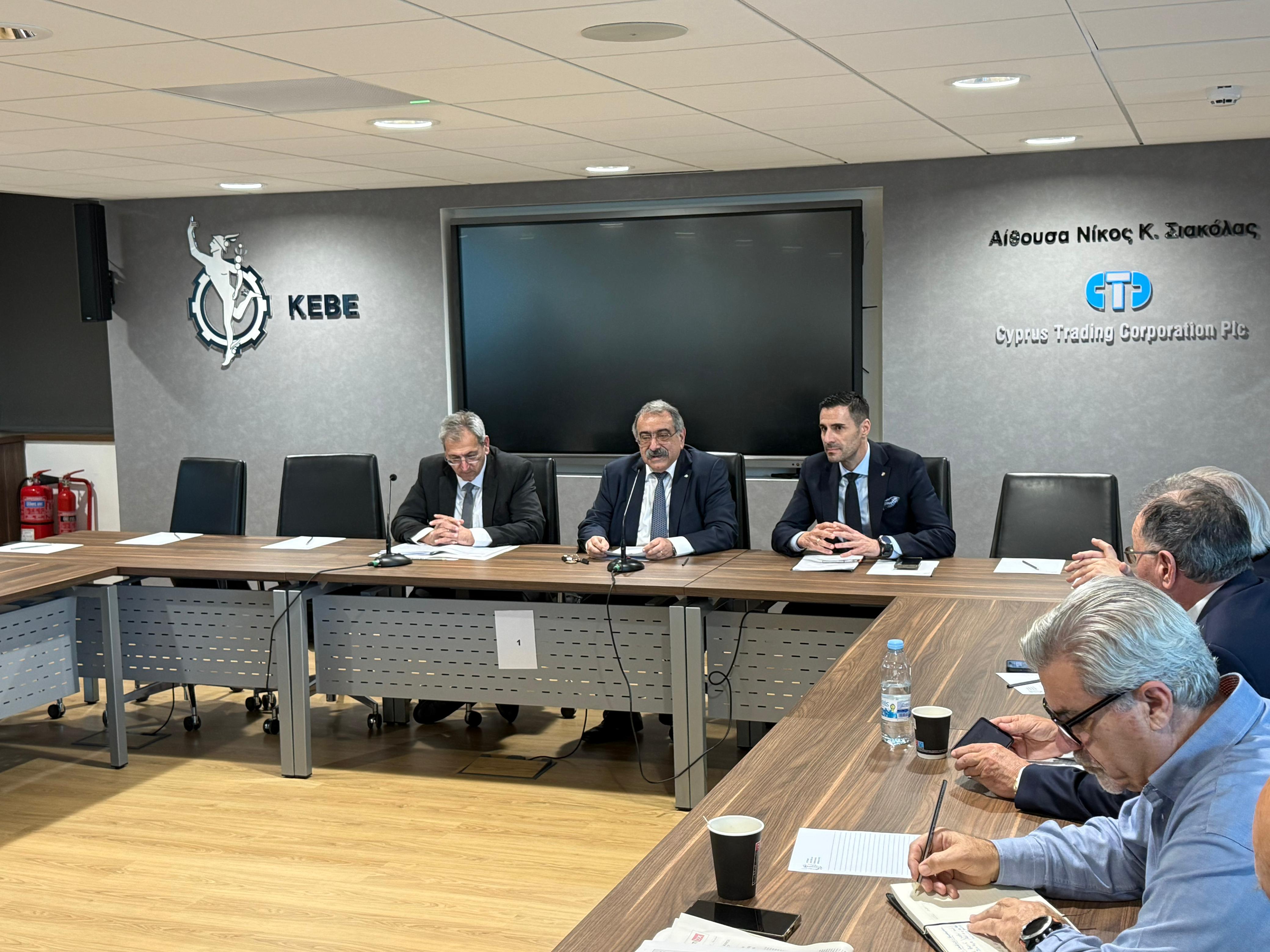
Labour Minister Marinos Moushiouttas on Tuesday met with the board of the Cyprus Chamber of Commerce and Industry (Keve) to discuss mounting labour market pressures and key policy reforms affecting businesses.
The meeting took place in Cyprus and involved members of the Keve board of directors, who held extensive discussions with the minister on labour and social insurance issues.
During the talks, serious workforce shortages across all sectors of economic activity were highlighted as a growing challenge affecting the smooth operation of businesses.
Keve stressed that these shortages are undermining business competitiveness, with knock-on effects for the wider economy.
Drawing on the latest labour market data, Keve pointed out that the employment rate has reached 79.85 per cent, while unemployment has declined to 5 per cent, signalling conditions of near full employment.
These conditions, Keve argued, “are creating an acute shortage of labour, making it increasingly difficult for businesses to meet their staffing needs”.
In this context, the chamber indicated that “the continued granting of permits for foreign workers is unavoidable in order to cover labour shortages”.
At the same time, Keve underlined the need to modernise the criteria for issuing work permits, so that current labour market realities are properly taken into account.
The chamber also called for students to be allowed to work without restrictions across all professions, in line with practices followed in other European Union countries.
The discussion also covered pension reform, with Keve emphasising that it is actively participating in the work of the relevant technical committee examining the issue.
The chamber stated that “its aim is to help shape a socially fair, long-term sustainable pension system that is compatible with the needs and resilience of the Cypriot economy”.
Moreover, it was underlined that the proposed pension reform “constitutes a deeply structural intervention with significant social, economic and fiscal implications”.
For this reason, Keve stressed that the reform “requires a well-documented approach, clear cost assessment and full transparency, so that changes do not impose disproportionate burdens on the real economy”.
Additionally, the chamber reiterated that it “supports the rationalisation of the pension system, provided that the reform remains transparent, fiscally prudent and socially targeted”.
Keve also warned that “reforms should not endanger the sustainability of the Social Insurance Fund or lead to future slippage through increased contributions”.
According to an announcement from the chamber, the national minimum wage was also discussed during the meeting.
Keve stated that “it conveyed its strong disagreement with the introduction of an hourly minimum wage, expressing concern about its impact on businesses”.
The chamber argued that “the determination of hourly labour costs should remain as it is today, based on the working hours applied by each individual business”.
Finally, Keve pointed out that this approach “mirrors practices in other EU countries that apply a statutory minimum wage”.





Click here to change your cookie preferences