
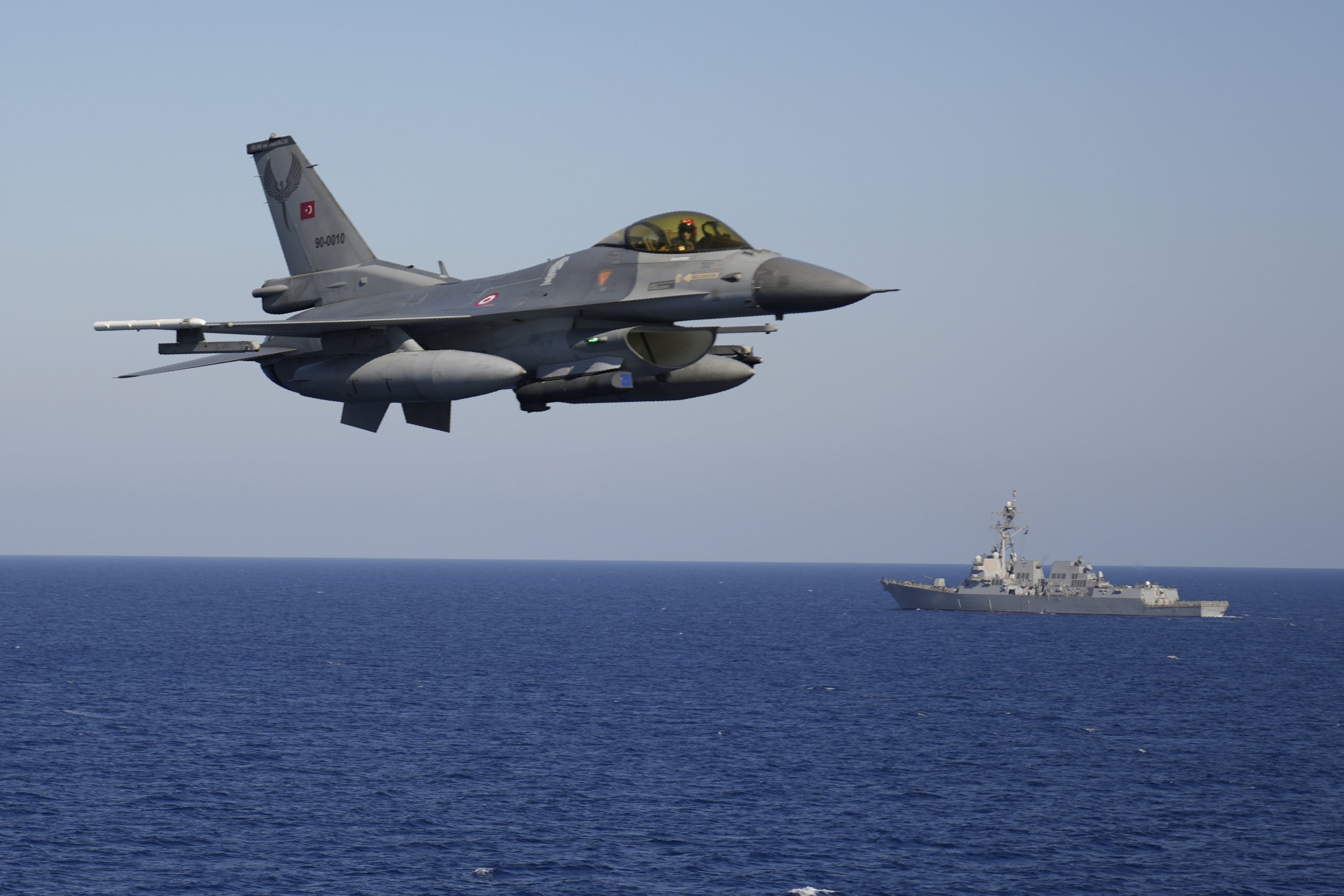
A total of six Turkish F-16 fighter jets are set to arrive in Cyprus on Monday, the Turkish Cypriot civil aviation authority’s acting director Askin Meseli said on Sunday.
It had initially been confirmed that four such fighter jets would be deployed to the north’s Ercan (Tymbou) airport, and those jets were expected to arrive on Sunday.
However, Meseli told news website Kibris Postasi that the number of jets to be deployed has risen to six, and that they are now expected to arrive in the early hours of Monday morning.
The aircraft are to be deployed amid an ongoing conflict in the Middle East, and after Cyprus itself was hit by an Iranian-made drone last Monday.
Since last Monday’s drone strike, multiple countries have deployed military assets to Cyprus, with Greece having been the first, deploying four F-16s of its own to Paphos last Monday evening.
Those jets were followed by two frigates, including the Kimon, which was described by Greek Prime Minister Kyriakos Mitsotakis on Wednesday as the “pride of the Greek fleet”.
With Greece having announced the deployment of assets to the island and its vicinity, France followed suit, with the Languedoc frigate having arrived in Cypriot waters on Wednesday and the aircraft carrier the Charles de Gaulle on its way.
Mitsotakis and French President Emmanuel Macron are set to visit Paphos on Monday.
During the week, Italy announced its intention to send the Federico Martinego frigate to Cyprus, while Spain is to send the Cristobal Colon frigate.
The United Kingdom, meanwhile, the owners of the air force base in Cyprus which was hit by last Monday’s drone, has sent two AW159 Wildcat helicopters, armed with anti-drone missiles, to the island, with the HMS Dragon Type 45 destroyer warship is expected to depart from Portsmouth next week.
Reports on Sunday suggested that the UK may also send the HMS Prince of Wales aircraft carrier to the region.
The deployment of the Turkish fighter jets comes with Greece and Turkey seeming now to be heading towards alignment regarding Cyprus’ role in the conflict.
Following the arrival of the Greek F-16s on Monday, Turkey lodged no protest, and the country’s defence ministry’s spokesman rear admiral Zeki Akturk instead announced that a delegation from the Greek air force will visit Turkey next Monday “within the framework of bilateral relations and regional developments”.
He then described the Greek delegation’s planned visit of as a “confidence-building measure”.
Then, on Friday, a delegation from the Turkish navy visited the UK ahead of the deployment of the HMS Dragon to the region.
While Cyprus was targeted by a drone on Monday, Turkey was on Tuesday the target of a ballistic missile which was fired from Iran.
The missile was shot down by Nato forces in the region and fell to the ground in Turkey’s Hatay province, which is located northeast of Cyprus’ Karpas peninsula.
It had been reported in some quarters that the missile had been aimed at Cyprus, but Intelligence and diplomatic sources in both Turkey and Cyprus confirmed to the Cyprus Mail that the missile was aimed at the Incirlik airbase.
The airbase is jointly operated by the Turkish air force and that of the United States, and is located in Turkey’s southeastern Adana province.




Click here to change your cookie preferences